 Indietro
DNA Replication: Structure, Mechanism, and Biological Significance
Guida di studio - Note intelligenti
 Appunti personalizzati basati sui tuoi materiali, ampliati con definizioni chiave, esempi e contesto.
DNA Replication
Central Dogma of Molecular Biology
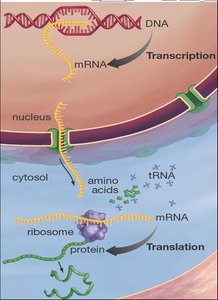
The central dogma describes the flow of genetic information within a biological system. It explains how DNA is transcribed into RNA and then translated into protein, with replication ensuring the faithful copying of genetic material.
Transcription: DNA is used as a template to synthesize messenger RNA (mRNA).
Translation: mRNA is decoded by ribosomes to produce proteins.
Replication: DNA is copied to produce identical DNA molecules for cell division.
Language change: Information is rewritten from nucleic acids (DNA/RNA) to amino acids (proteins).
Properties of Life Related to DNA
DNA is fundamental to life because it is self-replicating, stores and follows instructions, and evolves through mutation.
Self-replication: DNA can make copies of itself.
Instruction storage: DNA encodes information for cellular processes.
Evolution: Mutations in DNA provide genetic variation.
DNA Structure
Double Helix and Nucleotide Composition
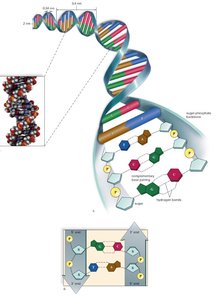
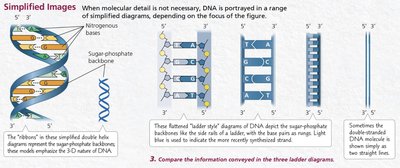
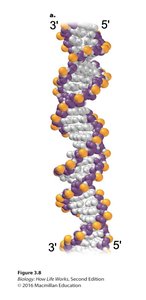
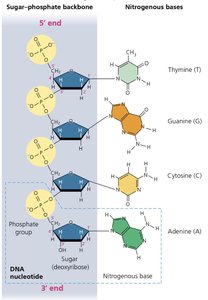
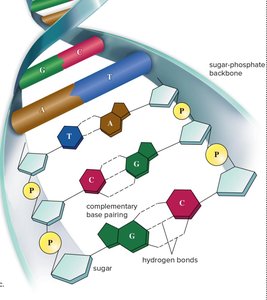
DNA consists of two twisted strands forming a double helix. Each strand is a polymer of nucleotides, which are composed of a sugar, phosphate group, and one of four nitrogenous bases.
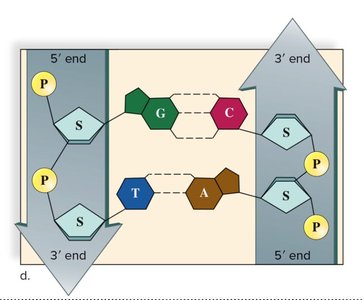
Antiparallel strands: The two DNA strands run in opposite directions (5' to 3' and 3' to 5').
Complementary base pairing: Adenine pairs with Thymine (A-T), and Guanine pairs with Cytosine (G-C).
Sugar-phosphate backbone: The backbone is formed by alternating sugar and phosphate groups.
Nucleotide Structure
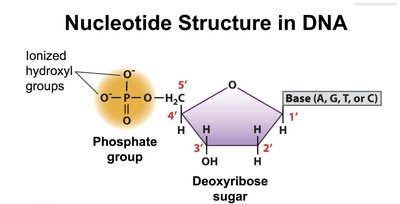
Nucleotides are the monomers of DNA. Each nucleotide contains a deoxyribose sugar, a phosphate group, and a nitrogenous base (A, T, G, or C).
Polarity: Nucleotides have directionality, giving DNA strands a 5' to 3' polarity.
Dehydration synthesis: Nucleotides are joined by phosphodiester bonds through dehydration synthesis.
Base Pairing and Hydrogen Bonds
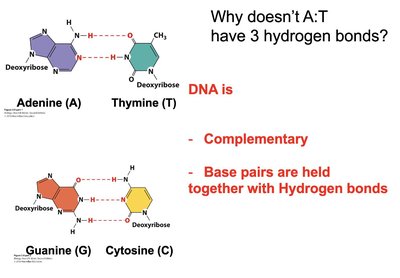
Base pairs are held together by hydrogen bonds, ensuring the stability and specificity of the double helix.
A-T pairs: Held together by two hydrogen bonds.
G-C pairs: Held together by three hydrogen bonds.
Complementarity: Ensures accurate replication and transcription.
Mechanism of DNA Replication
Overview of DNA Replication
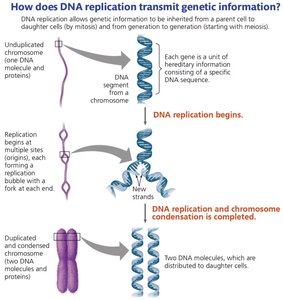
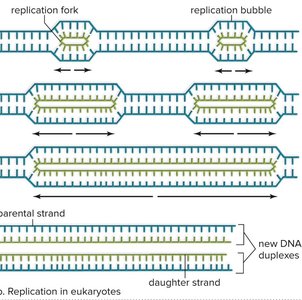
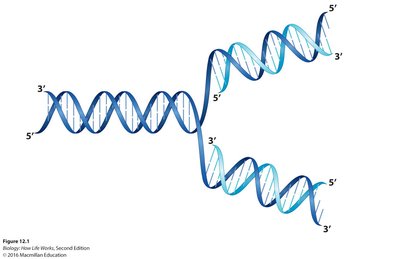
DNA replication is essential for cell division, ensuring each daughter cell receives an identical copy of genetic material. Replication begins at specific origins and proceeds bidirectionally, forming replication bubbles and forks.
Replication bubble: Region where DNA is unwound and replication occurs.
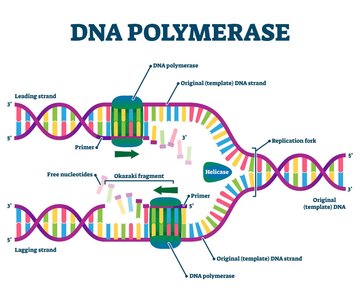
Replication fork: The Y-shaped region where new DNA strands are synthesized.
Initiator proteins: Bind to the origin and recruit helicase to unwind DNA.
Enzymes Involved in DNA Replication
Several enzymes coordinate the replication process:
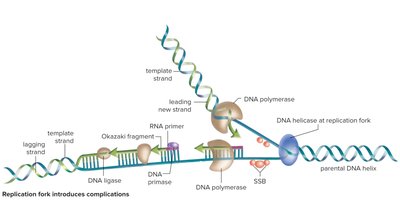
Helicase: Unwinds the DNA double helix.
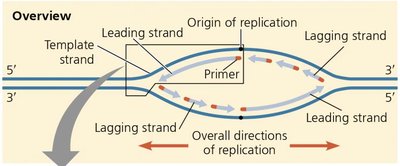
RNA Primase: Synthesizes short RNA primers to provide a starting point for DNA polymerase.
DNA Polymerase: Adds nucleotides to the growing DNA strand and proofreads for errors.
DNA Ligase: Seals nicks in the DNA backbone, joining Okazaki fragments on the lagging strand.
Replication Directionality and Strand Synthesis
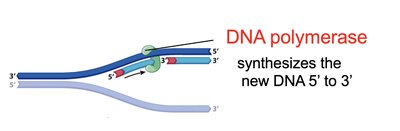
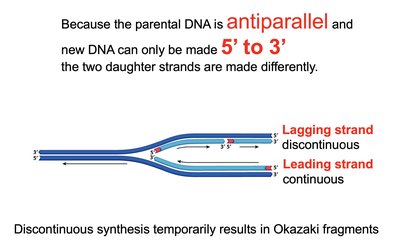
DNA polymerase synthesizes new DNA only in the 5' to 3' direction. Because the parental strands are antiparallel, the two daughter strands are synthesized differently:
Leading strand: Synthesized continuously toward the replication fork.
Lagging strand: Synthesized discontinuously away from the fork in short segments called Okazaki fragments.
Proofreading and DNA Repair
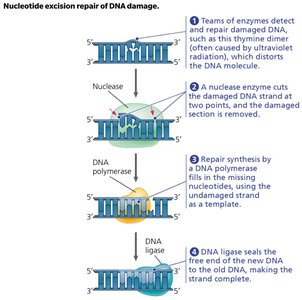
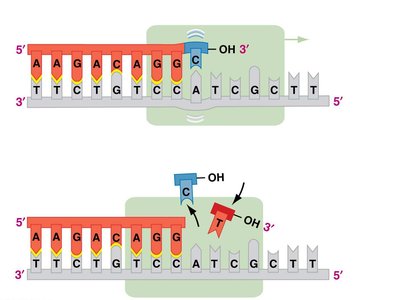
DNA polymerase proofreads newly synthesized DNA, correcting mismatches. If errors are not corrected, mutations may occur. Additional repair mechanisms, such as nucleotide excision repair, fix damaged DNA.
Proofreading: DNA polymerase removes incorrectly paired nucleotides.
Nucleotide excision repair: Enzymes remove damaged sections and fill in the gap with new nucleotides.
Models of DNA Replication
Semi-Conservative Replication
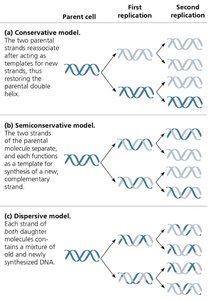
DNA replication is semi-conservative, meaning each new DNA molecule consists of one parental strand and one newly synthesized strand. This ensures genetic continuity across generations.
Conservative model: Parental strands remain together; new strands form a separate double helix (not supported).
Semi-conservative model: Each daughter DNA contains one parental and one new strand (supported by evidence).
Dispersive model: DNA strands are a mix of old and new segments (not supported).
Summary Table: Key Enzymes and Functions in DNA Replication
Enzyme | Function |
|---|---|
Helicase | Unwinds DNA double helix |
RNA Primase | Synthesizes RNA primers |
DNA Polymerase | Adds nucleotides, proofreads, replaces RNA primers |
DNA Ligase | Seals nicks, joins Okazaki fragments |
Key Equations and Concepts
Phosphodiester bond formation: Nucleotides are joined by dehydration synthesis, releasing water.
Directionality: DNA is synthesized 5' to 3'.
Base pairing: (2 H bonds), (3 H bonds)
Biological Significance
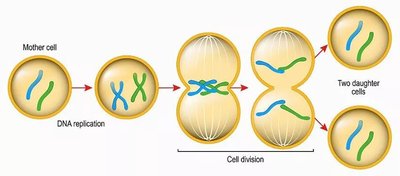
DNA Replication and Cell Division
DNA replication ensures that each daughter cell receives a complete set of genetic instructions during cell division. This process is fundamental to growth, development, and inheritance.
Mutation and Evolution
Errors in DNA replication that escape proofreading can result in mutations, which are a source of genetic variation and drive evolution.
Conclusion
DNA replication is a highly regulated, accurate process essential for life. Understanding its structure, mechanism, and biological significance is foundational for studies in genetics, molecular biology, and biotechnology.
