 Indietro
DNA Replication: Structure, Mechanism, and Biological Significance
Guida di studio - Note intelligenti
 Appunti personalizzati basati sui tuoi materiali, ampliati con definizioni chiave, esempi e contesto.
DNA Replication and the Central Dogma
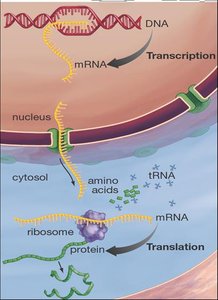
Overview of the Central Dogma
The central dogma of molecular biology describes the flow of genetic information within a biological system. It states that DNA is transcribed into RNA, which is then translated into protein. This process is fundamental to all living organisms and underlies the properties of life: self-replication, information storage and execution, and evolution through mutation.
Transcription: The process by which DNA is used as a template to synthesize RNA.
Translation: The process by which RNA is used to synthesize proteins.
Replication: The process by which DNA makes an identical copy of itself before cell division.
Properties and Structure of DNA
DNA Structure and Function
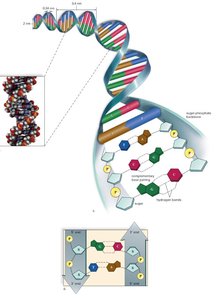
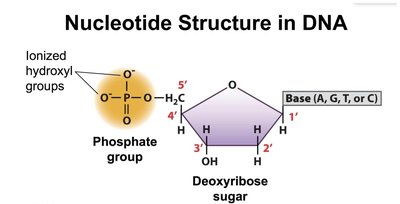
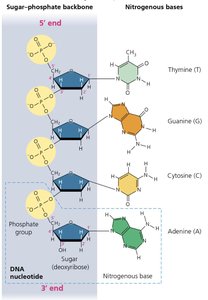
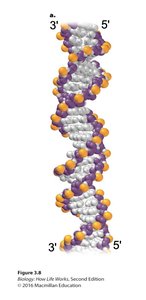
DNA is a double-stranded molecule composed of nucleotide polymers arranged in a double helix. Each nucleotide consists of a deoxyribose sugar, a phosphate group, and one of four nitrogenous bases (adenine, thymine, guanine, cytosine). The strands are antiparallel and complementary, held together by hydrogen bonds between the bases.
Double Helix: Two twisted strands form the DNA molecule.
Antiparallel Strands: The two strands run in opposite directions (5' to 3' and 3' to 5').
Complementary Base Pairing: Adenine pairs with thymine (A-T), and guanine pairs with cytosine (G-C).
Sugar-Phosphate Backbone: The backbone is formed by alternating sugar and phosphate groups.
Polarity and Directionality
Each DNA strand has polarity, defined by the orientation of the 5' and 3' ends. This directionality is crucial for replication and transcription.
5' End: The end with a free phosphate group.
3' End: The end with a free hydroxyl group.
DNA Replication: Mechanism and Enzymes
Initiation of Replication
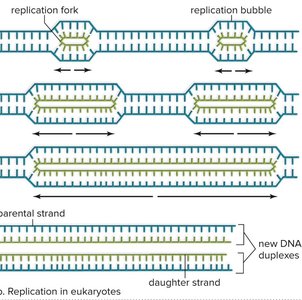
DNA replication begins at specific locations called origins of replication. Initiator proteins bind to the origin, recruit DNA helicase, and unwind the DNA to form a replication fork.
Replication Bubble: Formed by two replication forks moving in opposite directions.
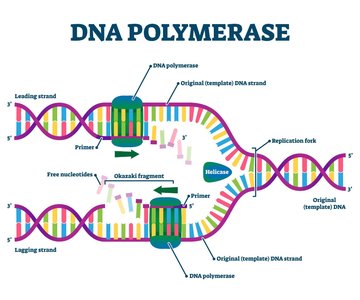
Helicase: Unwinds the DNA strands by breaking hydrogen bonds.
Primer Synthesis and Elongation
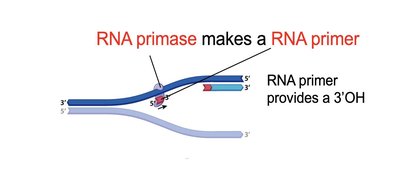
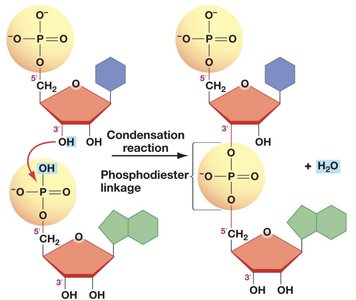
RNA primase synthesizes short RNA primers to provide a 3' OH group for DNA polymerase. DNA polymerase then adds nucleotides to the 3' end, synthesizing the new DNA strand in the 5' to 3' direction.
RNA Primase: Lays down RNA primers.
DNA Polymerase: Extends the DNA strand by adding nucleotides.
Phosphodiester Bond Formation: DNA polymerase catalyzes the formation of phosphodiester bonds between nucleotides.
Proofreading and Error Correction
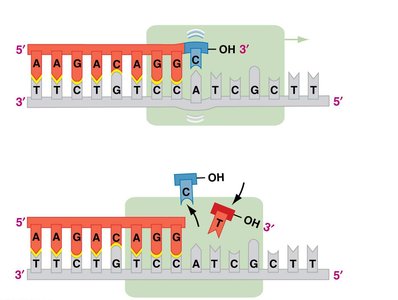
DNA polymerase has proofreading activity. If a mismatched nucleotide is incorporated, the enzyme detects and corrects the error. If not corrected, the error becomes a mutation.
Proofreading: DNA polymerase checks and fixes base pair mismatches.
Mutation: Uncorrected errors result in changes to the nucleotide sequence.
Removal of RNA Primers and DNA Ligase
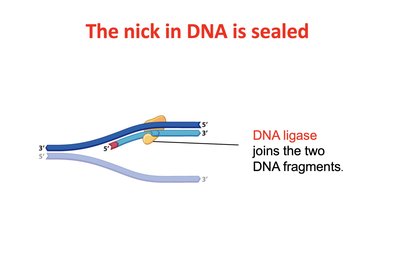
After DNA synthesis, RNA primers are removed and replaced with DNA. DNA ligase seals the nicks in the DNA backbone, joining fragments together.
DNA Ligase: Catalyzes the formation of the final phosphodiester bond.
Fragment Joining: Essential for completing the lagging strand (Okazaki fragments).
Biological Significance of DNA Replication
Transmission of Genetic Information
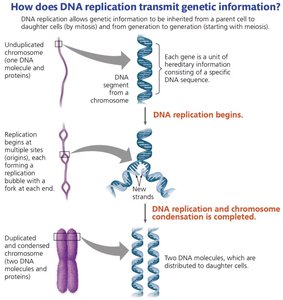
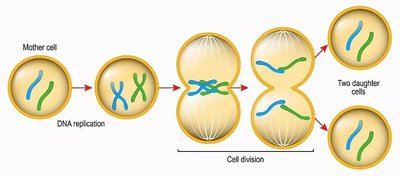
DNA replication ensures that genetic information is faithfully transmitted from parent to daughter cells during cell division. Each new cell receives an identical copy of the genome, maintaining genetic continuity.
Cell Division: DNA replication precedes mitosis and meiosis.
Chromosome Condensation: Duplicated chromosomes are distributed to daughter cells.
Summary Table: Key Components of DNA Replication
Component | Function |
|---|---|
DNA Helicase | Unwinds DNA strands |
RNA Primase | Synthesizes RNA primers |
DNA Polymerase | Adds nucleotides, proofreads, replaces RNA primers |
DNA Ligase | Seals nicks, joins DNA fragments |
Origin of Replication | Starting point for replication |
Additional info:
DNA replication is semi-conservative: each new DNA molecule contains one parental and one newly synthesized strand.
Replication bubbles allow rapid and efficient copying of large genomes.
Mutations arising from replication errors are a source of genetic variation and evolution.
