 Indietro
DNA Replication: Structure, Mechanism, and Enzymatic Processes
Guida di studio - Note intelligenti
 Appunti personalizzati basati sui tuoi materiali, ampliati con definizioni chiave, esempi e contesto.
DNA Replication
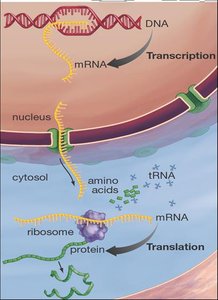
Overview of the Central Dogma
The Central Dogma of Molecular Biology describes the flow of genetic information within a biological system. It involves three main processes: replication (copying DNA), transcription (synthesizing RNA from DNA), and translation (synthesizing proteins from RNA). The language of nucleic acids is converted into the language of amino acids during translation.
Replication: DNA makes an identical copy of itself.
Transcription: DNA is used as a template to make RNA.
Translation: RNA is used as a template to synthesize proteins.
Properties of Life: Living systems are self-replicating, store and follow instructions, and evolve through mutation.
DNA Replication and Cell Division
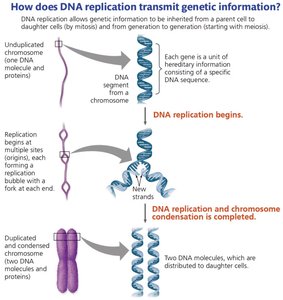
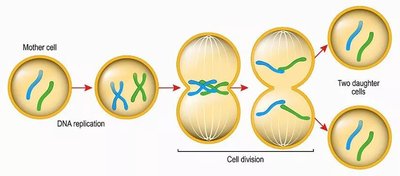
Before a cell divides, it must replicate its DNA to ensure that each daughter cell receives an identical set of genetic instructions. DNA replication is essential for growth, development, and maintenance of all living organisms.
Each chromosome consists of a double helix of DNA.
Replication produces two identical DNA molecules, which are separated during cell division.
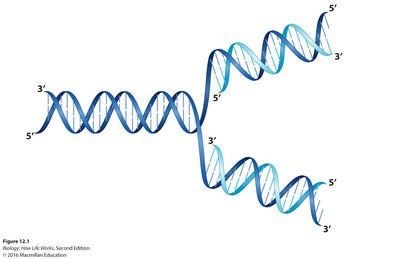
Replication is semi-conservative: each new DNA molecule contains one parental and one newly synthesized strand.
DNA Structure
Double Helix and Nucleotide Composition
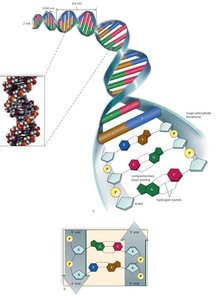
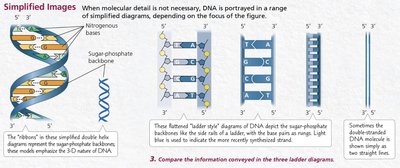
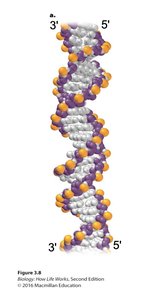
DNA is composed of two antiparallel strands forming a double helix. Each strand is a polymer of nucleotides, which are the monomers of DNA. The structure of DNA is critical for its function in storing and transmitting genetic information.
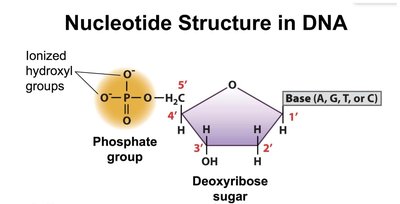
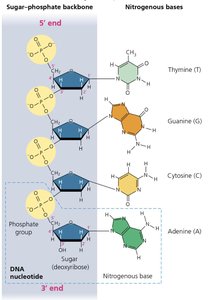
Nucleotide: Consists of a 5-carbon sugar (deoxyribose), a phosphate group, and a nitrogenous base (adenine, thymine, cytosine, or guanine).
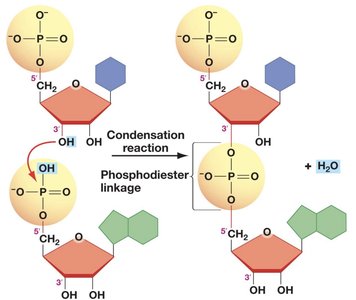
Sugar-Phosphate Backbone: The backbone of each strand is formed by covalent bonds between the sugar of one nucleotide and the phosphate of the next.
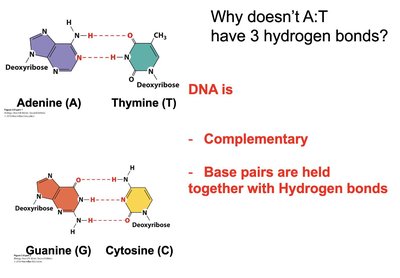
Base Pairing: Nitrogenous bases pair specifically (A with T, G with C) via hydrogen bonds, forming the rungs of the ladder-like structure.
Antiparallel Orientation: The two strands run in opposite directions (5' to 3' and 3' to 5').
Nucleotide Structure and Polarity
Each nucleotide in DNA has a specific orientation, giving the DNA strand polarity. The 5' end has a free phosphate group, and the 3' end has a free hydroxyl group. This polarity is essential for the directionality of DNA synthesis.
Phosphodiester Bond: Covalent bond linking the 3' carbon of one sugar to the 5' phosphate of the next nucleotide.
Dehydration Synthesis: The process by which nucleotides are joined, releasing a molecule of water.
Base Pairing and Hydrogen Bonds
Base pairing is governed by hydrogen bonding between complementary bases. Adenine pairs with thymine (A-T) via two hydrogen bonds, and guanine pairs with cytosine (G-C) via three hydrogen bonds. This specificity ensures accurate replication and transcription.
Complementary Base Pairing: Ensures that genetic information is accurately copied.
Hydrogen Bonds: Hold the two strands together but are weak enough to allow strand separation during replication.
Mechanism of DNA Replication
Initiation of Replication
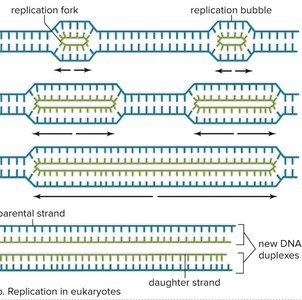
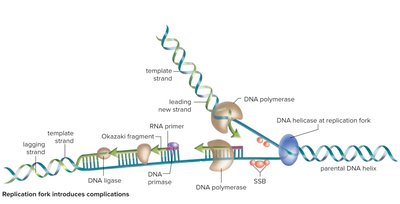
DNA replication begins at specific locations called origins of replication. Initiator proteins bind to these sites, causing the DNA to unwind and form replication bubbles. Each bubble contains two replication forks moving in opposite directions.
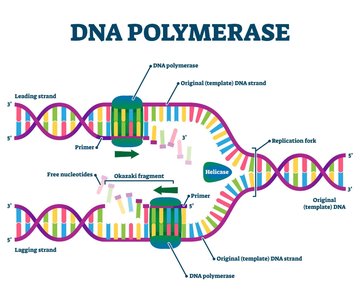
Helicase: Unwinds the DNA double helix by breaking hydrogen bonds between bases.
Single-Strand Binding Proteins (SSB): Stabilize unwound DNA strands.
Replication Fork: The Y-shaped region where new DNA strands are synthesized.
Elongation: Synthesis of New DNA Strands
DNA polymerase synthesizes new DNA strands by adding nucleotides to the 3' end of a pre-existing chain. Because DNA polymerase cannot initiate synthesis de novo, an RNA primer is first laid down by primase.
RNA Primase: Synthesizes short RNA primers to provide a starting point for DNA polymerase.
DNA Polymerase: Adds nucleotides to the 3' end of the primer, synthesizing DNA in the 5' to 3' direction.
Leading Strand: Synthesized continuously toward the replication fork.
Lagging Strand: Synthesized discontinuously away from the fork in short fragments called Okazaki fragments.
Joining and Proofreading
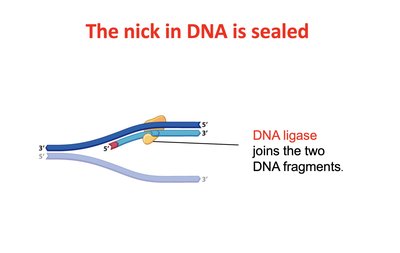
After synthesis, RNA primers are removed and replaced with DNA. DNA ligase seals the nicks between Okazaki fragments, forming a continuous strand. DNA polymerase also proofreads the newly synthesized DNA, correcting errors to maintain genetic fidelity.
DNA Ligase: Forms the final phosphodiester bond between adjacent DNA fragments.
Proofreading: DNA polymerase checks and corrects mismatched bases, reducing mutation rates.
Models of DNA Replication
Three models were proposed for DNA replication: conservative, semiconservative, and dispersive. Experiments confirmed that DNA replication is semiconservative, meaning each new DNA molecule consists of one parental and one new strand.
Semiconservative Model: Each daughter DNA molecule contains one old and one new strand.
Summary Table: Key Enzymes and Functions in DNA Replication
Enzyme | Function |
|---|---|
Helicase | Unwinds the DNA double helix |
Single-Strand Binding Protein (SSB) | Stabilizes unwound DNA |
Primase | Synthesizes RNA primers |
DNA Polymerase | Adds nucleotides to the 3' end; proofreads and corrects errors |
Ligase | Seals nicks between Okazaki fragments |
Key Concepts and Applications
DNA replication ensures genetic continuity between generations of cells.
Errors in replication can lead to mutations, which are the source of genetic variation and evolution.
Understanding DNA replication is fundamental for biotechnology, medicine, and genetics.
