 Indietro
DNA, RNA, and Eukaryotic Chromosomes: Structure and Function
Guida di studio - Note intelligenti
 Appunti personalizzati basati sui tuoi materiali, ampliati con definizioni chiave, esempi e contesto.
DNA, RNA, and Introduction to Eukaryotic Chromosomes
Overview of Genetic Material
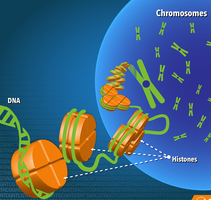
All living organisms store genetic information in the form of DNA, which is organized into chromosomes. DNA and RNA are nucleic acids, polymers made of nucleotide monomers. Eukaryotic chromosomes are composed of DNA double helices wrapped around histone proteins, forming complex structures essential for genetic regulation and inheritance.
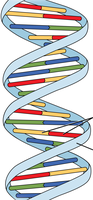
DNA (Deoxyribonucleic acid): The hereditary material in all living organisms, forming a double helix structure.
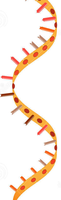
RNA (Ribonucleic acid): A single-stranded nucleic acid, transcribed from DNA, that plays various roles in gene expression.
Eukaryotic Chromosomes: Linear DNA molecules packaged with histone proteins into chromatin and further condensed into chromosomes.
Nucleotides: Structure and Types
Generalized Nucleotide Structure
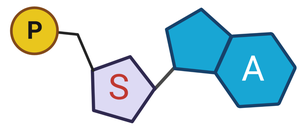
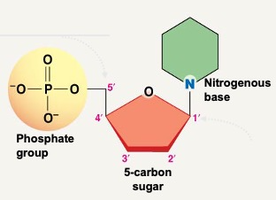
Nucleotides are the building blocks of nucleic acids. Each nucleotide consists of three components:
A five-carbon (pentose) sugar
A phosphate group
A nitrogenous base (one of four types)
DNA vs. RNA Nucleotides
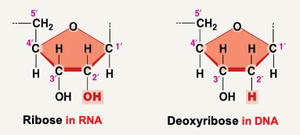
The pentose sugar differs between DNA and RNA:
Deoxyribose (in DNA): Lacks an oxygen atom at the 2' carbon (has H).
Ribose (in RNA): Has an OH group at the 2' carbon, making RNA more reactive and less stable than DNA.
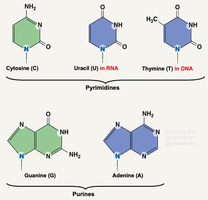
Nitrogenous Bases: There are two groups:
Pyrimidines (single ring): Cytosine (C), Thymine (T, DNA only), Uracil (U, RNA only)
Purines (double ring): Adenine (A), Guanine (G)
DNA and RNA Polymers
Polymerization and Directionality
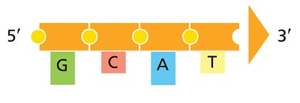
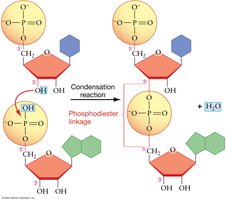
Nucleotides are joined by phosphodiester bonds between the 3' OH of one nucleotide and the 5' phosphate of the next. This forms a sugar-phosphate backbone with distinct 5' and 3' ends. DNA strands are long and stable; RNA strands are shorter and more reactive.
DNA Double Helix Structure
Antiparallel Strands and Base Pairing
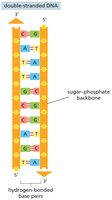
DNA consists of two antiparallel strands forming a double helix. The strands are held together by hydrogen bonds between complementary nitrogenous bases:
Adenine (A) pairs with Thymine (T) via two hydrogen bonds.
Guanine (G) pairs with Cytosine (C) via three hydrogen bonds.
This base pairing ensures accurate replication and transcription. The antiparallel orientation means one strand runs 5' to 3', and the other 3' to 5'.
Base Pairing Rules and Proportions
Base pairing rules allow prediction of base proportions in DNA:
Amount of A = Amount of T
Amount of G = Amount of C
For example, if a DNA molecule is 30% A, it must also be 30% T, and the remaining 40% is split equally between G and C (20% each).
Comparison of DNA and RNA
DNA | RNA | |
|---|---|---|
Sugar | Deoxyribose | Ribose |
Strandedness | Double-stranded | Single-stranded |
Nitrogenous Bases | A, T, G, C | A, U, G, C |
Stability | More stable | Less stable |
DNA Packaging in Eukaryotic Chromosomes
Chromatin, Histones, and Nucleosomes
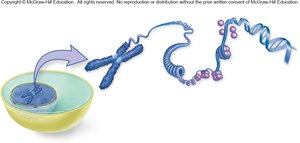
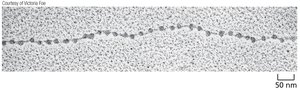
In eukaryotes, DNA is tightly packaged to fit within the nucleus. DNA wraps around histone proteins to form nucleosomes, which resemble beads on a string. These nucleosomes further coil and fold to form chromatin, which can be loosely packed (euchromatin) or tightly packed (heterochromatin). During cell division, chromatin condenses further to form visible chromosomes.
The Central Dogma of Molecular Biology
Flow of Genetic Information
The central dogma describes the flow of genetic information within a cell:
DNA contains genes, which are specific sequences encoding information.
Transcription: Genes are copied into messenger RNA (mRNA).
Translation: Ribosomes read mRNA to synthesize proteins, which perform cellular functions.
Some genes encode functional RNAs (e.g., rRNA, tRNA) instead of proteins.
Summary: DNA → RNA → Protein
Key Terms and Concepts
Nucleotide: Monomer of nucleic acids, consisting of a sugar, phosphate, and nitrogenous base.
Phosphodiester bond: Covalent bond linking nucleotides in a nucleic acid strand.
Antiparallel: Orientation of DNA strands running in opposite directions.
Chromatin: DNA-protein complex forming chromosomes.
Histone: Protein around which DNA winds to form nucleosomes.
Nucleosome: Structural unit of chromatin, consisting of DNA wrapped around histones.
Central Dogma: The directional flow of genetic information from DNA to RNA to protein.
