 Indietro
Chapter 16
Guida di studio - Note intelligenti
 Appunti personalizzati basati sui tuoi materiali, ampliati con definizioni chiave, esempi e contesto.
The Molecular Basis of Inheritance
Introduction to DNA as Genetic Material
DNA is the hereditary material responsible for the transmission of genetic information from one generation to the next. Early experiments established DNA as the molecule carrying genes, distinguishing it from proteins. - Key Point 1: Genes are located on chromosomes, which consist of DNA and protein. - Key Point 2: DNA's role in heredity was discovered through studies of bacteria and viruses. 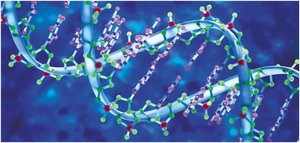
Transformation and Griffith's Experiment
Frederick Griffith's 1928 experiment demonstrated that DNA could transform bacteria, providing evidence for DNA as genetic material. - Key Point 1: Griffith used two strains of bacteria: one pathogenic (S) and one harmless (R). - Key Point 2: Mixing heat-killed S cells with living R cells resulted in the transformation of R cells into pathogenic S cells. - Example: Mice injected with the mixture died, and living S cells were recovered, showing genetic transformation. 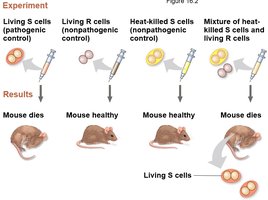
Evidence from Bacteriophages: Hershey-Chase Experiment
The Hershey-Chase experiment (1952) used bacteriophages to show that DNA, not protein, is the genetic material. - Key Point 1: Bacteriophages are viruses that infect bacteria, composed of DNA and a protein coat. - Key Point 2: Radioactive labeling showed that only DNA entered bacterial cells and directed viral replication. 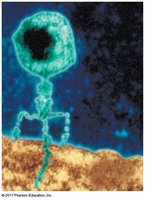
DNA Structure and Composition
Nucleotides and Chargaff's Rules
DNA is a polymer made of nucleotides, each containing a nitrogenous base, a sugar (deoxyribose), and a phosphate group. Chargaff's rules describe the base composition of DNA. - Key Point 1: Four nitrogenous bases: adenine (A), thymine (T), guanine (G), cytosine (C). - Key Point 2: Chargaff's rules: A = T and G = C in any organism; base composition varies between species. 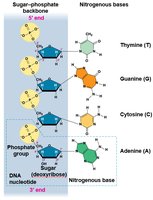
Base Pairing and the Double Helix
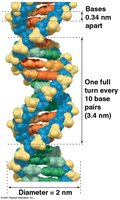
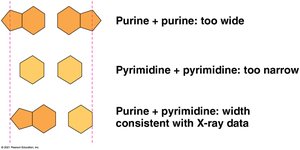
Watson and Crick's model revealed that DNA is a double helix with specific base pairing. - Key Point 1: Adenine pairs with thymine (A-T), guanine pairs with cytosine (G-C). - Key Point 2: Purines (A, G) pair with pyrimidines (C, T), resulting in uniform helix width. - Example: The double helix has a diameter of 2 nm, with bases 0.34 nm apart and one full turn every 10 base pairs (3.4 nm). 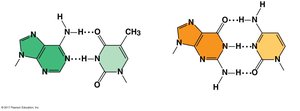
Discovery of the Double Helix: Franklin's X-ray Crystallography
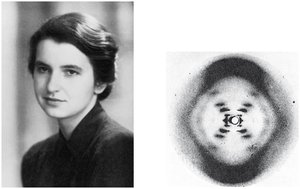
Rosalind Franklin's X-ray crystallographic images provided critical evidence for the helical structure of DNA. - Key Point 1: X-ray images revealed the width and spacing of DNA's nitrogenous bases. - Key Point 2: The pattern suggested two strands forming a double helix, with antiparallel sugar-phosphate backbones. 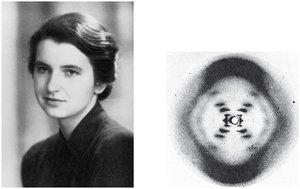
DNA Replication
Overview and Significance
DNA replication ensures genetic information is inherited by daughter cells during cell division. - Key Point 1: Replication begins at multiple sites along the chromosome. - Key Point 2: Each gene is copied, and two DNA molecules are distributed to daughter cells. 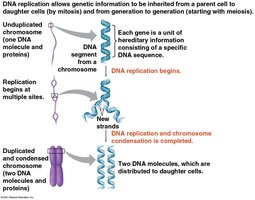
Models of DNA Replication
Three models were proposed: conservative, semiconservative, and dispersive. The semiconservative model is correct. - Key Point 1: Semiconservative model: each daughter DNA molecule has one old strand and one new strand. - Key Point 2: Meselson and Stahl's experiment confirmed the semiconservative model. 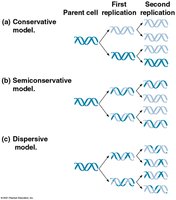
Mechanism and Enzymes of DNA Replication
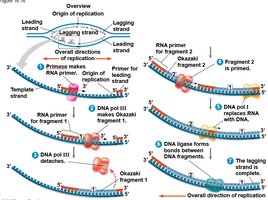
DNA replication involves multiple enzymes and proteins, starting at origins of replication and proceeding bidirectionally. - Key Point 1: Helicase unwinds the double helix; single-strand binding proteins stabilize the strands; topoisomerase relieves strain. - Key Point 2: Primase synthesizes RNA primers; DNA polymerase adds nucleotides to the 3' end; DNA ligase joins Okazaki fragments. 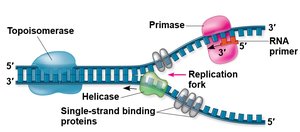
Leading and Lagging Strands
DNA polymerase synthesizes the leading strand continuously and the lagging strand discontinuously as Okazaki fragments. - Key Point 1: Leading strand: synthesized toward the replication fork. - Key Point 2: Lagging strand: synthesized away from the fork in fragments, joined by DNA ligase. 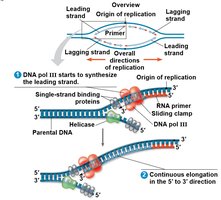
Proofreading and DNA Repair
DNA polymerases proofread new DNA and repair mechanisms correct errors and damage. - Key Point 1: Mismatch repair fixes incorrectly paired bases. - Key Point 2: Nucleotide excision repair removes damaged DNA segments. 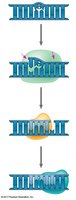
Telomeres and Replication of Chromosome Ends
Eukaryotic chromosomes have telomeres at their ends to protect genetic information during replication. - Key Point 1: Telomeres postpone gene erosion but do not prevent DNA shortening. - Key Point 2: Telomerase extends telomeres in germ cells, maintaining chromosome integrity. 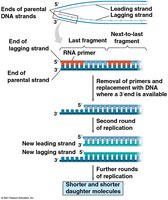
DNA Packaging and Chromosome Structure
Chromatin and Chromosome Organization
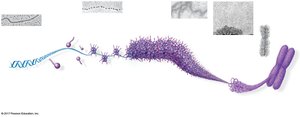
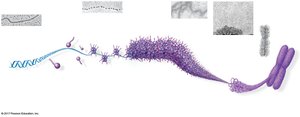
DNA is packed with proteins into chromatin, allowing it to fit inside the nucleus and regulate gene expression. - Key Point 1: Bacterial chromosomes are circular and supercoiled; eukaryotic chromosomes are linear and highly organized. - Key Point 2: Histones are proteins responsible for DNA packing; nucleosomes are DNA wrapped around histone cores. 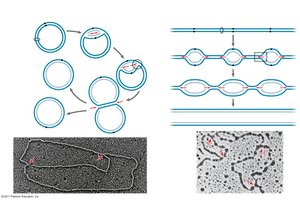
Euchromatin and Heterochromatin
Chromatin can be loosely packed (euchromatin) or highly condensed (heterochromatin), affecting gene expression. - Key Point 1: Euchromatin is accessible for transcription; heterochromatin is transcriptionally inactive. - Key Point 2: Chromosomes occupy specific regions in the nucleus during interphase. 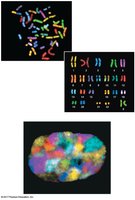
Summary Table: DNA Replication Enzymes
Enzyme | Function |
|---|---|
Helicase | Unwinds the DNA double helix |
Single-strand binding protein | Stabilizes single-stranded DNA |
Topoisomerase | Relieves strain ahead of replication fork |
Primase | Synthesizes RNA primer |
DNA polymerase | Adds nucleotides to growing DNA strand |
DNA ligase | Joins Okazaki fragments |
Key Equations
Base Pairing
Semiconservative Replication
Nucleotide Addition
Additional info:
- DNA structure and replication are fundamental to understanding genetics, cell division, and heredity. - Chromatin organization is essential for gene regulation and chromosome stability. ----------------------------------------
