 Indietro
DNA Structure, Replication, and Information Flow: Study Notes for General Biology
Guida di studio - Note intelligenti
 Appunti personalizzati basati sui tuoi materiali, ampliati con definizioni chiave, esempi e contesto.
Central Dogma of Molecular Biology
Overview of Information Flow
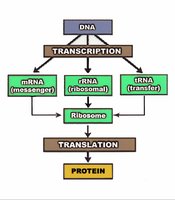
The central dogma describes the directional flow of genetic information in all living organisms: from DNA to RNA to protein. This process involves three main steps: replication, transcription, and translation.
Replication: DNA is copied to produce identical DNA molecules.
Transcription: DNA is used as a template to synthesize RNA.
Translation: RNA is used to synthesize proteins, the functional molecules of the cell.
Key RNA types: mRNA (messenger), rRNA (ribosomal), tRNA (transfer).
Ribosomes: The site of protein synthesis.
History of DNA Discovery
Chromosome Basics and Early Experiments
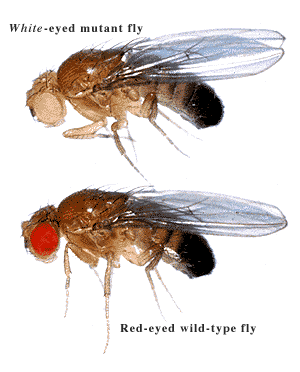
Chromosomes are composed of DNA and associated proteins. Early geneticists, such as Morgan, established that chromosomes carry heritable information. DNA was initially thought to be a structural element, but experiments revealed its role in inheritance.
Frederick Griffith (1928): Demonstrated the "transforming principle" by showing that non-virulent bacteria could be transformed into virulent forms.
Avery, MacLeod, & McCarty (1944): Identified DNA as the transforming principle through in vitro experiments.
Hershey & Chase (1952): Used bacteriophages to confirm that DNA, not protein, is the genetic material.
Structure of DNA
Double Helix Model and Key Discoveries
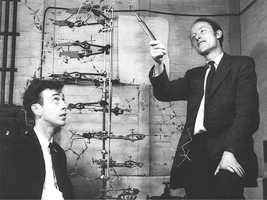
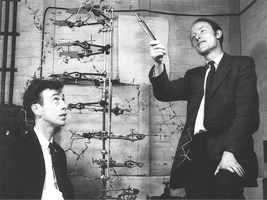
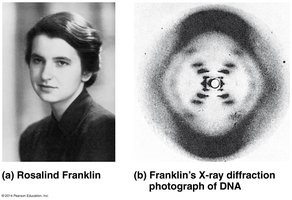
The structure of DNA was solved in 1953 by Watson and Crick, using clues from Chargaff's rules and X-ray diffraction images produced by Rosalind Franklin. DNA is a double helix with two antiparallel strands held together by complementary base pairing.
Chargaff's Rules: %A ≈ %T and %G ≈ %C, indicating base pairing specificity.
Rosalind Franklin: Provided critical X-ray diffraction data (Photograph 51) that revealed the helical structure.
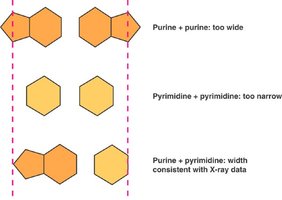
Watson & Crick: Proposed the double helix model, with purines pairing with pyrimidines to maintain uniform width.
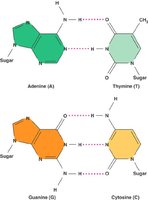
Base Pairing: Adenine (A) pairs with Thymine (T); Guanine (G) pairs with Cytosine (C).
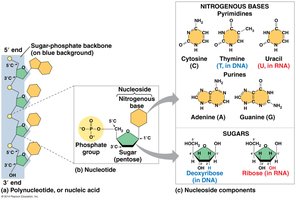
Antiparallel Strands: The two DNA strands run in opposite directions (5' to 3' and 3' to 5').
DNA Replication
Models and Mechanisms
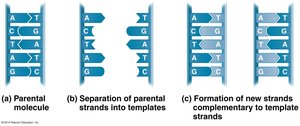
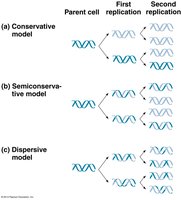
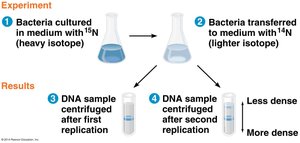
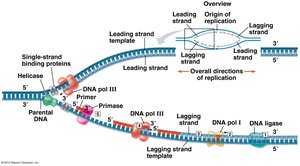
DNA replication is the process by which a cell copies its DNA before cell division. Three models were proposed: conservative, semi-conservative, and dispersive. The semi-conservative model, confirmed by Meselson and Stahl, states that each new DNA molecule consists of one old strand and one new strand.
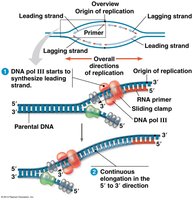
Replication occurs: In both directions from multiple origins in eukaryotes; from a single origin in prokaryotes.
Key Steps: Initiation, elongation, and termination.
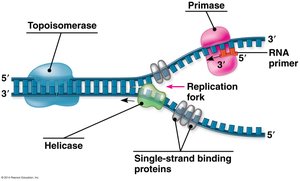
Enzymes involved: Helicase, primase, DNA polymerase, ligase, and single-strand binding proteins.
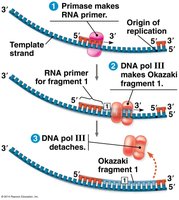
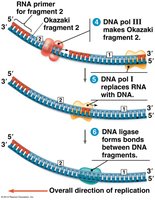
Leading and Lagging Strands: DNA is synthesized continuously on the leading strand and discontinuously (as Okazaki fragments) on the lagging strand.
Replication Proteins and Their Functions
Several proteins are essential for the accurate and efficient replication of DNA. The following table summarizes their functions:
Protein | Function |
|---|---|
Helicase | Unwinds parental double helix at replication forks |
Single-strand binding proteins | Bind to and stabilize single-stranded DNA |
Topoisomerase | Relieves overwinding strain ahead of replication forks |
Primase | Synthesizes RNA primers for initiation of DNA synthesis |
DNA polymerase III | Extends DNA strand from the primer |
DNA polymerase I | Removes RNA primers and replaces them with DNA |
DNA ligase | Joins Okazaki fragments on the lagging strand |
Mechanism of DNA Replication
Replication begins at origins, proceeds bidirectionally, and involves the coordinated action of multiple enzymes. The process ensures high fidelity and stability of genetic information.
Initiation: Primase synthesizes RNA primers.
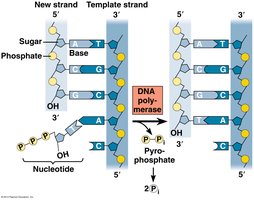
Elongation: DNA polymerase adds nucleotides to the growing strand.
Termination: DNA ligase seals nicks between fragments.
Summary Table: DNA Replication Models
The following table compares the three proposed models of DNA replication:
Model | Description |
|---|---|
Conservative | Parent DNA remains intact; new molecule is entirely new DNA |
Semi-Conservative | Each new DNA molecule contains one old strand and one new strand |
Dispersive | Each strand of both daughter molecules contains a mix of old and new DNA |
Key Equations and Concepts
Base Pairing and Chargaff's Rules
Chargaff's Rule:
Antiparallel Strands: and
Hydrogen Bonding:
Conclusion
Understanding the structure and replication of DNA is fundamental to the study of biology. The central dogma, historical experiments, and the molecular mechanisms of replication provide a foundation for further exploration of gene expression and inheritance.
