 Indietro
DNA Structure, Replication, and Packaging: Study Notes for General Biology
Guida di studio - Note intelligenti
 Appunti personalizzati basati sui tuoi materiali, ampliati con definizioni chiave, esempi e contesto.
DNA as the Genetic Material
Discovery of DNA's Role
The identification of DNA as the genetic material was a pivotal moment in biology. Frederick Griffith's experiment in 1928 demonstrated transformation, where harmless bacteria assimilated foreign DNA and became pathogenic. This phenomenon is now defined as a change in genotype and phenotype due to the assimilation of foreign DNA.
Transformation: Uptake of foreign DNA by a cell, resulting in genetic change.
Griffith's Experiment: Showed that genetic information could be transferred between bacteria.
Evidence from Viruses
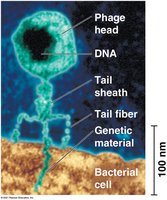
Further evidence for DNA as the genetic material came from studies of bacteriophages, viruses that infect bacteria. These studies showed that viral DNA could program cells, supporting the role of DNA in heredity.
Bacteriophage: A virus that infects bacteria, consisting of DNA (or RNA) enclosed in a protein coat.
Genetic Material: DNA is responsible for directing cellular functions.
DNA Structure
Composition and Chargaff's Rules
DNA is a polymer made of nucleotides, each containing a nitrogenous base, a sugar, and a phosphate group. The four bases are adenine (A), thymine (T), guanine (G), and cytosine (C). Erwin Chargaff discovered that DNA composition varies between species and that the number of A equals T, and G equals C in any species.
Nucleotide: Basic unit of DNA, consisting of a base, sugar, and phosphate.
Chargaff's Rules: A = T, G = C; base composition varies between species.
Double Helix Model
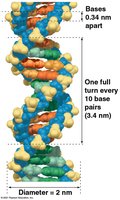
Rosalind Franklin used X-ray crystallography to reveal the helical structure of DNA. Watson and Crick built a model showing two antiparallel sugar-phosphate backbones with paired bases inside, forming a double helix.
Antiparallel: The two DNA strands run in opposite directions.
Double Helix: Two intertwined strands of DNA.
Base Pairing
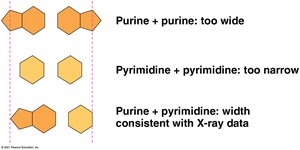
Base pairing occurs between a purine and a pyrimidine, resulting in a uniform width consistent with X-ray data. Adenine pairs with thymine, and guanine pairs with cytosine.
Purine: Adenine (A) and Guanine (G).
Pyrimidine: Cytosine (C) and Thymine (T).
Base Pairing: A-T and G-C.
DNA Replication
Mechanism of Replication
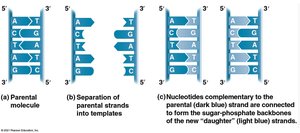
DNA replication is the process by which DNA is copied before cell division. Each strand serves as a template for a new strand, resulting in two identical DNA molecules.
Template Strand: Each original strand guides the synthesis of a new strand.
Replication: Produces two exact copies of DNA.
Models of Replication
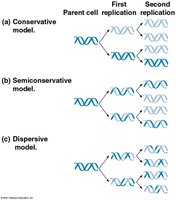
Three models were proposed: conservative, semiconservative, and dispersive. The semiconservative model, supported by evidence, states that each new DNA molecule contains one old and one new strand.
Semiconservative Model: Each daughter DNA has one parental and one new strand.
Conservative Model: Parental strands rejoin; daughter strands are new.
Dispersive Model: Strands are a mix of old and new DNA.
Enzymes and Proteins in Replication
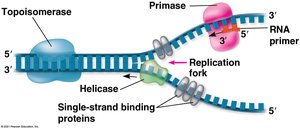
DNA replication involves many enzymes and proteins. Replication begins at origins of replication, forming replication bubbles. Key enzymes include helicase, primase, DNA polymerase, and topoisomerase.
Helicase: Unwinds DNA.
Primase: Synthesizes RNA primer.
DNA Polymerase: Synthesizes new DNA.
Topoisomerase: Relieves strain from unwinding.
Single-Strand Binding Proteins: Stabilize single-stranded DNA.
Synthesizing New DNA Strands
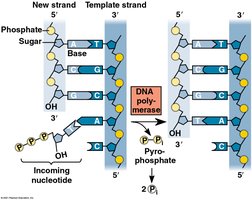
DNA polymerases require an RNA primer to start synthesis. Nucleotides are added as nucleoside triphosphates, losing two phosphate groups as pyrophosphate during incorporation.
RNA Primer: Short RNA sequence needed to start DNA synthesis.
Nucleoside Triphosphate: The form in which nucleotides are added to DNA.
Pyrophosphate: Released during nucleotide addition.
Antiparallel Elongation
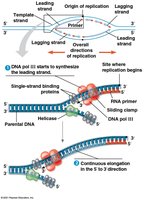
DNA polymerases can only add nucleotides to the 3' end, so DNA elongates in the 5' to 3' direction. This creates a leading strand (continuous synthesis) and a lagging strand (discontinuous synthesis).
Leading Strand: Synthesized continuously toward the replication fork.
Lagging Strand: Synthesized in fragments (Okazaki fragments) away from the fork.
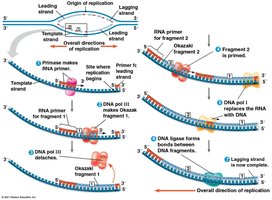
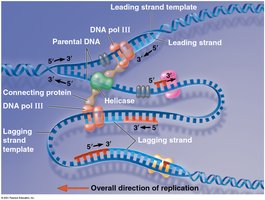
DNA Replication Complex
The proteins involved in DNA replication form a large complex, often referred to as the DNA replication machine, which coordinates the synthesis of both strands.
Proofreading and Repair
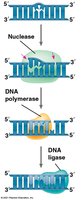
DNA polymerases proofread newly synthesized DNA, correcting errors. DNA can also be repaired by mismatch repair and nucleotide excision repair, which involve cutting out and replacing damaged DNA.
Mismatch Repair: Corrects errors missed during replication.
Nucleotide Excision Repair: Removes damaged DNA segments.
Telomeres and Replication of DNA Ends
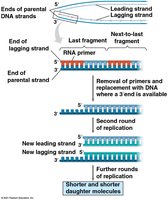
Linear DNA molecules have ends that cannot be fully replicated, leading to shortening with each cell cycle. Telomeres are special sequences at chromosome ends that protect genes. Telomerase extends telomeres in germ cells.
Telomere: Repetitive DNA sequence at chromosome ends.
Telomerase: Enzyme that extends telomeres.
DNA Packaging in Chromosomes
Chromatin Structure
In eukaryotes, DNA is packaged with proteins into chromatin. The basic unit is the nucleosome, consisting of DNA wrapped around histone proteins. Chromatin can be loosely packed (euchromatin) or highly condensed (heterochromatin).
Nucleosome: DNA wrapped around histone core.
Histone: Protein involved in DNA packaging and regulation.
Euchromatin: Loosely packed, transcriptionally active chromatin.
Heterochromatin: Densely packed, transcriptionally inactive chromatin.
Chromatin Modifications
Histones can undergo chemical modifications, affecting chromatin condensation and gene expression. These modifications play a role in regulating access to genetic information.
Histone Modification: Chemical changes to histones that impact gene expression.
Summary Table: DNA Replication Enzymes and Functions
Enzyme/Protein | Function |
|---|---|
Helicase | Unwinds DNA helix |
Primase | Synthesizes RNA primer |
DNA Polymerase | Synthesizes new DNA, proofreads |
Topoisomerase | Relieves strain from unwinding |
Single-Strand Binding Proteins | Stabilize single-stranded DNA |
DNA Ligase | Joins Okazaki fragments |
Nuclease | Removes damaged DNA |
Key Equations
Base Pairing:
Nucleotide Addition:
Additional info: Academic context was added to clarify the function of enzymes, the significance of telomeres, and the structural details of chromatin.
