 Indietro
Ecological Communities and Ecosystem Energy Flow: Study Notes for General Biology
Guida di studio - Note intelligenti
 Appunti personalizzati basati sui tuoi materiali, ampliati con definizioni chiave, esempi e contesto.
Ecological Communities
Definition and Structure
An ecological community is an assemblage of populations of different species living in close proximity and interacting with one another. These interactions shape the structure, diversity, and dynamics of the community.
Community structure is defined by species diversity and feeding relationships (trophic structure).
Some species exert a disproportionate influence on community structure due to their abundance or ecological roles.
Species Interactions in Communities
Types of Interactions
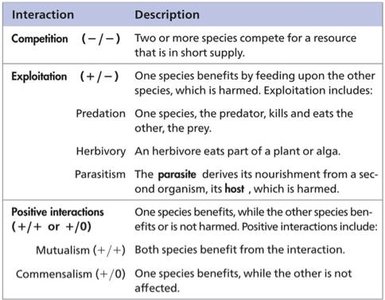
Species interactions are classified based on their effects on the survival and reproduction of the interacting individuals:
Interaction | Description |
|---|---|
Competition (−/−) | Two or more species compete for a resource that is in short supply. |
Exploitation (+/−) | One species benefits by feeding upon the other species, which is harmed. Includes predation, herbivory, and parasitism. |
Mutualism (+/+) | Both species benefit from the interaction. |
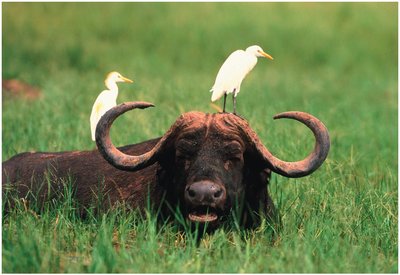
Commensalism (+/0) | One species benefits, while the other is not affected. |
Competition and Resource Partitioning
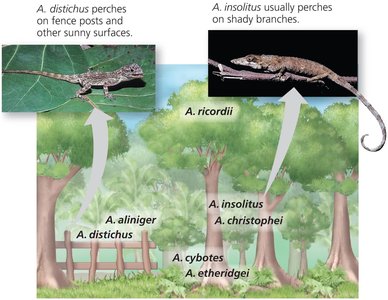
Competition occurs when species vie for the same limiting resources. The competitive exclusion principle states that two species competing for the same resource cannot coexist permanently. Resource partitioning allows similar species to coexist by utilizing different resources or habitats.
Ecological niche: The sum of a species' use of biotic and abiotic resources.
Fundamental niche: The potential niche a species could occupy.
Realized niche: The actual niche occupied due to competition.
Character Displacement
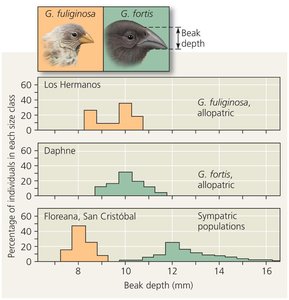
Character displacement is the tendency for characteristics to be more divergent in sympatric populations of two species than in allopatric populations, providing evidence of past competition.
Exploitation: Predation, Herbivory, and Parasitism
Predation (+/−): One species (predator) kills and eats another (prey). Predators have adaptations for capturing prey, while prey have behavioral, morphological, and chemical defenses.
Herbivory (+/−): An herbivore eats parts of a plant or alga. Plants have evolved mechanical and chemical defenses.
Parasitism (+/−): The parasite derives nourishment from its host, harming it. Parasites may be internal (endoparasites) or external (ectoparasites).
Defensive Adaptations
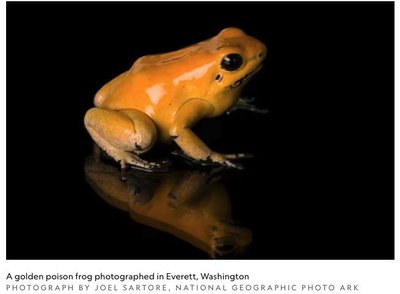
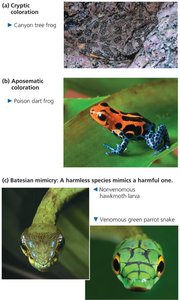
Chemical defenses: Some animals, like the golden poison frog, produce toxins.
Cryptic coloration (camouflage): Allows prey or predators to blend into their environment.
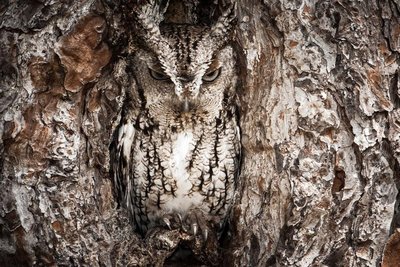
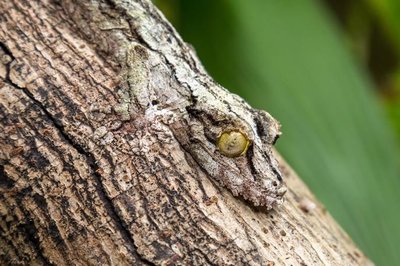
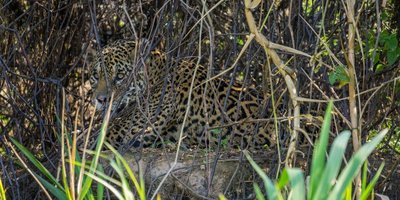
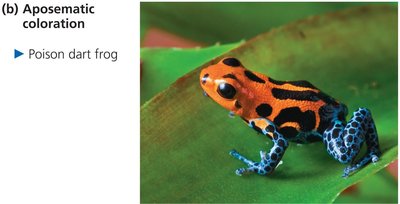
Aposematic coloration: Bright warning coloration in animals with effective chemical defenses, such as poison dart frogs.
Batesian mimicry: A harmless species mimics a harmful one to avoid predation.
Positive Interactions: Mutualism and Commensalism
Mutualism (+/+): Both species benefit. Example: Mycorrhizal fungi and plants exchange nutrients and sugars.
Commensalism (+/0): One species benefits, the other is unaffected. Example: Cattle egrets feed on insects stirred up by buffalo.
Community Structure: Diversity and Trophic Structure
Species Diversity
Species richness: Number of different species in a community.
Relative abundance: Proportion each species represents of all individuals in the community.
Higher diversity communities are more productive, stable, and resistant to invasive species.
Trophic Structure
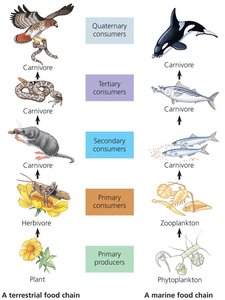
Trophic structure describes the feeding relationships among organisms in a community. Organisms are grouped into trophic levels:
Producers: Plants, algae, and phytoplankton that convert solar energy into chemical energy.
Primary consumers: Herbivores that eat producers.
Secondary and tertiary consumers: Carnivores that eat other consumers.
Detritivores: Organisms that consume dead organic matter.
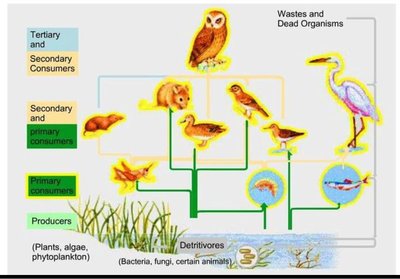
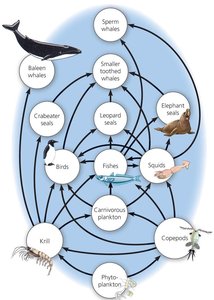
Food chains: Linear sequences of energy transfer.
Food webs: Complex networks of interconnected food chains.
Species with Large Impact
Foundation species: Have strong effects due to their large size or abundance (e.g., trees in a forest).
Keystone species: Exert strong control on community structure by their ecological roles, not abundance (e.g., sea stars controlling mussel populations).
Disturbance and Succession in Communities
Disturbance
A disturbance is an event that changes a community by removing organisms or altering resource availability (e.g., fire, storms, human activity). The intermediate disturbance hypothesis states that moderate levels of disturbance foster greater diversity than high or low levels.
Primary succession: Occurs in lifeless areas (e.g., after glacial retreat).
Secondary succession: Occurs where a disturbance removes most but not all organisms.
Ecosystems and Energy Flow
Physical Laws in Ecosystems
First law of thermodynamics: Energy cannot be created or destroyed, only transformed.
Second law of thermodynamics: Every energy transfer increases entropy; energy conversions are inefficient, and some energy is lost as heat.
Law of conservation of mass: Matter cannot be created or destroyed; elements are recycled within ecosystems.
Biogeochemical Cycles
Biogeochemical cycles describe the movement of nutrients through biotic and abiotic components of ecosystems. Major cycles include:
Water cycle: Involves evaporation, transpiration, condensation, precipitation, and movement through surface and groundwater.
Carbon cycle: Involves photosynthesis, respiration, decomposition, and combustion.
Nitrogen cycle: Involves nitrogen fixation, nitrification, assimilation, ammonification, and denitrification.
Phosphorus cycle: Involves weathering of rocks, uptake by organisms, and return to the environment through decomposition.
Pathogens and Community Structure
Pathogens and Disease
Pathogens (disease-causing microorganisms and viruses) can dramatically alter community structure, especially when introduced to new habitats.
Zoonotic diseases: Diseases transferred from animals to humans, often via vectors such as ticks or mosquitoes.
Summary Table: Types of Species Interactions
Type | Effect on Species 1 | Effect on Species 2 | Example |
|---|---|---|---|
Competition | − | − | Weeds vs. garden plants |
Predation | + | − | Lion and zebra |
Herbivory | + | − | Caterpillar and leaf |
Parasitism | + | − | Tape worm in mammals |
Mutualism | + | + | Bees and flowers |
Commensalism | + | 0 | Barnacles on whales |
Additional info: These notes synthesize and expand upon the provided lecture slides and textbook images, integrating key definitions, examples, and diagrams to support student understanding of community ecology and ecosystem energy flow.
