 Indietro
Ecology and Biodiversity: Population Assessment and Community Interactions
Guida di studio - Note intelligenti
 Appunti personalizzati basati sui tuoi materiali, ampliati con definizioni chiave, esempi e contesto.
Ecology and Biodiversity
Keystone Species and Community Structurel
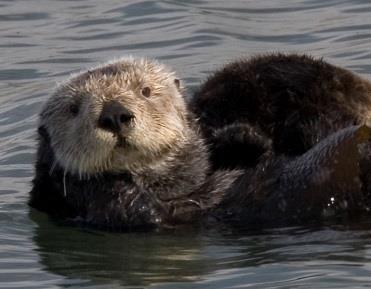
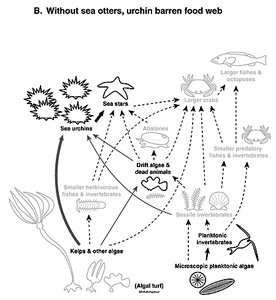
Keystone species play a critical role in maintaining the structure and health of their ecosystems. Their presence or absence can dramatically alter community composition and ecosystem function. - Keystone Species: Species whose impact on their community or ecosystem is disproportionately large relative to their abundance. - Example: Sea otters in the North Pacific Ocean regulate sea urchin populations, preventing the destruction of kelp forests. Without sea otters, sea urchins proliferate and devastate kelp forests, affecting many other species. 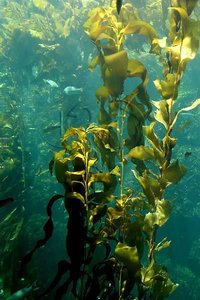
Species Interactions: Competition and Character Displacement
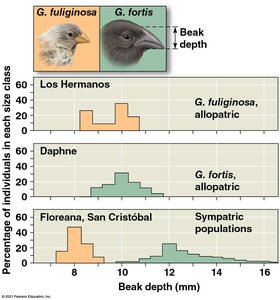
Competition occurs when two or more species vie for the same resources, often leading to changes in their traits or distributions. - Competition: Interaction between organisms or species that vie for the same resources in an ecosystem. - Character Displacement: Tendency for characteristics to diverge more in sympatric populations (where species co-occur) than in allopatric populations (where they are separate). - Example: Two barnacle species in Scotland, Balanus and Chthamalus, show altered distributions when one is experimentally removed, demonstrating competition. 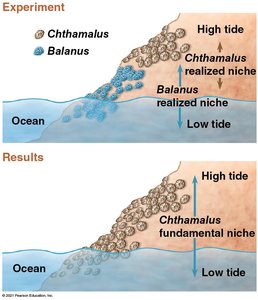 - Example: Beak depth divergence in sympatric versus allopatric populations of Galápagos finches illustrates character displacement.
Disturbance and Ecosystem Recovery
Disturbances such as fire, storms, or human activity can alter ecosystems, but many communities have mechanisms for recovery and resilience. - Disturbance: An event that changes a community by removing organisms or altering resource availability. - Example: Fire can initially reduce plant cover, but over time, vegetation and animal populations may recover. 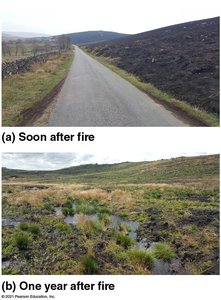
Biodiversity and Its Assessment
What is Biodiversity?
Biodiversity refers to the variety of life in all its forms, levels, and combinations. It is commonly measured as species diversity within an ecosystem. - Species Diversity: The number and relative abundance of species in a given area. - Endemic Species: Species native to a single area, such as an island, country, or ecosystem. 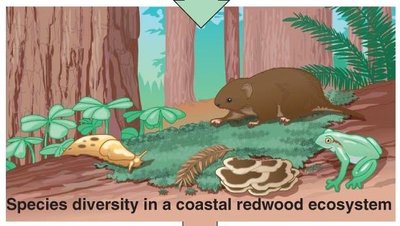
Threats to Biodiversity and Conservation Status
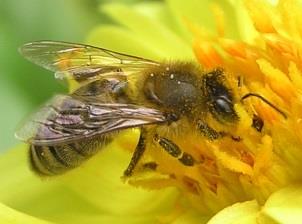
The International Union for Conservation of Nature (IUCN) classifies species based on their risk of extinction, helping guide conservation efforts. - IUCN Categories: Extinct, Extinct in the Wild, Critically Endangered, Endangered, Vulnerable, Near Threatened, Least Concern. - Colony Collapse Disorder: A phenomenon affecting honey bee populations, with multiple proposed causes but no confirmed single reason. 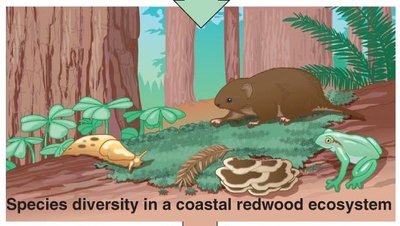
Estimating Species Diversity in Communities
Diversity can be estimated by counting species and considering their relative abundances. - Example: Sample A (3 species) may appear more diverse than Sample B (2 species), but Sample B may have greater evenness, meaning individuals are more evenly distributed among species. 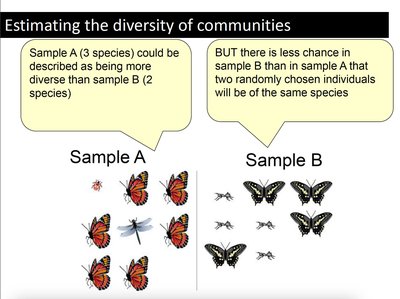
Population Assessment Methods
Census and Effective Population Size
Assessing population size is fundamental in ecology for understanding species abundance and genetic health. - Census Population Size (Nc): The total actual count of all individuals of a given species in a given area. - Effective Population Size (Ne): The size of an idealized population that would experience the same rate of random genetic drift, inbreeding, and loss of genetic diversity as a real population. - Idealized Population: Population with random mating, equal numbers of breeding males and females, and equal family sizes. - Key Point: Ne is almost always lower than Nc due to factors like unequal sex ratios and variation in family size.
Methods for Counting Populations
Different methods are used depending on whether species are stationary or mobile. - Stationary Species: Often assessed using plot sampling methods, where individuals in a defined area are counted. - Non-stationary Species: Capture-Mark-Recapture methods are used, where individuals are captured, marked, released, and then recaptured to estimate population size. Plot Sampling Example: Comparing plots of equal size and similar abiotic and biotic factors is essential for accurate assessment. 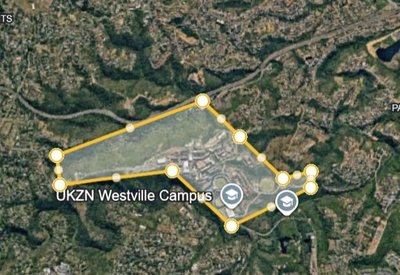

Capture-Mark-Recapture Method
This method is widely used for estimating populations of mobile animals. - Steps: 1. Capture a sample of individuals. 2. Mark and release them. 3. Recapture another sample and count how many are marked. - Formula: The Lincoln-Petersen estimator is commonly used: where is the estimated population size, is the number of individuals marked in the first sample, is the total number captured in the second sample, and is the number of marked individuals recaptured. 

Challenges in Population Assessment
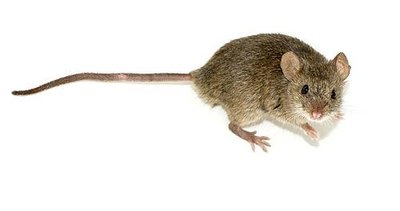
- Not all individuals may be caught or observed, leading to underestimation. - Plots and sampling methods must be standardized for valid comparisons. Example: In a trapping experiment, 50 traps may catch 30 mice, but the actual population could be higher.
Summary Table: IUCN Conservation Status Categories
Category | Description |
|---|---|
Extinct (EX) | No known individuals remaining |
Extinct in the Wild (EW) | Survives only in captivity |
Critically Endangered (CR) | Extremely high risk of extinction |
Endangered (EN) | Very high risk of extinction |
Vulnerable (VU) | High risk of extinction |
Near Threatened (NT) | Likely to become endangered soon |
Least Concern (LC) | Lowest risk |
Conclusion
Understanding community interactions, biodiversity, and population assessment methods is essential for conservation biology and ecological research. These concepts help scientists monitor ecosystem health, manage species, and address threats to biodiversity. Additional info: Some explanations and context were expanded for clarity and completeness, including definitions and formulas for population estimation.
