 Indietro
Ecology and the Biosphere: Study Guide for Exam 1 (BIOL 181)
Guida di studio - Note intelligenti
 Appunti personalizzati basati sui tuoi materiali, ampliati con definizioni chiave, esempi e contesto.
Introduction to Biology
Critical Thinking and Scientific Method
Biology is the scientific study of life, and understanding it requires critical thinking and the application of the scientific method. Bloom’s Taxonomy provides a framework for critical thinking, ranging from remembering facts to evaluating and creating new ideas.
Inductive Reasoning: Drawing general conclusions from specific observations. Example: Observing many cells and concluding all living things are made of cells.
Deductive Reasoning: Applying general principles to predict specific outcomes. Example: If all living things are made of cells, then any newly discovered organism should be composed of cells.
Scientific Method: Steps include observation, hypothesis formation, experimentation, data collection, and conclusion.
Emergent Properties: New properties that arise at each level of biological organization, such as tissues forming organs.
Classification System: Biologists classify life using a hierarchical system (Domain, Kingdom, Phylum, etc.), reflecting evolutionary relationships.
Scientific Names: Properly formatted as Genus species, e.g., Homo sapiens.
Intro to Ecology and the Biosphere
Global Climate Patterns and Biomes
Ecology examines how organisms interact with their environment, including the distribution of biomes across the globe. Solar radiation, air circulation, and the tilt of the earth are key factors.
Solar Radiation: Drives temperature and air circulation, influencing biome distribution.
Air and Moisture: Warm air holds more moisture; rising air cools and releases moisture as precipitation.
Adiabatic Lapse Rate: The rate at which air temperature decreases with altitude, differing for moist and dry air.
High Specific Heat of Water: Water moderates climate by absorbing and releasing heat slowly.
Earth’s Tilt: Causes seasonality at temperate latitudes.
Rainshadow Effect: Mountains block moist air, creating dry areas on the leeward side.
Predicting Changes: Alterations in earth’s tilt, spin, or Hadley cell size can shift biome locations.
Population Ecology
Population Dynamics and Growth Models
Population ecology studies the factors affecting population size and distribution, including interactions and growth patterns.
Range of a Species: Determined by abiotic and biotic factors.
Dispersion Patterns: Influenced by inter- and intraspecies interactions (clumped, uniform, random).
Exponential Growth: Population increases rapidly under ideal conditions. Equation:
Logistic Growth: Population growth slows as it approaches carrying capacity. Equation:
Life-History Trade-Offs: Balancing reproduction, survival, and growth.
Adult Survival Rates: Changes can affect reproductive strategies and population dynamics.
Community Ecology
Interspecies Interactions and Food Webs
Community ecology focuses on interactions among species and their effects on abundance and distribution.
Types of Interactions: Predation, herbivory, parasitism, mutualism, commensalism.
Food Webs: Diagrams showing energy flow; arrows point from prey to predator.
Trophic Levels: Position in the food web (producer, consumer, etc.).
Fundamental vs. Realized Niche: Fundamental is potential range; realized is actual range due to interactions.
Ecological Interactions: Competition, competitive exclusion, resource partitioning, keystone species, ecosystem engineers, trophic cascades.
Indirect Effects: Can alter species abundance or disease incidence.
Succession: Process of community change; involves establishment, facilitation, inhibition.
Disturbance: Influences succession; intermediate disturbance hypothesis suggests moderate disturbance increases diversity.
Human Modifications: Can affect disease risk and ecosystem stability.
Case Study: Sea Otters, Urchins, and Kelp Forests
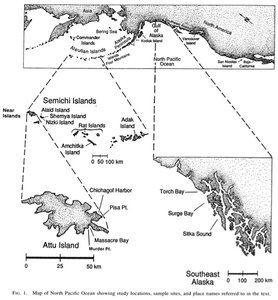
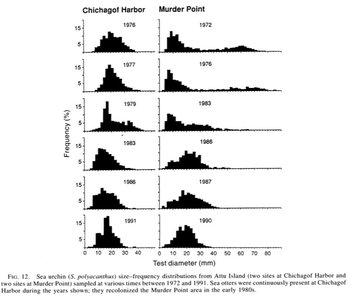
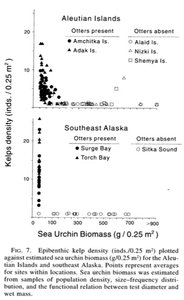
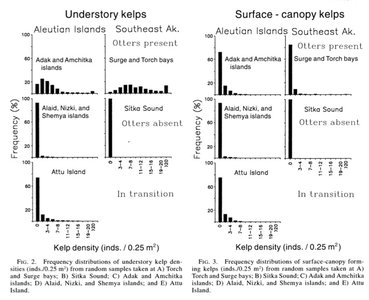
This case study examines the role of sea otters as a keystone species in Alaskan kelp forest communities. Ecologists surveyed locations with varying otter presence and measured sea urchin and kelp densities.
Predictor Variable: Otter presence/absence.
Response Variables: Sea urchin density/size, kelp density.
Control: Locations without otters serve as controls to compare effects.
Major Inferences: Otter presence reduces sea urchin size/density and increases kelp density.
Keystone Species: Otters regulate urchin populations, allowing kelp forests to thrive.
Additional Response Variable: Measuring fish abundance could strengthen conclusions about ecosystem effects.
Ecosystem & Restoration Ecology
Energy Flow and Biogeochemical Cycles
Ecosystem ecology studies how energy and matter move through living and nonliving components.
Energy Capture: Producers (plants, algae) convert solar energy to chemical energy.
Conservation of Matter: Matter cycles through ecosystems; energy flows and is lost as heat.
Thermodynamics: First law: energy is conserved; second law: energy transfer increases entropy.
Trophic Pyramid: Energy decreases at higher trophic levels; only ~10% transferred between levels.
Diet Choices: Eating lower on the food chain conserves energy.
Biogeochemical Cycles: Water, carbon, nitrogen, phosphorus cycles move elements through ecosystems.
Dead Zones: Result from nutrient pollution disrupting biogeochemical cycles.
Restoration Ecology: Returning degraded ecosystems to natural states.
Conservation Biology & Global Change
Biodiversity and Climate Change
Conservation biology aims to preserve biodiversity and address threats from global change.
Biodiversity Levels: Genetic, species, ecosystem diversity.
Threats: Habitat loss, invasive species, pollution, overexploitation, climate change.
Values of Biodiversity: Ecological, economic, cultural, scientific.
Extent of Discovery: Many species remain undiscovered.
Greenhouse Gases: CO2, CH4, N2O, contribute to climate change.
Effects of Climate Change: Alters population and community dynamics, threatens biodiversity.
Essay Question Scoring Rubric
Writing Clear, Concise, Logical Arguments
Essays are graded on content and accuracy (60%), depth (20%), and clarity (20%). Answers should be concise, relevant, and written in complete sentences.
Score 9-10 (A): Accurate, in-depth, clear, logical, concise.
Score 8 (B): Mostly accurate, moderate depth, clear, logical.
Score 7 (C): Some accuracy, somewhat clear and logical.
Score 6 (D): Some relevance, unclear or illogical explanation.
Score 0 (F): No content provided.
