 Indietro
Ecology and the Distribution of Organisms: Study Notes for General Biology
Guida di studio - Note intelligenti
 Appunti personalizzati basati sui tuoi materiali, ampliati con definizioni chiave, esempi e contesto.
Ecology: The Study of Interactions
Definition and Scope
Ecology is the scientific study of the interactions between organisms and their environment. These interactions are organized into a hierarchy, ranging from individual organisms to the entire biosphere.
Organismal Ecology: Examines how an organism’s structure, physiology, and behavior meet environmental challenges.
Population Ecology: Focuses on factors affecting population size and composition over time.
Community Ecology: Studies interactions between species and their effects on community structure and organization.
Ecosystem Ecology: Emphasizes energy flow and chemical cycling between organisms and their environment.
Landscape Ecology: Investigates exchanges of energy, materials, and organisms across multiple ecosystems.
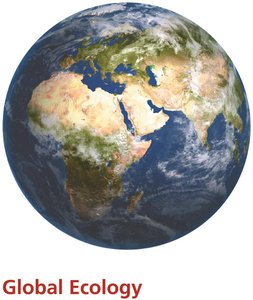
Global Ecology: Concerned with the biosphere, examining the influence of energy and materials on organisms globally.
Climate and Its Role in Biome Distribution
Climate: Definition and Components
The climate of an area is defined by its long-term prevailing weather conditions. Four major physical components of climate are:
Temperature
Precipitation
Sunlight
Wind
Global Climate Patterns
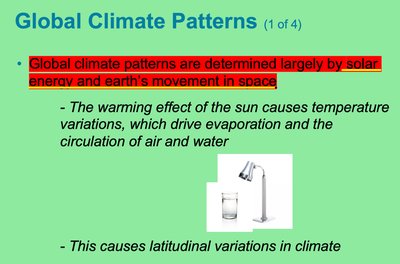
Global climate patterns are determined largely by solar energy and Earth's movement in space. The sun’s warming effect causes temperature variations, which drive evaporation and the circulation of air and water, resulting in latitudinal variations in climate.
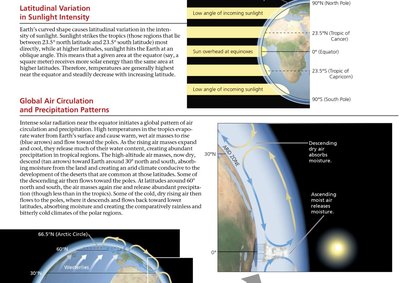
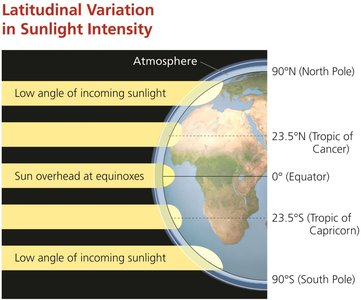
Latitudinal Variation in Sunlight Intensity: The curvature of Earth causes sunlight to strike the surface at different angles, resulting in more intense sunlight at the equator and less at the poles.
Global Air Circulation and Precipitation Patterns: Warm, wet air rises near the equator, creating precipitation in the tropics. Dry air descends at 30° north and south, creating deserts. This pattern repeats at higher latitudes.
Regional and Local Effects on Climate
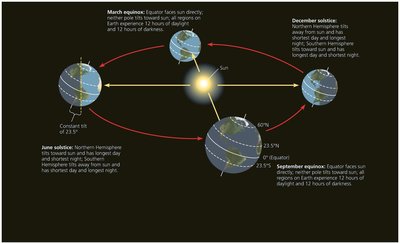
Seasonality: Caused by the tilt of Earth’s axis and its orbit around the sun, leading to seasonal variations in light and temperature, especially at higher latitudes.
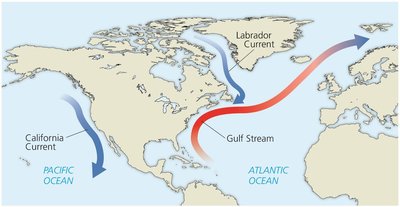
Bodies of Water: Oceans and large lakes moderate the climate of nearby land by absorbing and releasing heat.
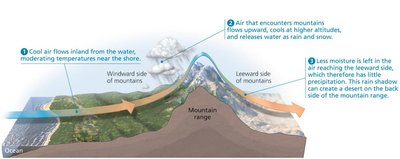
Mountains: Affect climate by influencing sunlight exposure, temperature, and precipitation patterns (e.g., rain shadows).
Terrestrial Biomes
Definition and Classification
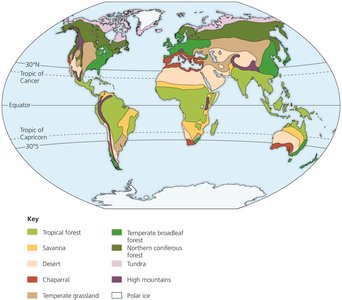
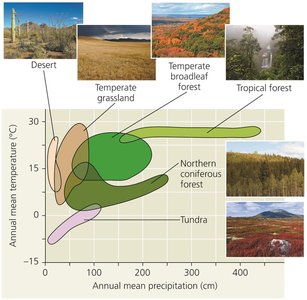
Biomes are major life zones characterized by vegetation type (terrestrial biomes) or physical environment (aquatic biomes). Climate is the primary determinant of the distribution of terrestrial biomes, which show latitudinal patterns corresponding to climate zones.
Terrestrial biomes are often named for their predominant vegetation and climate features.
Vertical layering (e.g., canopy, understory, ground layer) provides diverse habitats for animals.
Biomes usually grade into each other in areas called ecotones.
Climographs
A climograph plots the annual mean temperature and precipitation in a region, helping to visualize how climate influences biome distribution. Patterns of temperature and precipitation throughout the year also affect biome characteristics.
Disturbance and Biome Distribution
Disturbance: An event that changes a community by removing organisms or altering resource availability (e.g., fire, storms, human activity).
Disturbances can alter the distribution and composition of biomes.
Aquatic Biomes
Characteristics and Zonation
Aquatic biomes are primarily characterized by their physical and chemical environment. They are stratified into vertical and horizontal zones:
Photic Zone: Sufficient light for photosynthesis.
Aphotic Zone: Little light penetrates.
Pelagic Zone: Open water, includes both photic and aphotic zones.
Benthic Zone: Bottom substrate, home to benthos organisms.
Littoral Zone (lakes): Near shore, shallow, supports rooted plants.
Limnetic Zone (lakes): Farther from shore, too deep for rooted plants.
Thermocline: Temperature boundary separating warm upper water from cold deeper water.
Oceans cover about 75% of Earth's surface and have a major impact on global climate and wind patterns.
Population Ecology
Population Density and Dispersion
Population ecology explores how biotic and abiotic factors influence population density, dispersion, and demographics.
Density: Number of individuals per unit area or volume.
Dispersion: Pattern of spacing among individuals (clumped, uniform, random).
Sampling techniques are used to estimate population size and density.
Patterns of Dispersion
Clumped: Individuals aggregate in patches, often due to resource availability or social behavior.
Uniform: Evenly spaced, often due to territoriality or competition.
Random: Position of each individual is independent of others, often where resources are consistent.
Demographics and Life Tables
Demography: Study of births, deaths, and migration rates over time.
Life Table: Age-specific summary of survival and reproductive rates, often constructed by following a cohort from birth to death.
Age (years) | Number alive at start of year | Number dying during year | Proportion surviving |
|---|---|---|---|
0 | 1000 | 200 | 0.80 |
1 | 800 | 150 | 0.81 |
2 | 650 | 100 | 0.85 |
3 | 550 | 50 | 0.91 |
4 | 500 | 50 | 0.90 |
5 | 450 | 450 | 0.00 |
Additional info: Table values are representative and may differ from the original data.
Survivorship Curves
A survivorship curve graphically represents the number or proportion of a cohort surviving at each age. There are three general types:
Type I: High survivorship early and middle life, steep drop in old age (e.g., humans).
Type II: Constant death rate over the organism’s life span (e.g., some birds).
Type III: Low survivorship for young, higher for survivors (e.g., oysters, many fish).
Reproductive Rates
Measured as the average number of female offspring produced by each female in a given age group.
Varies considerably among species and is a key factor in population growth and dynamics.
Summary Table: Hierarchy of Ecological Research
Level | Focus | Example Question |
|---|---|---|
Organismal | Adaptations of individuals | How does a frog regulate its body temperature? |
Population | Population size and dynamics | What limits the population size of flamingos? |
Community | Species interactions | How do predators affect prey diversity? |
Ecosystem | Energy flow, nutrient cycling | How does nutrient availability affect productivity? |
Landscape | Interactions across ecosystems | How do rivers connect forest and grassland ecosystems? |
Global | Biosphere-wide processes | How does climate change affect global biodiversity? |
