 Indietro
Ecology: Climate, Biogeography, Population, and Community Dynamics
Guida di studio - Note intelligenti
 Appunti personalizzati basati sui tuoi materiali, ampliati con definizioni chiave, esempi e contesto.
Ecology: The Study of Interactions and Distribution
Overview of Ecology
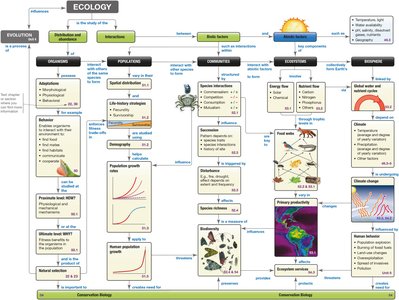
Ecology is the branch of biology that examines how organisms interact with each other and their environment. It encompasses the study of distribution and abundance of organisms, population dynamics, community structure, ecosystem function, and the biosphere.
Biotic factors: Interactions with living organisms (e.g., competition, predation).
Abiotic factors: Interactions with non-living components (e.g., temperature, precipitation, sunlight).
Evolution: Shapes adaptation and survival strategies in ecological contexts.
Global Climate Patterns
Seasonality and Earth's Tilt
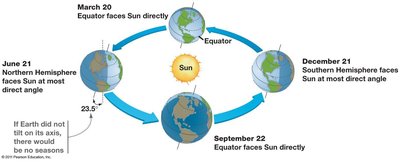
Seasonality refers to regular, annual fluctuations in temperature and precipitation. These patterns are primarily caused by Earth's 23.5º tilt on its axis, which affects the angle and intensity of sunlight received at different latitudes throughout the year.
Seasonality: More pronounced at higher latitudes; minimal at the equator.
Daylength and temperature: Vary with latitude and season.
Earth's tilt: Responsible for the alternation of seasons.
Latitudinal Variation in Temperature
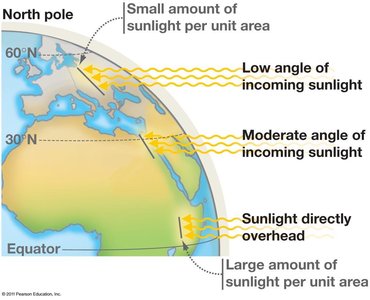
Temperature differences across the globe are driven by the angle at which sunlight strikes the Earth's surface. The tropics receive more direct sunlight, resulting in warmer temperatures, while the poles receive sunlight at a lower angle, leading to cooler climates.
Equator: Sunlight hits directly, resulting in high temperatures.
Poles: Sunlight is spread over a larger area and passes through more atmosphere, resulting in lower temperatures.
Global Precipitation Patterns and Hadley Cells
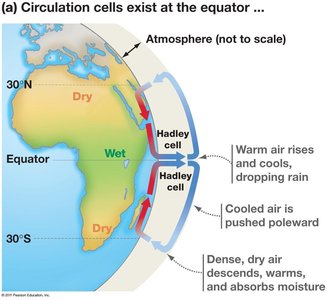
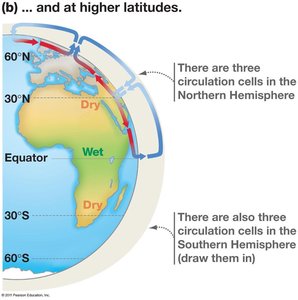
Precipitation patterns are influenced by global air circulation, particularly Hadley cells. These cells create wet conditions at the equator and dry conditions at approximately 30º N and S latitudes, explaining the location of tropical rainforests and deserts.
Hadley cell: Warm air rises at the equator, cools, and drops rain; dry air descends at 30º, creating deserts.
Precipitation: Highest at the equator, lowest at 30º N/S.
Influence of Physical Features and Ocean Currents
Regional climate is affected by physical features such as mountain ranges (rain shadow effect) and ocean currents. Mountain ranges can cause precipitation on one side and dry conditions on the other, while ocean currents redistribute heat, affecting coastal climates.
Rain shadow effect: Winds from the ocean drop precipitation on windward side; leeward side remains dry.
Ocean currents: Warm equatorial water moves toward poles, cools, and returns, influencing temperature and precipitation.
Biomes and Biogeographic Regions
Definition and Distribution of Biomes
Biomes are major groupings of plant and animal communities defined by dominant vegetation and distinctive abiotic conditions, such as average annual temperature and precipitation, and their variation.
Tropical wet forests: Occur near the equator, always warm, always wet.
Temperate grasslands: Moderate seasonality, temperature, and precipitation; found in continental interiors.
Boreal forests: Cold and wet; found at higher latitudes (~60º).
Biome | Temperature | Precipitation | Location |
|---|---|---|---|
Tropical Wet Forest | Warm | Wet | Equator |
Temperate Grassland | Moderate | Moderate | Interior, 30-60º |
Boreal Forest | Cold | Wet | ~60º |
Biogeographic Regions
Biogeographic regions are defined by barriers and time, separating areas where organisms have evolved in isolation. These regions are recognized by unique assemblages of species and are shaped by geographic features such as oceans, deserts, and mountain ranges.
Barriers: Oceans, deserts, mountain ranges.
Isolation: Leads to unique species assemblages.
Population Ecology
Population Growth and Demography
Population ecology studies how and why the number of individuals in a population changes over time. Growth rate is determined by birth, death, immigration, and emigration rates. Under ideal conditions, populations grow exponentially, but resource limitation leads to logistic growth.
Exponential growth: (density-independent, J-shaped curve).
Logistic growth: (density-dependent, S-shaped curve).
Carrying capacity (K): Maximum population size supported by environment.
Stage | Growth Rate (r) | Resource Availability |
|---|---|---|
Exponential | High, near rmax | Abundant |
Declining | Decreasing | Scarce |
Stable | Zero | Scarce |
Community Ecology
Species Interactions
Community ecology examines how species interact and the consequences for fitness, distribution, and abundance. Interactions include competition, consumption, mutualism, commensalism, and amensalism.
Competition (–/–): Both species suffer reduced fitness.
Consumption (+/–): One species benefits, the other is harmed.
Mutualism (+/+): Both species benefit.
Commensalism (+/0): One benefits, the other is unaffected.
Amensalism (–/0): One is harmed, the other is unaffected.
Ecological Niche and Competition
The ecological niche is the range of resources a species can use and conditions it can tolerate. Competition can lead to niche differentiation or competitive exclusion.
Fundamental niche: Resources used in absence of competitors.
Realized niche: Resources used in presence of competitors.
Competitive exclusion principle: Two species cannot coexist in the same niche.
Ecosystem Ecology
Energy Flow and Productivity
Energy flows through ecosystems via food webs, starting with primary producers (autotrophs) and moving through consumers and decomposers. Net Primary Productivity (NPP) is the energy available to the rest of the food web after accounting for respiration.
Gross Primary Productivity (GPP): Total energy captured by producers.
Respiration: Energy used by producers for metabolism.
Net Primary Productivity (NPP):
Pyramid of productivity: Only ~10% of energy is transferred between trophic levels.
Nutrient Cycling
Nutrients cycle through ecosystems via biogeochemical cycles, moving between biotic and abiotic reservoirs. Key cycles include carbon and nitrogen, which are affected by human activities such as fossil fuel burning and agricultural runoff.
Carbon cycle: Photosynthesis, respiration, fossil fuel burning.
Nitrogen cycle: Nitrogen fixation, decomposition, pollution.
Summary Table: Major Concepts in Ecology
Concept | Definition | Example |
|---|---|---|
Biome | Major ecosystem type defined by climate and vegetation | Tropical rainforest |
Population Growth | Change in number of individuals over time | Exponential vs. logistic growth |
Species Interaction | Effects of organisms on each other's fitness | Competition, predation, mutualism |
Energy Flow | Movement of energy through trophic levels | Food web, NPP |
Nutrient Cycle | Movement of elements through biotic and abiotic reservoirs | Carbon, nitrogen cycles |
*Additional info: Some explanations and table entries were expanded for clarity and completeness based on standard General Biology curriculum.*
