 Indietro
Ecosystems and Energy: Energy Flow, Trophic Structure, and Biogeochemical Cycles
Guida di studio - Note intelligenti
 Appunti personalizzati basati sui tuoi materiali, ampliati con definizioni chiave, esempi e contesto.
Ecosystems and Energy
Physical Laws Govern Energy Flow and Chemical Cycling in Ecosystems
Ecosystems are composed of all living organisms and the abiotic factors with which they interact. The flow of energy and cycling of chemical elements in ecosystems are governed by physical laws, particularly the laws of thermodynamics and the conservation of mass.
Ecosystem: The sum of all organisms living within its boundaries and all abiotic factors with which they interact.
Energy Flow: Energy enters most ecosystems as sunlight, is converted to chemical energy by autotrophs (primary producers), passed to consumers, and eventually dissipated as heat.
Chemical Cycling: Chemical elements are transformed and recycled within ecosystems through processes such as photosynthesis, feeding, and decomposition.
First Law of Thermodynamics: Energy cannot be created or destroyed, only transferred or transformed.
Second Law of Thermodynamics: Every energy transfer increases the entropy of the universe; some energy is always lost as heat.
Conservation of Mass: Matter cannot be created or destroyed; elements cycle within ecosystems.
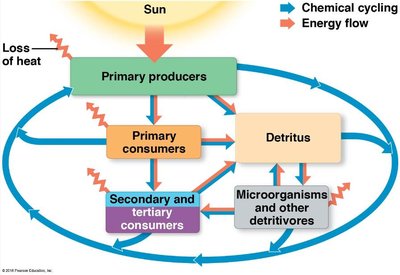
Key Point: Energy flows through ecosystems (it is not recycled), while chemicals cycle within them.
Trophic Structure and Energy Flow
Organisms in an ecosystem are organized into trophic levels based on their source of energy and nutrients.
Primary Producers: Autotrophs (plants, algae, photosynthetic prokaryotes) that support all other trophic levels.
Primary Consumers: Herbivores that eat primary producers.
Secondary and Tertiary Consumers: Carnivores that eat other animals.
Detritivores/Decomposers: Organisms (fungi, prokaryotes, earthworms) that consume non-living organic material (detritus) and recycle nutrients.
Primary Production in Ecosystems
Primary production is the amount of light energy converted to chemical energy by autotrophs in an ecosystem. It sets the energy budget for the entire ecosystem.
Gross Primary Production (GPP): Total primary production in an ecosystem (total amount of light energy converted to chemical energy per unit time).
Net Primary Production (NPP): GPP minus the energy used by primary producers for respiration (R). Only NPP is available to consumers.
Only about 1% of the visible light that strikes photosynthetic organisms is converted to chemical energy.
Standing Crop: The total biomass of photosynthetic autotrophs in an ecosystem.
Primary production in aquatic ecosystems is limited by light and nutrients (often phosphorus and nitrogen).
Primary production in terrestrial ecosystems is mainly controlled by temperature and moisture.
Energy Transfer Between Trophic Levels
Energy transfer between trophic levels is inefficient, with only a small fraction of energy passed on to the next level.
Secondary Production: The amount of chemical energy in consumers' food that is converted to new biomass during a given period.
Production Efficiency: The percentage of energy stored in assimilated food that is not used for respiration.
Trophic Efficiency: The percentage of production transferred from one trophic level to the next, typically 10% (range: 5-20%).
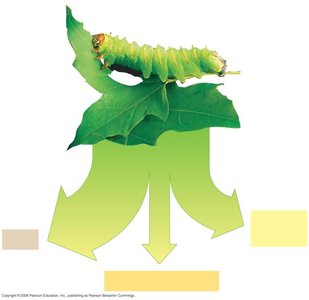
Example: A caterpillar eats a leaf; some energy is used for cellular respiration, some is lost as feces, and some is converted to new biomass.
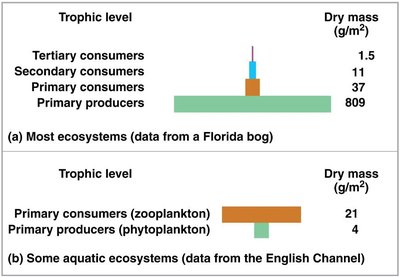
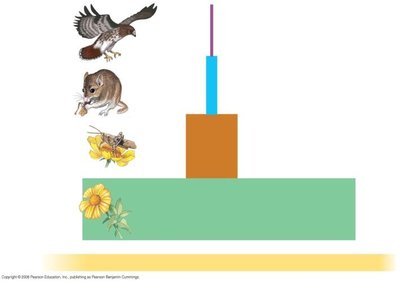
Key Point: Energy is lost at each trophic level, resulting in a pyramid-shaped distribution of biomass and energy.
Biogeochemical Cycles
Biogeochemical cycles describe the movement of chemical elements through biotic and abiotic components of ecosystems. These cycles are essential for ecosystem function and include the water, phosphorus, carbon, and nitrogen cycles.
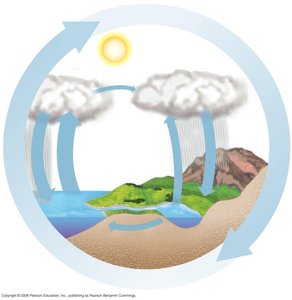
Water Cycle
Evaporation: Water is lost from bodies of water due to solar energy (mainly from oceans).
Precipitation: Water returns to Earth as rain or snow.
Transpiration: Loss of water from plants to the atmosphere.
Phosphorus Cycle
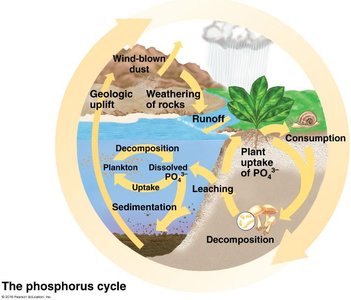
Phosphorus is essential for nucleic acids, phospholipids, and ATP.
The only inorganic form of phosphorus that plants can absorb is phosphate (PO43-).
Phosphorus cycles through weathering of rocks, uptake by plants, consumption by animals, and return to the soil via decomposition.
Carbon Cycle
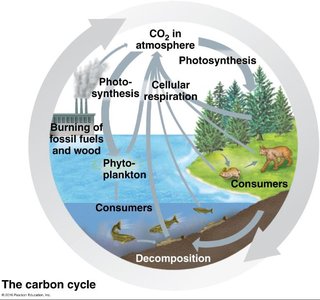
Carbon cycles between the atmosphere and terrestrial environments primarily through photosynthesis and cellular respiration.
Burning of fossil fuels adds significant CO2 to the atmosphere, contributing to global warming.
(Photosynthesis)
(Cellular Respiration)
Nitrogen Cycle
Nitrogen is a component of amino acids, proteins, and nucleic acids, and is often a limiting nutrient.
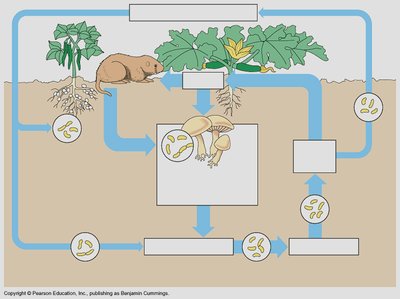
The main reservoir of nitrogen is the atmosphere (N2), which is unusable by plants.
Plants can use nitrogen in the form of ammonium (NH4+) or nitrate (NO3-).
Nitrogen Fixation: Conversion of N2 by bacteria to ammonium (NH4+).
Nitrification: Conversion of ammonium to nitrate by bacteria.
Ammonification: Decomposition of organic nitrogen to ammonium.
Denitrification: Conversion of nitrate to N2 gas by bacteria, returning nitrogen to the atmosphere.
Restoration Ecology
Restoration ecology seeks to return degraded ecosystems to a more natural state through two main strategies:
Bioremediation: Use of organisms (prokaryotes, fungi, plants) to detoxify polluted ecosystems (e.g., removing oil or radioactive elements).
Biological Augmentation: Introduction of desirable species to add essential materials to a degraded ecosystem (e.g., planting nitrogen-fixing plants).
Big Ideas in Ecosystem Ecology
All living systems require constant input of free energy and matter to grow, reproduce, and maintain homeostasis.
Interactions within and among biological systems result in the movement of matter and energy, leading to complex properties and adaptation to different environments.
