 Indietro
Emergent Properties of Water and Their Biological Importance
Guida di studio - Note intelligenti
 Appunti personalizzati basati sui tuoi materiali, ampliati con definizioni chiave, esempi e contesto.
Water: Structure and Polarity
Polarity of Water Molecules
Water (H2O) is a polar molecule, meaning it has an uneven distribution of electron density. The oxygen atom is more electronegative than hydrogen, causing electrons to spend more time near the oxygen atom. This polarity allows water molecules to form hydrogen bonds with each other, which are crucial for many of water's unique properties.
Intramolecular bonds: Polar covalent bonds within a water molecule.
Intermolecular bonds: Hydrogen bonds between different water molecules.
Emergent Properties of Water
Overview
Water exhibits four emergent properties that are essential for life on Earth:
Cohesive behavior
Ability to moderate temperature
Expansion upon freezing
Versatility as a solvent
Cohesion and Surface Tension
Cohesion refers to the attraction between water molecules due to hydrogen bonding. This property results in high surface tension, which is the measure of how difficult it is to stretch or break the surface of a liquid. Surface tension allows certain organisms, such as some insects and spiders, to move across the surface of water without sinking.
Surface tension: The force that allows the surface of a liquid to resist external force.
Example: Water striders and some spiders can walk on water due to high surface tension.

Adhesion
Adhesion is the attraction between water molecules and other substances. This property is important in biological systems, such as the movement of water up plant cell walls (capillarity).
Example: Water adheres to the walls of plant vessels, aiding in the transport of water from roots to leaves.
Moderation of Temperature
Water can absorb or release large amounts of heat with only a slight change in its own temperature, due to its high specific heat. The specific heat of water is 1 cal/(g·ºC), which is much higher than most other substances. This property helps moderate Earth's climate and stabilizes temperatures in organisms and environments.
Heat absorption: Heat is absorbed when hydrogen bonds break (e.g., during evaporation).
Heat release: Heat is released when hydrogen bonds form (e.g., when water freezes).
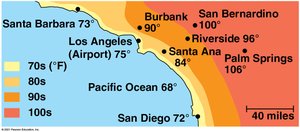
Example: Coastal areas experience milder climates due to the ocean's ability to absorb and release heat.
Formula:
where is heat absorbed or released, is mass, is specific heat, and is temperature change.
Expansion Upon Freezing
Water is less dense as a solid than as a liquid. At 0ºC, water molecules form a crystalline lattice maintained by hydrogen bonds, causing ice to float. This property is vital for aquatic life, as ice insulates the water below and prevents entire bodies of water from freezing solid.
Density of ice: About 10% less than liquid water.
Greatest density: Water reaches its maximum density at 4ºC.
Biological importance: Floating ice insulates aquatic habitats in winter.
Water as a Solvent
Water is known as the "universal solvent" because its polarity allows it to dissolve a wide variety of substances. When ionic compounds dissolve in water, each ion is surrounded by a hydration shell of water molecules. Water can also dissolve large polar molecules, such as proteins, if they have ionic or polar regions.
Solution: Homogeneous mixture of two or more substances.
Solvent: The dissolving agent (water in aqueous solutions).
Solute: The substance that is dissolved.
Hydrophilic: Substances with an affinity for water (e.g., salts, sugars).
Hydrophobic: Substances that do not mix with water (e.g., oils, lipids).
Acidification: A Threat to Our Oceans
Ocean Acidification
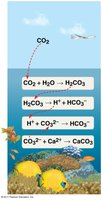
Human activities, such as burning fossil fuels, increase atmospheric CO2. About 25% of this CO2 is absorbed by the oceans, where it reacts with water to form carbonic acid. This process, known as ocean acidification, lowers the pH of seawater and reduces the availability of carbonate ions (CO32–), which are essential for marine organisms that build shells and skeletons from calcium carbonate (CaCO3).
Key reactions:
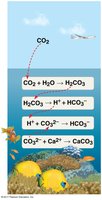
Biological impact: Reduced carbonate ion concentration impairs the ability of corals and other marine organisms to produce calcium carbonate structures, threatening reef ecosystems.
Practice Questions and Applications
Emergent Properties of Water
Cohesion: Water molecules stick together, enabling transport in plants and surface tension.
Moderation of temperature: Water stabilizes temperatures in organisms and environments due to high specific heat.
Expansion upon freezing: Ice floats, insulating aquatic life in winter.
Solvent properties: Water dissolves many substances, facilitating chemical reactions in cells.
Hydrophobic Glycolipids in Skin
If the hydrophobic glycolipid coating on skin were absent, water would be lost from skin cells more quickly, skin would swell when swimming, and skin would wrinkle more.
Ocean Acidification and Coral Reefs
Increased atmospheric CO2 leads to a decrease in carbonate ions in seawater, resulting in slower reef growth due to impaired calcification.
Property | Definition | Biological Importance |
|---|---|---|
Cohesion | Attraction between water molecules | Enables transport in plants, surface tension |
Moderation of Temperature | High specific heat buffers temperature changes | Stabilizes climate and organismal temperature |
Expansion upon Freezing | Ice is less dense than liquid water | Insulates aquatic habitats |
Solvent Properties | Polarity allows dissolution of many substances | Facilitates biochemical reactions |
