 Indietro
Energetics and Kinetics of Chemical Reactions: Study Notes for General Biology
Guida di studio - Note intelligenti
 Appunti personalizzati basati sui tuoi materiali, ampliati con definizioni chiave, esempi e contesto.
Reaction Coordinate Diagrams
Understanding Energy Changes in Reactions
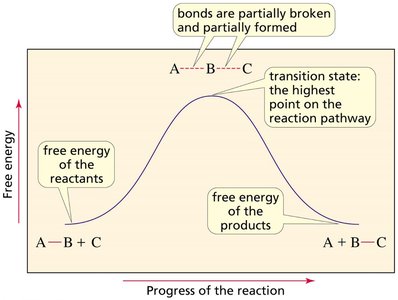
A reaction coordinate diagram visually represents the energy changes that occur during a chemical reaction. The y-axis shows the energy (often free energy), while the x-axis tracks the progress of the reaction from reactants to products. These diagrams are essential for understanding the stability of chemical species and the energy barriers that must be overcome for reactions to proceed.
Transition State: The highest energy point on the diagram, representing a temporary, unstable arrangement of atoms.
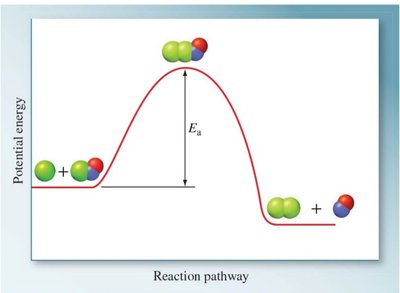
Activation Energy (Ea): The minimum energy required to reach the transition state and initiate the reaction.
Stability: Lower energy species are more stable; higher energy species are less stable.
Thermodynamics and Kinetics
Thermodynamics: Equilibrium and Stability
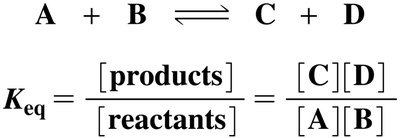
Thermodynamics studies reactions at equilibrium, focusing on the relative concentrations of reactants and products. The equilibrium constant (Keq) quantifies the ratio of product to reactant concentrations at equilibrium.
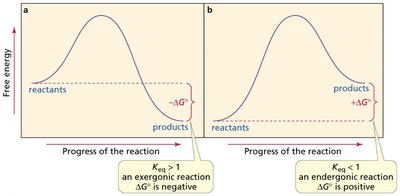
Keq > 1: Products are more stable than reactants; product-favored.
Keq < 1: Reactants are more stable than products; reactant-favored.
Kinetics: Reaction Rates
Kinetics examines how fast reactions occur. The rate depends on factors such as activation energy, temperature, concentration, and the presence of catalysts.
Activation Energy (Ea): Higher Ea means slower reaction; lower Ea means faster reaction.
Transition State: Temporary, high-energy state where bonds are partially broken and formed.
Enthalpy and Entropy
Enthalpy (ΔH°): Heat Flow in Reactions
Enthalpy (ΔH°) measures the heat released or absorbed during a reaction under standard conditions.
Exothermic (ΔH° < 0): Bonds formed are stronger than bonds broken; heat is released.
Endothermic (ΔH° > 0): Bonds formed are weaker than bonds broken; heat is absorbed.
Strain: Torsional, steric, and angle strain increase enthalpy.
Entropy (ΔS°): Disorder and Freedom of Motion
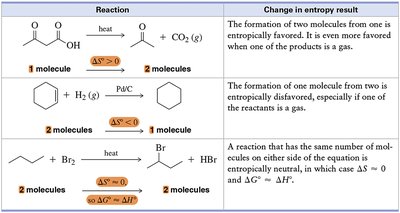
Entropy (ΔS°) quantifies the disorder or freedom of motion in a system.
ΔS° > 0: More product molecules or greater freedom of movement in products.
ΔS° < 0: More reactant molecules or greater freedom of movement in reactants.
Gibbs Free Energy (ΔG°)
Determining Reaction Spontaneity
Gibbs free energy (ΔG°) is the difference in free energy between products and reactants under standard conditions. It determines whether a reaction is spontaneous.
ΔG° < 0: Products are more stable; reaction is exergonic (spontaneous, energy-releasing).
ΔG° > 0: Products are less stable; reaction is endergonic (non-spontaneous, energy-absorbing).
Key Equations:
Manipulating Reaction Favorability
Factors Affecting Gibbs Free Energy
To favor product formation, a reaction should have a negative ΔH° (stronger bonds formed) and a positive ΔS° (greater disorder in products). Changing reaction conditions, such as temperature, can alter ΔG° and shift equilibrium.
Increasing Temperature: Can make ΔG° more negative, favoring products.
Le Châtelier’s Principle: System shifts to offset disturbances in equilibrium.
Coupled Reactions: Endergonic reactions followed by exergonic reactions can drive product formation, common in metabolic pathways.
Collision Theory and Activation Energy
Effective Collisions and Reaction Initiation
For a reaction to occur, molecules must collide with sufficient energy and proper orientation. The minimum energy required is the activation energy (Ea). At the transition state, an activated complex forms temporarily.
Effective Collisions: Convert kinetic energy into vibrational energy, breaking bonds.
Activation Energy (Ea): Energy barrier to reaction initiation.

Free Energy of Activation (ΔG‡)
Kinetic Stability and Reaction Speed
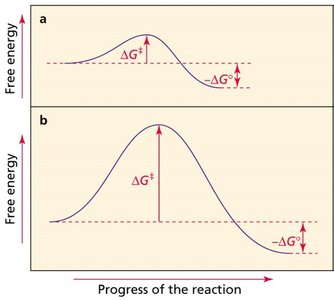
The free energy of activation (ΔG‡) is the energy barrier that determines the rate of a reaction. Smaller ΔG‡ means the reaction is kinetically unstable and occurs rapidly; larger ΔG‡ means the reaction is kinetically stable and occurs slowly.
Controlling Reaction Rates
Factors Influencing Reaction Speed
The rate of chemical reactions can be controlled by several factors:
Temperature: Increasing temperature increases reaction rate by providing more energy for collisions. The relationship is described by the Arrhenius Equation:
Concentration and Surface Area: Higher concentration and greater surface area increase collision frequency, speeding up reactions.
Catalysts: Catalysts lower activation energy, increasing reaction rate without being consumed. Enzymes are biological catalysts. Note: Catalysts do not change Keq, only the speed.
Reaction Mechanism: The physical state and pathway of the reaction affect whether and how quickly it occurs.
Example: Enzymes in metabolic pathways act as catalysts to speed up biological reactions.
Summary Table: Thermodynamic and Kinetic Properties
Property | Definition | Effect on Reaction |
|---|---|---|
ΔH° (Enthalpy) | Heat flow during reaction | Negative favors exothermic, positive favors endothermic |
ΔS° (Entropy) | Disorder or freedom of motion | Positive favors product formation, negative favors reactant formation |
ΔG° (Gibbs Free Energy) | Free energy difference between products and reactants | Negative is spontaneous (exergonic), positive is non-spontaneous (endergonic) |
ΔG‡ (Activation Free Energy) | Energy barrier to reaction | Smaller is faster, larger is slower |
Additional info: These concepts are foundational for understanding metabolic pathways, enzyme function, and cellular energetics in General Biology.
