 Indietro
Energy and Cellular Respiration: Metabolic Pathways in Biology
Guida di studio - Note intelligenti
 Appunti personalizzati basati sui tuoi materiali, ampliati con definizioni chiave, esempi e contesto.
Energy and Cellular Respiration
Introduction
All living organisms require energy to survive, grow, reproduce, and carry out daily activities. This energy is primarily obtained through cellular respiration, a process that releases energy from carbohydrates and other energy-rich molecules. The metabolic pathways involved in cellular respiration are fundamental to understanding how cells transform matter and energy.

Metabolism and Energy
Metabolic Pathways
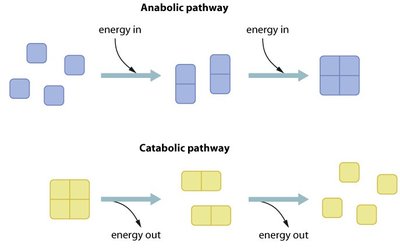
Metabolism encompasses all chemical reactions occurring within a cell. These reactions are organized into metabolic pathways, where the product of one reaction becomes the reactant for the next. Each step is catalyzed by a specific enzyme.
Anabolic reactions: Build large molecules from smaller ones, requiring energy input.
Catabolic reactions: Break down large molecules into smaller products, releasing energy.
Defining Energy
Energy is the capacity to do work. It exists in two main forms:
Kinetic energy: Energy of motion.
Potential energy: Stored energy.
Cells transform potential energy into kinetic energy to perform work, following the same physical laws as in chemistry and physics.
Bond Energy
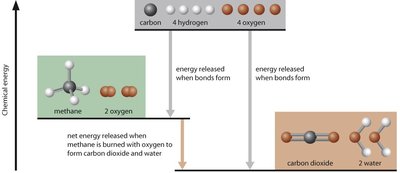
When chemical bonds form between atoms, energy is released. Breaking these bonds requires the same amount of energy that was released during formation. Free (unbonded) atoms possess more chemical (potential) energy than compounds.
The Laws of Thermodynamics
First Law of Thermodynamics
Energy cannot be created or destroyed, only transformed or transferred. Biological systems are open, exchanging matter and energy with their surroundings.
Second Law of Thermodynamics
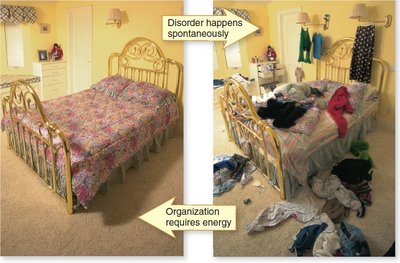
The universe tends toward disorder (entropy). As energy is transformed, some becomes unusable heat, increasing entropy. Living organisms maintain order by using inputs of matter and energy to reduce entropy.
Free Energy and Chemical Reactions
Free Energy (G)
Free energy is the energy available from a chemical reaction to do work, excluding heat. It is determined by the molecule's chemical bonds (enthalpy, H) and the system's disorder (entropy, S) at a given temperature (T):
For biological reactions under constant conditions, the change in free energy is:
Endergonic and Exergonic Reactions
Reactions can be classified based on their free energy change:
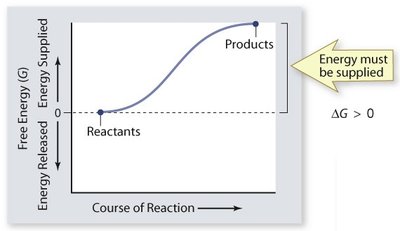
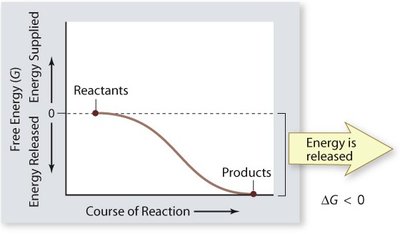
Endergonic reactions: is positive; products have more free energy than reactants. These reactions require energy input and do not proceed spontaneously.
Exergonic reactions: is negative; products have less free energy than reactants. These reactions proceed spontaneously and release energy.
Activation Energy and Enzymes
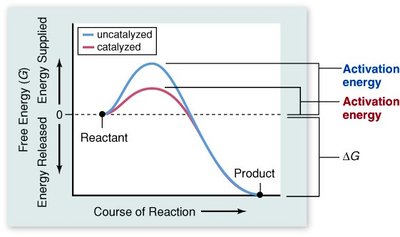
Most spontaneous reactions require an initial input of energy (activation energy) to begin. Enzymes, as biological catalysts, lower the activation energy required, facilitating reactions in cells.
ATP: The Energy Currency of the Cell
Structure and Function of ATP
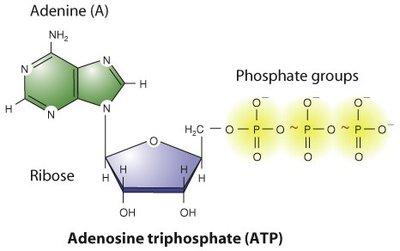
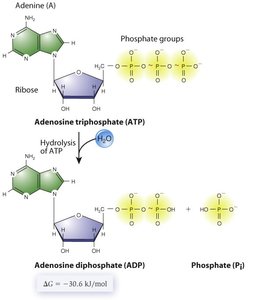
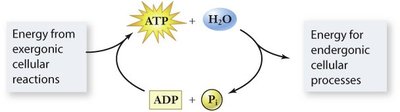
ATP (adenosine triphosphate) stores energy in its phosphate bonds. Hydrolysis of ATP to ADP (adenosine diphosphate) and inorganic phosphate (Pi) is highly exergonic, releasing energy for cellular work.
ATP Cycle and Coupled Reactions
Cells use exergonic reactions to synthesize ATP from ADP and Pi, then hydrolyze ATP to power endergonic reactions. Most cells maintain only a few seconds' supply of ATP and continuously produce more.
Electron Carriers and Redox Reactions
Electron Carriers
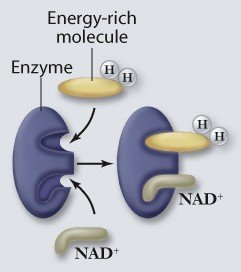
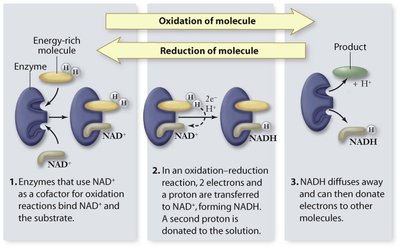
Electron carriers, such as NAD+ (nicotinamide adenine dinucleotide) and FAD (flavin adenine dinucleotide), transport electrons during cellular respiration. Their reduced forms, NADH and FADH2, carry energy to other molecules.
Mechanism of Electron Transfer
Redox reactions involve the transfer of electrons. The reduced form of a molecule is at a higher energy level than the oxidized form. NAD+ receives electrons from hydrogen atoms, becoming NADH, which then carries reducing power to other molecules.
Aerobic Respiration
Overview of Pathways
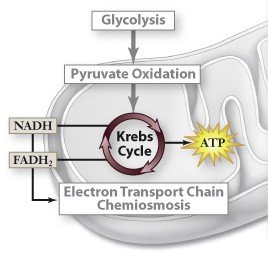
Cellular respiration includes catabolic pathways that break down energy-rich compounds to produce ATP. Aerobic respiration requires oxygen and occurs in multiple cellular locations.
The overall equation for aerobic respiration is:
Summary Table: Metabolic Pathways
Process | Location | Yield of ATP/Reducing Power |
|---|---|---|
Glycolysis | cytosol | 2 NADH, 2 ATP |
Pyruvate oxidation | mitochondrial matrix | 2 NADH |
Krebs cycle | mitochondrial matrix | 6 NADH, 2 FADH2, 2 ATP |
Oxidative phosphorylation | inner mitochondrial membrane | ~30-32 ATP |
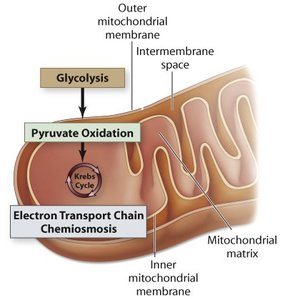
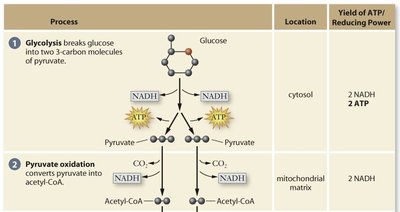
Glycolysis
Pathway and Reactions
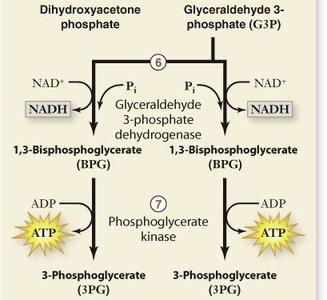
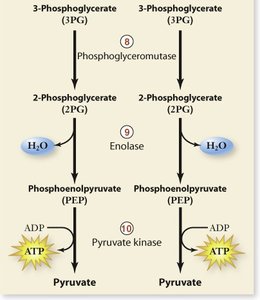
Glycolysis is a ten-step pathway that breaks down glucose into two molecules of pyruvate, producing ATP and NADH. The first five reactions convert glucose to two molecules of G3P (glyceraldehyde 3-phosphate).
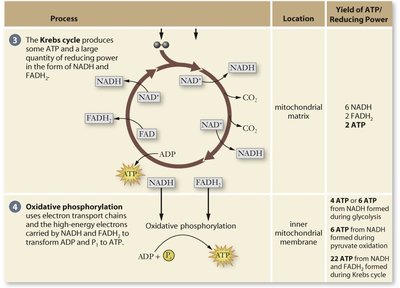
The next five reactions (6-10) convert G3P to pyruvate, generating ATP and NADH.
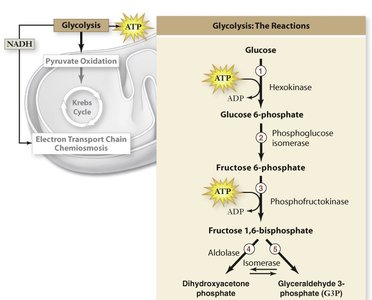
Pyruvate Oxidation
Mechanism and Products
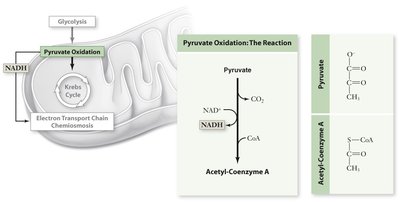
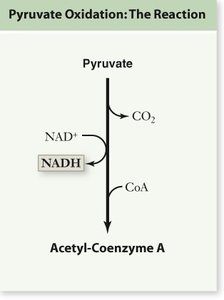
Pyruvate oxidation occurs in the mitochondrial matrix, converting pyruvate into acetyl-CoA and NADH. Each glucose molecule yields two acetyl-CoA and two NADH. Acetyl-CoA enters the Krebs cycle for further oxidation.
The Krebs Cycle
Cycle Overview
The Krebs cycle is a series of nine reactions that completes the breakdown of glucose to carbon dioxide. Each acetyl-CoA enters the cycle separately, producing CO2, NADH, FADH2, and ATP.
Reactions and Yield
Substrate-level phosphorylation, oxidation, and regeneration of oxaloacetate occur, resulting in the net production of 3 NADH, 1 FADH2, and 1 ATP per acetyl-CoA.
Oxidative Phosphorylation
Electron Transport Chain and Chemiosmosis
Oxidative phosphorylation couples the oxidation of NADH and FADH2 by the electron transport chain with ATP synthesis via chemiosmosis. Oxygen acts as the final electron acceptor, forming water.
Mechanism
Electrons from NADH and FADH2 are passed through protein complexes, pumping hydrogen ions to create a gradient.
Hydrogen ions flow back through ATP synthase, driving ATP production.
Yield of ATP from Aerobic Respiration
ATP Production
Each NADH can produce up to 3 ATP, and each FADH2 up to 2 ATP. Eukaryotes typically generate 30-32 ATP per glucose, while prokaryotes can produce up to 38 ATP due to differences in membrane transport.
Regulation of Aerobic Catabolic Pathways
Feedback Mechanisms
Cells regulate ATP production through feedback inhibition. Key enzymes include:
Phosphofructokinase (glycolysis): Inhibited by excess ATP or citrate; activated by ADP.
Pyruvate dehydrogenase (pyruvate oxidation): Inhibited by excess NADH.
Anaerobic Respiration and Fermentation
Anaerobic Respiration
In anaerobic respiration, molecules other than oxygen (e.g., sulfate, nitrate, carbon dioxide) serve as the final electron acceptors. Bacteria can switch to nitrate reduction when oxygen is unavailable.
Summary equation:
Methanogenesis
Methanogens use hydrogen ions and carbon dioxide to produce methane and water:
Fermentation
Fermentation transfers electrons from NADH to an organic acceptor, producing ATP only from glycolysis. Pathways include lactate and ethanol fermentation.
Lactate fermentation: Pyruvate is converted to lactate, reoxidizing NADH to NAD+. Oxygen is required to metabolize lactate, creating an oxygen debt.
Ethanol fermentation: Yeast and some bacteria convert pyruvate to ethanol and CO2, reoxidizing NADH. Used in food and drink industries.
Bioaugmentation: Metabolic Processes and Waste Clean-up
Applications of Metabolic Pathways
Some bacteria can metabolize substances problematic for human disposal, such as petroleum. Bioaugmentation uses specific microbes to break down waste, offering advantages like lower cost, in situ treatment, and reduced environmental impact. However, maintaining optimal conditions for microbial activity can be challenging.
Section Review: Metabolism and Energy
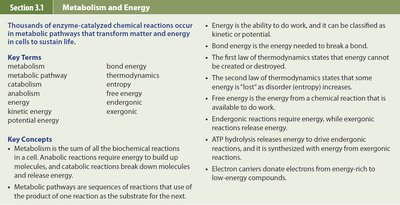
Key Terms: metabolism, metabolic pathway, catabolism, anabolism, energy, kinetic energy, potential energy, bond energy, thermodynamics, entropy, free energy, endergonic, exergonic.
Key Concepts: Metabolism is the sum of all biochemical reactions. Anabolic reactions build molecules; catabolic reactions break them down. Metabolic pathways are sequences of reactions. Energy is the ability to do work. The first law of thermodynamics states energy cannot be created or destroyed. The second law states entropy increases. Free energy is the energy from a chemical reaction that is available to do work. Endergonic reactions require energy; exergonic reactions release energy. ATP hydrolysis releases energy to drive endergonic reactions. Electron carriers donate electrons from energy-rich to low-energy compounds.
