 Indietro
Energy and Enzymes: An Introduction to Metabolism (Chapter 8 Study Notes)
Guida di studio - Note intelligenti
 Appunti personalizzati basati sui tuoi materiali, ampliati con definizioni chiave, esempi e contesto.
Energy and Enzymes: An Introduction to Metabolism
Overview of Chapter 8
This chapter explores how energy is managed and utilized in biological systems, focusing on the role of enzymes in driving the chemical reactions essential for life. It covers the nature of energy in cells, how enzymes function, and the regulation of metabolic pathways.
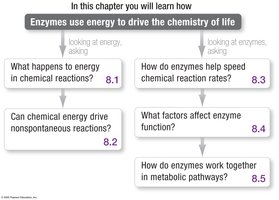
8.1 What Happens to Energy in Chemical Reactions?
Types of Energy
Energy is fundamental to all cellular processes and exists in two main forms:
Kinetic Energy: The energy of motion. In biological systems, this is often observed as thermal energy, which is the energy of molecules moving.
Potential Energy: The energy stored due to position or configuration. In cells, chemical energy is stored in the bonds of molecules.
Energy can be transformed from one type to another, such as from potential to kinetic energy during chemical reactions.
Chemical Bonds and Potential Energy
The amount of potential energy in a covalent bond depends on the position of shared electrons relative to the nuclei of bonded atoms.
Longer, weaker bonds with equally shared electrons have higher potential energy, while shorter, stronger bonds with unequally shared electrons have lower potential energy.
8.2 Nonspontaneous Reactions May Be Driven Using Chemical Energy
Energetic Coupling
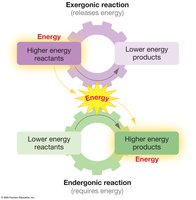
Cells often need to drive nonspontaneous (endergonic) reactions using the energy released from spontaneous (exergonic) reactions. This process is called energetic coupling and occurs via:
Transfer of electrons (redox reactions)
Transfer of phosphate groups
Redox Reactions
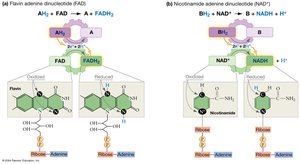
Reduction–oxidation (redox) reactions involve the transfer of electrons:
Oxidation: Loss of electrons (exergonic)
Reduction: Gain of electrons (endergonic)
These reactions always occur together and represent energetic coupling of two half-reactions.
Electron carriers such as FAD and NAD+ play key roles in transferring electrons and energy within cells.
ATP: The Energy Currency of the Cell
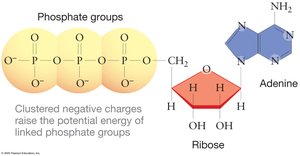
Adenosine triphosphate (ATP) is the primary energy carrier in cells. It consists of three phosphate groups, ribose, and adenine. The clustered negative charges on the phosphate groups store a large amount of potential energy.
ATP Hydrolysis
ATP hydrolysis is a highly exergonic reaction, releasing about 7.3 kcal/mol of energy.
This energy is used to drive endergonic reactions in cells, often through phosphorylation (the addition of a phosphate group to a molecule).
8.3 How Enzymes Work
Activation Energy and Transition State
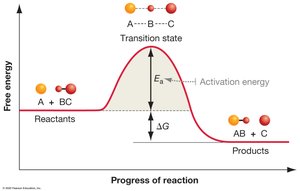
For a chemical reaction to proceed, reactants must overcome an energy barrier known as activation energy (E_a). The transition state is the high-energy intermediate between reactants and products.
Role of Enzymes
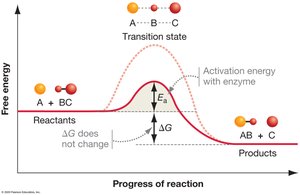
Enzymes are biological catalysts that lower the activation energy required for reactions, making them proceed faster.
They bring substrates together in precise orientations and stabilize the transition state.
Enzyme-Substrate Interaction
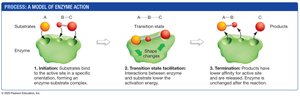
Substrates bind to the enzyme's active site, forming an enzyme-substrate complex.
Binding often induces a conformational change in the enzyme, known as induced fit.
Enzymes are specific for their substrates and reactions.
Cofactors, Coenzymes, and Prosthetic Groups
Cofactors: Inorganic ions (e.g., Zn2+, Mg2+, Fe2+) that assist enzyme function.
Coenzymes: Organic molecules (e.g., NADH, FADH2) that interact with enzymes.
Prosthetic groups: Non-amino acid molecules permanently attached to enzymes.
8.4 What Factors Affect Enzyme Function?
Factors Influencing Enzyme Activity
Enzyme structure is critical to function and is sensitive to changes in:
Temperature
pH
Interactions with other molecules
Modifications of protein structure
Enzyme Regulation
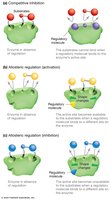
Enzyme activity is regulated by molecules that can activate or inhibit their function. Regulation can occur via:
Competitive inhibition: A molecule competes with the substrate for the active site.
Allosteric regulation: A molecule binds at a site other than the active site, causing a conformational change that can activate or inhibit the enzyme.
Covalent Modifications
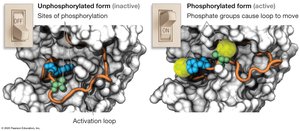
Enzyme activity can also be regulated by covalent modifications, such as phosphorylation.
Phosphorylation can activate or deactivate enzymes by changing their shape.
Some modifications are reversible, while others (e.g., peptide bond cleavage) are irreversible.
8.5 Enzymes Can Work Together in Metabolic Pathways
Metabolic Pathways
Metabolic pathways are ordered series of chemical reactions, each catalyzed by a specific enzyme, that build up or break down biological molecules.
Feedback Inhibition
Feedback inhibition is a regulatory mechanism where the end product of a pathway inhibits an enzyme involved earlier in the pathway.
This prevents the cell from wasting resources and allows for efficient regulation of metabolic processes.
Summary Table: Types of Enzyme Regulation
Type of Regulation | Mechanism | Effect |
|---|---|---|
Competitive Inhibition | Inhibitor binds to active site | Blocks substrate binding |
Allosteric Regulation | Regulator binds to allosteric site | Changes enzyme shape; can activate or inhibit |
Covalent Modification | Chemical group (e.g., phosphate) added/removed | Activates or deactivates enzyme |
Feedback Inhibition | End product inhibits pathway enzyme | Prevents overproduction of product |
Additional info: Enzyme regulation is essential for maintaining homeostasis and responding to changes in the cellular environment. Many drugs and toxins act by inhibiting specific enzymes, highlighting their importance in health and disease.
