 Indietro
Energy and Enzymes: An Introduction to Metabolism (Chapter 8 Study Notes)
Guida di studio - Note intelligenti
 Appunti personalizzati basati sui tuoi materiali, ampliati con definizioni chiave, esempi e contesto.
Energy and Enzymes: An Introduction to Metabolism
Overview
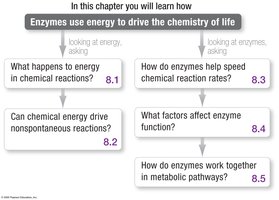
This chapter explores how energy and enzymes drive the chemistry of life, focusing on the principles of metabolism, energy transformations, and enzyme function. Understanding these concepts is fundamental to studying biological processes at the molecular level.
Energy in Chemical Reactions
Types of Energy
Energy is essential for cellular activities and exists in two main forms:
Kinetic energy: The energy of motion, including thermal energy (movement of molecules).
Potential energy: Energy stored in position or configuration, such as chemical energy in bonds.
Energy can be transformed from one type to another during chemical reactions.
Chemical Bonds and Potential Energy
The potential energy in covalent bonds depends on the position of shared electrons relative to the nuclei:
Longer, weaker bonds with equally shared electrons have high potential energy.
Shorter, stronger bonds with unequally shared electrons have low potential energy.
Energetic Coupling and Driving Nonspontaneous Reactions
Energetic Coupling
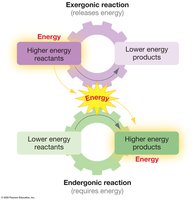
Cells use energetic coupling to drive nonspontaneous (endergonic) reactions by linking them to spontaneous (exergonic) reactions. This occurs via:
Transfer of electrons
Transfer of phosphate groups
Redox Reactions
Reduction–oxidation (redox) reactions involve electron transfer:
Oxidation: Loss of electrons (exergonic)
Reduction: Gain of electrons (endergonic)
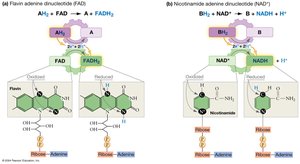
Redox reactions often involve transfer of electrons accompanied by protons (H+), increasing the potential energy of electron acceptors.
Electron Carriers
Key electron carriers in cells:
Flavin adenine dinucleotide (FAD): Accepts two electrons and two protons to form FADH2.
Nicotinamide adenine dinucleotide (NAD+): Accepts two electrons and one proton to form NADH.
ATP: The Energy Currency of the Cell
Structure and Function of ATP
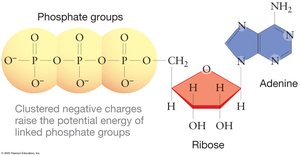
Adenosine triphosphate (ATP) is the primary energy carrier in cells. It consists of:
Three phosphate groups (high potential energy due to negative charges)
Ribose sugar
Adenine base
ATP Hydrolysis
ATP hydrolysis releases free energy:
ATP reacts with water, breaking the bond between the outermost phosphate group.
Produces ADP and inorganic phosphate (Pi).
Highly exergonic reaction, releasing about 7.3 kcal/mol.
Cells use this energy for cellular activities rather than losing it as heat.
Phosphorylation and Energetic Coupling
Phosphorylation is the addition of a phosphate group to a target molecule, increasing its potential energy and enabling endergonic reactions to proceed.
How Enzymes Work
Activation Energy and Transition State
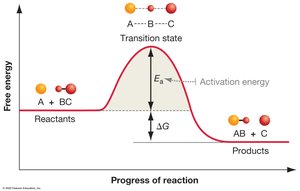
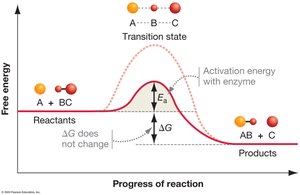
Enzymes lower the activation energy required for reactions by stabilizing the transition state—the intermediate point between breaking old bonds and forming new ones.
Enzyme Catalysis
Enzymes are biological catalysts that:
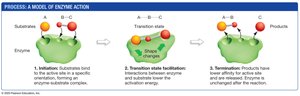
Bring substrates together in precise orientations
Increase the likelihood of reactions
Are specific for particular reactions
Substrates bind to the enzyme's active site, often causing an induced fit—a conformational change in the enzyme.
Enzymes Lower Activation Energy
Enzymes hold substrates in place via hydrogen bonding and weak interactions, destabilizing bonds to form the transition state and decreasing activation energy.
Enzyme Helpers
Enzyme function often requires additional molecules:
Cofactors: Inorganic ions (e.g., Zn2+, Mg2+, Fe2+)
Coenzymes: Organic molecules (e.g., NADH, FADH2)
Prosthetic groups: Non-amino acid atoms or molecules permanently attached to proteins
Factors Affecting Enzyme Function
Environmental and Structural Factors
Enzyme activity is sensitive to:
Temperature
pH
Interactions with other molecules
Modifications of protein structure
Enzyme Regulation
Enzymes are regulated by molecules that change their structure or ability to bind substrates, either activating or inactivating their function.
Noncovalent Regulation
Reversible regulatory interactions include:
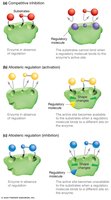
Competitive inhibition: Regulatory molecule competes with substrate for active site.
Allosteric regulation: Regulatory molecule binds elsewhere, changing enzyme shape and activity.
Covalent Modifications
Regulation may involve covalent changes to the enzyme's primary structure:
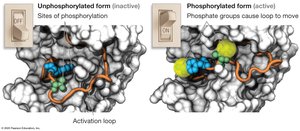
Can be reversible (e.g., phosphorylation) or irreversible (e.g., cleavage of peptide bonds).
Phosphorylation is the most common reversible modification, altering enzyme shape and activity.
Enzymes in Metabolic Pathways
Metabolic Pathways
Metabolic pathways are series of reactions, each catalyzed by a different enzyme, that build or break down biological molecules.
Feedback Inhibition
Feedback inhibition regulates metabolic pathways:
Final product inhibits an enzyme in the pathway.
Prevents depletion of initial substrate.
Allows efficient use and storage of resources.
Key Terms and Concepts
Metabolism: All chemical reactions in a cell
Exergonic reaction: Releases energy
Endergonic reaction: Requires energy
Activation energy (Ea): Energy required to initiate a reaction
Transition state: High-energy intermediate during a reaction
Feedback inhibition: Regulation of pathway by its end product
Important Equations
Free energy change:
ATP hydrolysis:
Summary Table: Types of Enzyme Regulation
Type | Mechanism | Effect |
|---|---|---|
Competitive Inhibition | Regulatory molecule binds active site | Blocks substrate binding |
Allosteric Regulation | Regulatory molecule binds elsewhere | Changes enzyme shape; can activate or inhibit |
Covalent Modification | Enzyme structure altered by chemical change (e.g., phosphorylation) | Activates or deactivates enzyme |
Example: Feedback inhibition in amino acid biosynthesis prevents overproduction and conserves cellular resources.
