 Indietro
Energy and Enzymes: An Introduction to Metabolism (Chapter 8 Study Notes)
Guida di studio - Note intelligenti
 Appunti personalizzati basati sui tuoi materiali, ampliati con definizioni chiave, esempi e contesto.
Energy and Enzymes: An Introduction to Metabolism
Overview of Chapter 8
This chapter explores how enzymes use energy to drive the chemistry of life, focusing on the principles of metabolism, energy transformations, and enzyme function. It covers the types of energy involved in biological reactions, the mechanisms by which enzymes catalyze reactions, and the regulation of metabolic pathways.
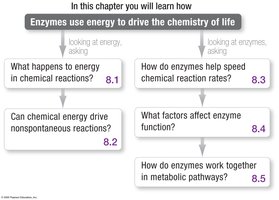
8.1 What Happens to Energy in Chemical Reactions?
Types of Energy
Biological systems utilize two main types of energy:
Kinetic energy: The energy of motion, including thermal energy (energy from molecular movement).
Potential energy: Energy stored in position or configuration, such as chemical energy stored in chemical bonds.
Energy can be transformed from one type to another during chemical reactions.
Chemical Bonds and Potential Energy
The potential energy in covalent bonds depends on the position of shared electrons relative to the nuclei of bonded atoms:
Longer, weaker bonds with equally shared electrons have high potential energy.
Shorter, stronger bonds with unequally shared electrons have low potential energy.
8.2 Nonspontaneous Reactions May Be Driven Using Chemical Energy
Energetic Coupling
Energetic coupling allows the energy released from exergonic reactions (spontaneous, energy-releasing) to drive endergonic reactions (nonspontaneous, energy-requiring). This coupling occurs via:
Transfer of electrons
Transfer of phosphate groups
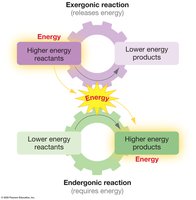
Redox Reactions
Reduction–oxidation (redox) reactions involve the transfer of electrons:
Oxidation: Loss of electrons (exergonic)
Reduction: Gain of electrons (endergonic)
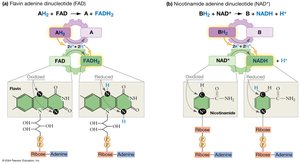
Redox reactions often involve electron carriers such as FAD and NAD+:
FAD accepts two electrons and two protons to form FADH2.
NAD+ accepts two electrons and one proton to form NADH.
ATP Transfers Energy via Phosphate Groups
Adenosine triphosphate (ATP) is the energy currency of cells. It stores potential energy in the bonds between its three negatively charged phosphate groups, which repel each other, raising the energy of the molecule.
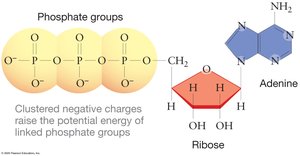
ATP Hydrolysis
ATP hydrolysis releases free energy:
ATP reacts with water, breaking the bond between the outermost phosphate group.
This forms ADP and releases about 7.3 kilocalories per mole of ATP.
Cells use this energy for cellular activities, not as heat.
Phosphorylation and Energetic Coupling
Phosphorylation adds a phosphate group to a target molecule, increasing its potential energy and enabling endergonic reactions to proceed.
8.3 How Enzymes Work
Activation Energy and Transition State
Enzymes lower the activation energy required for reactions by stabilizing the transition state—the intermediate point between breaking old bonds and forming new ones. The free energy of the transition state is high.
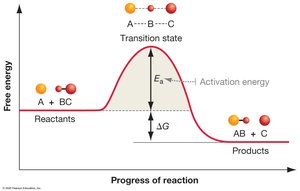
Enzyme Catalysis
Enzymes are biological catalysts that:
Bring reactants (substrates) together in precise orientations
Increase the likelihood of reactions
Are specific for a single type of reaction
Substrates bind to the enzyme's active site, often causing a conformational change called induced fit.
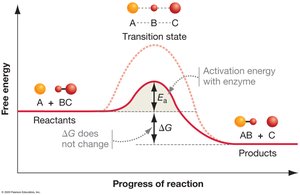
Enzymes Lower Activation Energy
Enzymes hold substrates in place via hydrogen bonding and weak interactions, destabilizing bonds to form the transition state and decreasing the activation energy required for the reaction.
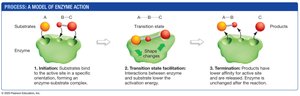
Model of Enzyme Action
Initiation: Substrates bind to the active site, forming an enzyme-substrate complex.
Transition state facilitation: Interactions between enzyme and substrate lower activation energy.
Termination: Products are released, and the enzyme is unchanged.
Enzyme Helpers
Cofactors: Inorganic ions (e.g., Zn2+, Mg2+, Fe2+) that reversibly interact with enzymes.
Coenzymes: Organic molecules (e.g., NADH, FADH2) that interact with enzymes.
Prosthetic groups: Non-amino acid atoms or molecules permanently attached to proteins.
8.4 What Factors Affect Enzyme Function?
Enzyme Structure and Function
The structure of an enzyme is critical to its function and is sensitive to:
Temperature
pH
Interactions with other molecules
Modifications of protein structure
Enzyme Regulation
Enzymes are regulated by molecules that change their structure or ability to bind substrates, either activating or inactivating their function.
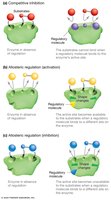
Noncovalent Regulation
Competitive inhibition: A molecule competes with the substrate for the active site.
Allosteric regulation: A molecule binds at a location other than the active site, causing a change in enzyme shape that can activate or deactivate the enzyme.
Covalent Modifications
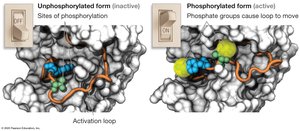
Regulation may involve covalent modifications, such as phosphorylation.
Phosphorylation is the most common reversible modification, changing enzyme shape and activity.
Irreversible changes often result from cleavage of peptide bonds.
8.5 Enzymes Can Work Together in Metabolic Pathways
Metabolic Pathways
A metabolic pathway is a series of reactions, each catalyzed by a different enzyme, that build biological molecules.
Feedback Inhibition
Feedback inhibition occurs when the final product of a pathway inhibits an enzyme earlier in the pathway. This prevents depletion of the initial substrate and allows regulation of pathway activity.
Summary Table: Types of Enzyme Regulation
Type | Mechanism | Effect |
|---|---|---|
Competitive Inhibition | Regulatory molecule competes for active site | Decreases enzyme activity |
Allosteric Regulation | Regulatory molecule binds elsewhere, changes shape | Can increase or decrease activity |
Covalent Modification | Phosphorylation or peptide bond cleavage | Activates or deactivates enzyme |
Key Equations:
Free energy change:
Activation energy: (energy required to reach transition state)
ATP hydrolysis:
Example: In glycolysis, ATP is used to phosphorylate glucose, increasing its potential energy and allowing subsequent reactions to proceed.
Additional info: Academic context was added to clarify enzyme mechanisms, regulation, and metabolic pathway concepts for completeness.
