 Indietro
Energy and Enzymes: An Introduction to Metabolic Pathways
Guida di studio - Note intelligenti
 Appunti personalizzati basati sui tuoi materiali, ampliati con definizioni chiave, esempi e contesto.
Energy and Enzymes: An Introduction to Metabolic Pathways
8.1: What Happens to Energy in Chemical Reactions?
Chemical reactions in biological systems involve the transformation of energy between different forms. Understanding these transformations is essential for grasping how cells perform work and maintain life.
Kinetic Energy: The energy of motion, used to perform work.
Potential Energy: Energy stored due to position or structure, such as in covalent bonds. The amount of potential energy in a bond depends on the position of electrons; electrons farther from the nucleus have higher potential energy.
Bond Energy: Electrons in nonpolar covalent bonds (e.g., C-H, C-C) have more potential energy than those in polar bonds (e.g., bonds with oxygen).
First Law of Thermodynamics: Energy cannot be created or destroyed, only transformed. For example, when an electron falls to a lower shell, potential energy is converted to kinetic energy, often released as heat or light.
Second Law of Thermodynamics: Every energy transformation increases entropy (disorder) in the system.
Exergonic Reactions: Catabolic reactions that release energy, are spontaneous, and result in products with lower potential energy and higher entropy than reactants.
Endergonic Reactions: Anabolic reactions that require energy input, are non-spontaneous, and result in products with higher potential energy and lower entropy than reactants.
8.2: Driving Non-Spontaneous Reactions with Chemical Energy
Cells use chemical energy to drive non-spontaneous reactions, often coupling them with energy-releasing reactions.
Energy can be supplied by transferring high-energy electrons or by transferring a phosphate group from ATP.
Redox Reactions: Involve the transfer of electrons. Oxidation is the loss of electrons, and reduction is the gain of electrons. These processes always occur together ("OIL RIG": Oxidation Is Loss, Reduction Is Gain).
Electron donors are oxidized, and electron acceptors are reduced. In cells, redox reactions often involve the transfer of hydrogen atoms (H), which include both an electron and a proton.
Coenzymes: NAD+ and FAD are important electron carriers in cells. They pick up electrons during oxidation and deliver them to other pathways.
NAD+ + 2e- + 2H+ → NADH + H+
FAD + 2e- + 2H+ → FADH2
Adenosine Triphosphate (ATP): The cell's energy currency, consisting of adenine, ribose, and three phosphate groups. Hydrolysis of ATP releases energy:
Phosphorylation: Addition of a phosphate group to a reactant, making the reaction more likely to occur.
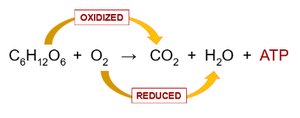
Redox Reaction Example: Cellular Respiration
The process of cellular respiration illustrates how glucose is oxidized and oxygen is reduced, resulting in the production of carbon dioxide, water, and ATP.
8.3: How Enzymes Work
Enzymes are biological catalysts that speed up chemical reactions in cells by lowering the activation energy required for the reaction to proceed.
Enzyme: An organic catalyst with a specific active site where substrates bind.
Substrate: The reactant(s) that bind to the enzyme's active site.
Enzyme Specificity: Each enzyme typically acts on a specific substrate due to the unique configuration of its active site.
Enzyme Naming: Enzymes often have names ending in "-ase" (e.g., lactase, dehydrogenase, ATP synthase).
Enzymes speed up reactions by:
Bringing substrates together in a precise orientation to facilitate bond formation or breakage.
Lowering the activation energy required to reach the transition state.
Enzymes are not consumed in the reaction and can be reused.
Models of Enzyme Action:
Lock-and-Key Model: Substrate fits exactly into the active site (original idea).
Induced Fit Model: Substrate binding induces a closer fit, facilitating the reaction (current model).
Limits to Catalysis: As substrate concentration increases, enzyme activity increases until all enzymes are saturated, reaching a maximum rate.
Cofactors: Some enzymes require cofactors (inorganic ions like Mg2+, Zn2+) or coenzymes (organic molecules like NAD+) to function. Many vitamins are essential for cofactor production.
8.4: Factors Affecting Enzyme Function
Enzyme activity is influenced by environmental conditions and regulatory mechanisms.
Temperature: Each enzyme has an optimal temperature range. Low temperatures slow reactions; high temperatures can denature enzymes.
pH: Each enzyme has an optimal pH range. Deviations can cause denaturation and loss of activity.
Enzyme Regulation:
Competitive Inhibition: Regulatory molecules resemble the substrate and bind to the active site, blocking substrate entry.
Allosteric Regulation: Regulatory molecules bind to a site other than the active site, changing the enzyme's shape and activity. Inhibitors make the enzyme inactive; activators make it active.
Some poisons act as enzyme inhibitors (e.g., organophosphates, cyanide, mercury, lead).
8.5: Enzymes in Metabolic Pathways
Enzymes often work together in multistep metabolic pathways, which can be anabolic (building molecules) or catabolic (breaking down molecules).
Each enzyme catalyzes a specific reaction in the pathway, similar to workers on an assembly line.
Feedback Inhibition: Surplus end product acts as an allosteric inhibitor of an early enzyme in the pathway, stopping the pathway until the surplus is used up.
Example: Feedback inhibition is a common mechanism for regulating metabolic pathways, ensuring that cells do not waste energy or resources.
