 Indietro
Energy and Enzymes: The Power Cycles of Life
Guida di studio - Note intelligenti
 Appunti personalizzati basati sui tuoi materiali, ampliati con definizioni chiave, esempi e contesto.
Energy and Metabolism
The Cell as a Factory
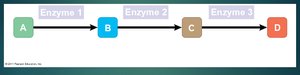
The cell operates as a factory, conducting millions of chemical reactions to extract and apply energy for work. The sum of all chemical reactions in an organism is called metabolism.
Metabolic pathway: A series of chemical reactions starting with reactants and ending with products, often catalyzed by enzymes.
Reactant(s) → Product(s): The transformation of molecules through metabolic pathways.
Types of Metabolic Pathways
Catabolic pathways: Break down complex molecules into simpler ones, releasing energy.
Anabolic pathways: Build complex molecules from simpler ones, requiring energy input.
Mnemonic: Catabolic = breaking down (think "cats break things").
Energy Concepts
What is Energy?
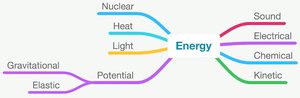
Energy: The ability to do work.
Work: Manipulation of matter.
Energy Transformation
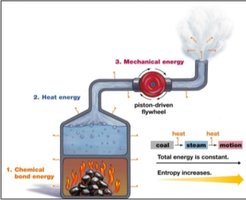
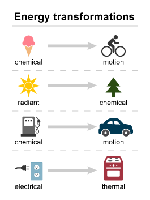
Energy can be transformed from one type to another, such as chemical to mechanical or electrical to thermal. 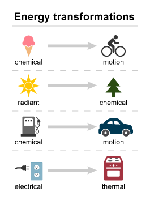
Potential vs Kinetic Energy
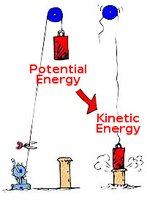
Potential energy: Stored energy available to do work.
Kinetic energy: Energy of motion; increases as movement increases.
Objects in motion but not at maximum movement possess both kinetic and potential energy.

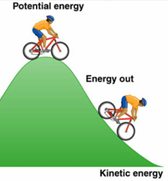
Examples of Potential and Kinetic Energy
Potential energy: A stretched bow, a rock held at height.
Kinetic energy: An arrow released, a rock falling.
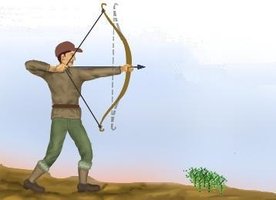
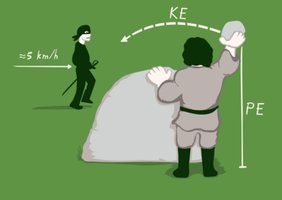
Energy Types in the Cell
Kinetic energy: Heat (thermal energy) from random movement of atoms/molecules.
Pote ntial energy: Chemical energy stored in bonds of macromolecules.
Cells convert energy from one form to another to perform work.
The Laws of Thermodynamics
Thermodynamics Overview
Thermodynamics studies energy transformations.
Isolated (closed) system: No energy transfer with surroundings.
Open system: Energy and matter can be exchanged with surroundings. Organisms are open systems.
The Three Laws of Thermodynamics
First Law (Conservation of Energy): Energy cannot be created or destroyed, only converted. Total energy remains constant.
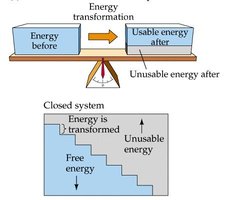
Second Law (Entropy): Entropy (disorder) in a closed system never decreases; energy conversions increase entropy.
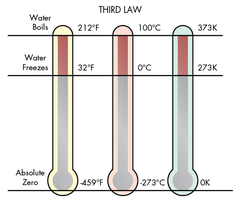
Third Law: The entropy of a pure/crystalline compound at 0 K is zero.
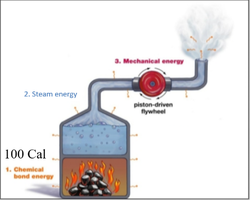
Entropy and Energy Loss
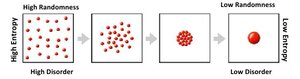
Entropy: Measure of disorder/randomness in a system.
Energy conversions always result in some energy lost as heat, increasing entropy.
Heat and Entropy
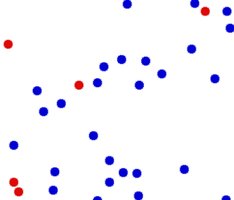
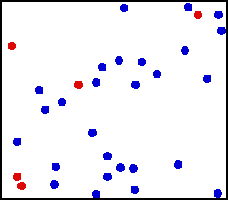
Heat increases random molecular movement, raising entropy.
At absolute zero (0 K), there is no movement and no entropy.
Energy Conversion Efficiency
Usable energy decreases with each transformation; total energy remains constant, but some is lost as heat.
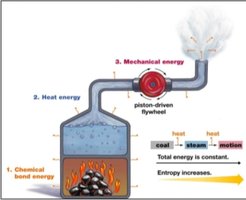
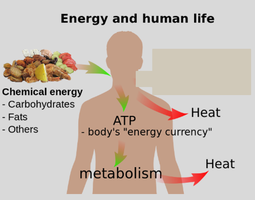
Energy in Biological Systems
When food is consumed, some energy is used for work (ATP), and some is lost as heat.
Total energy in a closed system remains constant.


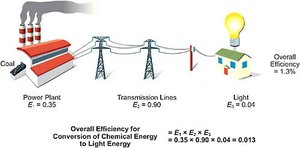
Conversion Efficiency Examples
Coal to electricity conversion is inefficient; much energy is lost as heat.
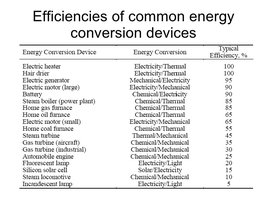
Device | Energy Conversion | Efficiency (%) |
|---|---|---|
Electric heater | Electricity/Thermal | 100 |
Hair dryer | Electricity/Thermal | 100 |
Electric generator | Mechanical/Electricity | 98 |
Battery | Chemical/Electricity | 90 |
Automobile engine | Chemical/Mechanical | 25 |
Incandescent lamp | Electricity/Light | 5 |
Additional info: | Table shows typical efficiency values for common devices. |
The Third Law: Absolute Zero
At 0 K, there is no molecular movement and no entropy (perfect order).
Free Energy and Chemical Reactions
Free Energy (G)
Free energy (G): Energy available to do work at constant temperature and pressure.
Change in free energy () relates to change in total energy (), change in entropy (), and temperature (T):
Exergonic vs Endergonic Reactions
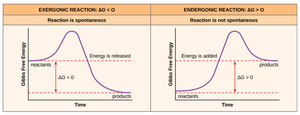
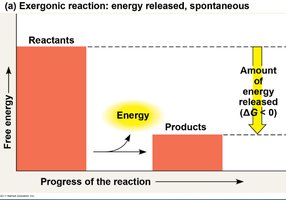
Exergonic: Net release of free energy; spontaneous.
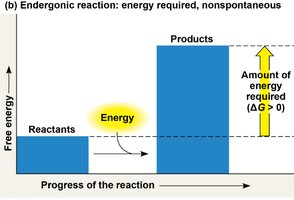
Endergonic: Absorbs free energy; nonspontaneous.
Hydrolysis vs Dehydration Synthesis
Hydrolysis: Breaking bonds using water; releases energy (often exergonic).
Dehydration synthesis: Forming bonds by removing water; requires energy (often endergonic).
ATP: The Cellular Energy Currency
Structure and Function of ATP
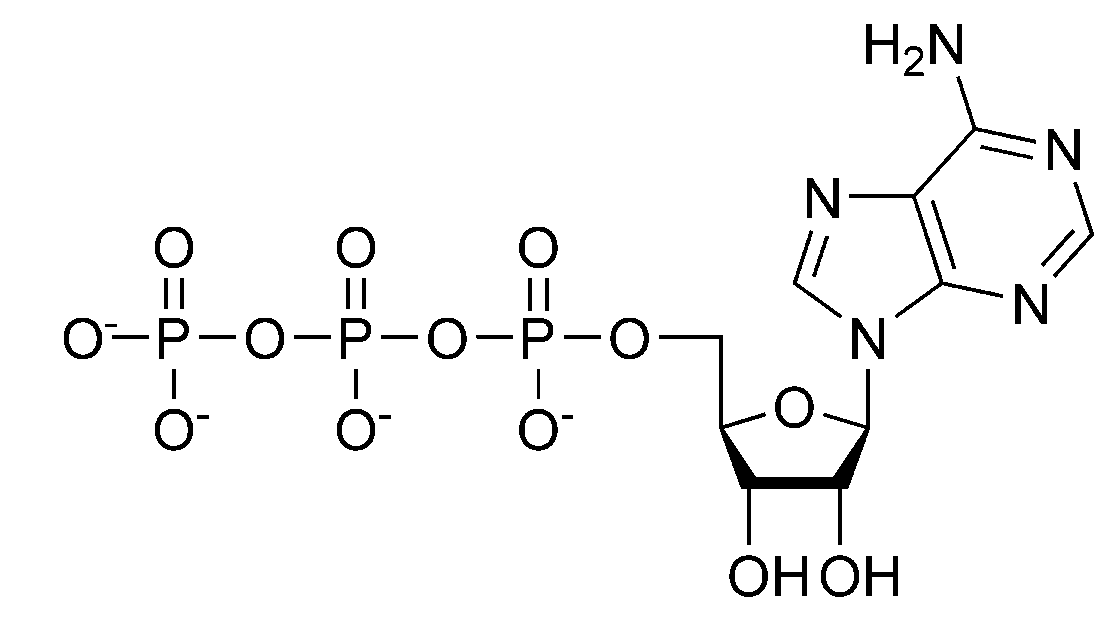
ATP (Adenosine 5'-triphosphate): Consists of adenine base, ribose sugar, and three phosphate groups.
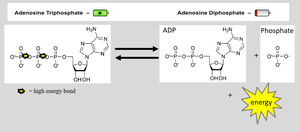
The terminal phosphate group can be broken off to release energy.
ATP Production and Usage
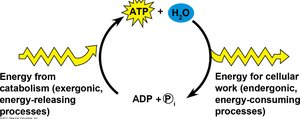
Cells produce and use ATP constantly; a single cell may use billions of ATP molecules per minute.
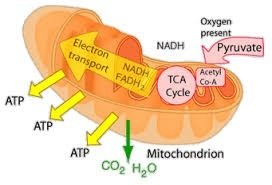
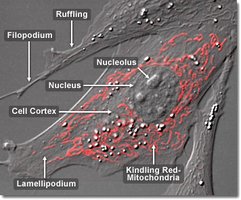
ATP is unstable and cannot be stored long-term; it is produced in mitochondria (cellular respiration) or chloroplasts (photosynthesis).
Enzymes and Metabolic Pathways
Role of Enzymes
Enzymes catalyze (speed up) metabolic reactions without being consumed.
Most enzymes are proteins, but some are RNA molecules.
Enzymes are essential for cell survival; reactions would be too slow without them.
Enzyme Mechanisms
Substrate: Molecule acted upon by the enzyme.
Enzyme-substrate complex: Temporary binding of enzyme and substrate.
Active site: Region where substrate binds.
Product: Result of the enzymatic reaction.
Models of Enzyme Action
Lock and Key Model: Substrate fits exactly into the active site, creating specificity.
Induced Fit Model: Active site changes shape to fit substrate upon binding.
Activation Energy
Activation energy (): Initial energy required to start a reaction.
Enzymes lower activation energy, making reactions proceed faster.
The total energy released or absorbed () does not change with enzyme presence.
Enzyme Regulation
Denaturing: Loss of enzyme shape (often irreversible), prevents substrate binding.
Competitive inhibition: Inhibitor binds to active site, blocking substrate.
Allosteric regulation: Molecule binds elsewhere, changing active site shape.
Feedback inhibition: End product shuts down pathway to prevent waste.
Summary Table: Exergonic vs Endergonic Reactions
Reaction Type | Energy Change | Spontaneity | Example |
|---|---|---|---|
Exergonic | Releases energy () | Spontaneous | Cellular respiration |
Endergonic | Absorbs energy () | Nonspontaneous | Photosynthesis |
Key Terms and Concepts
Metabolism: All chemical reactions in an organism.
Catabolic pathway: Breaks down molecules, releases energy.
Anabolic pathway: Builds molecules, requires energy.
ATP: Main energy currency of the cell.
Enzyme: Biological catalyst.
Activation energy: Energy needed to start a reaction.
Entropy: Measure of disorder.
Exergonic reaction: Releases energy, spontaneous.
Endergonic reaction: Absorbs energy, nonspontaneous.
Sample Questions
Which of the following are true of an endothermic reaction?
The reaction absorbs free energy.
The products will have higher free energy than the reactants.
Which of the following are true of an enzyme?
An enzyme is not always a protein.
An enzyme is never consumed in a reaction.
