Indietro
Energy and Enzymes: Thermodynamics in Biological Systems
Guida di studio - Note intelligenti
 Appunti personalizzati basati sui tuoi materiali, ampliati con definizioni chiave, esempi e contesto.
Energy and Enzymes: Thermodynamics
Overview of Chapter 8: Energy and Enzymes
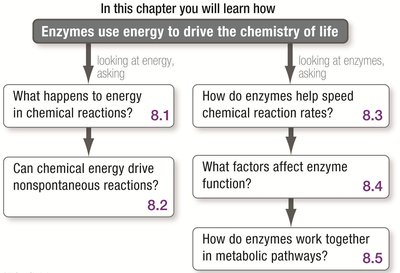
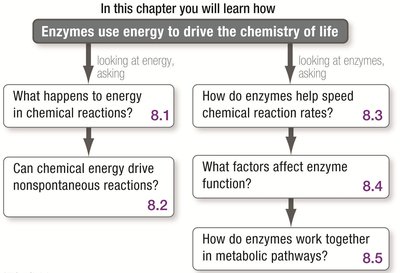
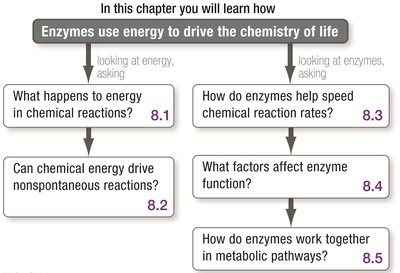
This chapter explores how biological systems use energy to drive the chemistry of life, focusing on the principles of thermodynamics and the role of enzymes in metabolic reactions. Key questions include how energy changes in chemical reactions, how nonspontaneous reactions are driven, and how enzymes facilitate these processes.
First Law of Thermodynamics
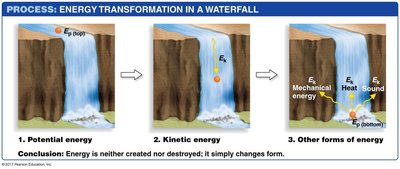
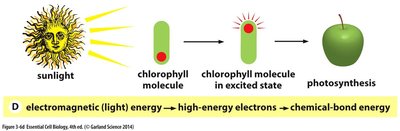
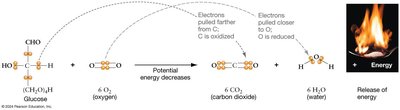
The first law of thermodynamics states that energy can be transformed from one type to another, but cannot be created or destroyed. In biological systems, potential energy stored in chemical bonds is used to perform work, such as driving chemical reactions. The amount of potential energy in these bonds is related to the position of electrons within molecules.
Potential Energy: Energy stored in chemical bonds, available to do work.
Kinetic Energy: Energy of motion, often resulting from the transformation of potential energy.
Energy Transformation: Energy changes form but is conserved in total amount.
Example: Waterfall: potential energy at the top is converted to kinetic energy and then to other forms (mechanical, heat, sound).
Potential Energy in Molecules
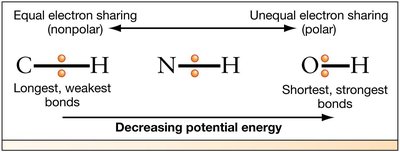
The potential energy in molecules depends on the nature of chemical bonds and the sharing of electrons. Nonpolar bonds (equal sharing) have higher potential energy than polar bonds (unequal sharing).
Bond Strength: Longer, weaker bonds (e.g., C-H) have higher potential energy.
Electron Sharing: Polar bonds (e.g., O-H) have lower potential energy due to stronger attraction.
Second Law of Thermodynamics
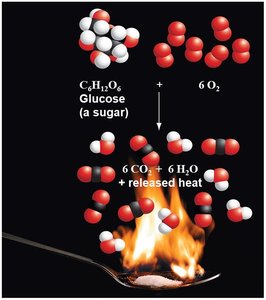
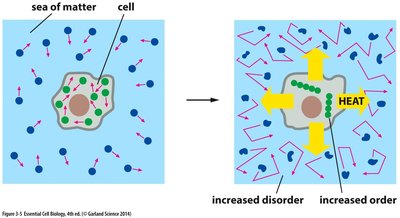
The second law of thermodynamics states that entropy (disorder) is always increasing. Physical and chemical processes proceed toward products with lower potential energy and greater disorder. Cells require energy to maintain order, but life processes increase the disorder of the universe overall.
Entropy: Measure of disorder; increases in spontaneous reactions.
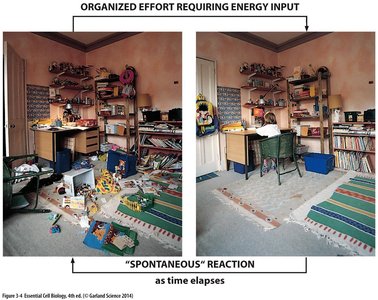
Order vs. Disorder: Organized systems require energy input; spontaneous processes lead to disorder.
Example: A tidy room becomes messy over time without energy input.
Metabolism: How Cells Get Energy
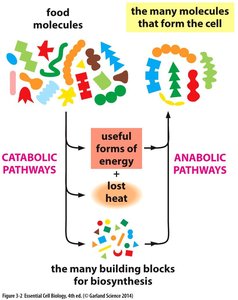
Cells acquire molecules from their environment, break some down to release energy, and use leftover monomers as building blocks for biosynthesis. Metabolism encompasses all these energy transformations.
Catabolic Pathways: Break down molecules to release energy.
Anabolic Pathways: Use energy to build complex molecules.
Chemical Reactions and Gibbs Free Energy
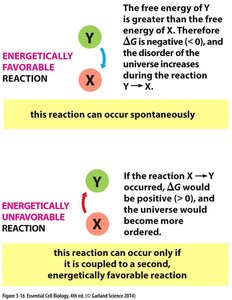
Chemical reactions involve energy transformations, which can be quantified using Gibbs free energy (G). The change in free energy () determines whether a reaction is spontaneous.
Gibbs Free Energy (): Energy available to do work.
Change in Free Energy ():
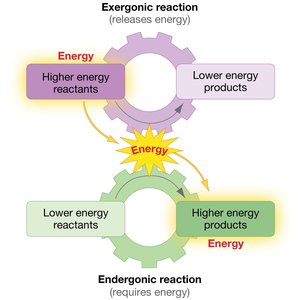
Spontaneous Reactions: (exergonic, favorable, increases entropy)
Nonspontaneous Reactions: (endergonic, unfavorable, decreases entropy)
Standard Free Energy Change () and Equilibrium
The standard free energy change () allows comparison of reaction energetics under standard conditions (1 M concentration, 25°C, 1 atm). At equilibrium, the concentrations of reactants and products remain constant, and the equilibrium constant () relates to .
Equilibrium Constant (): at equilibrium.
Relationship: where kcal/mol·K, K.
Interpretation: If , is negative (spontaneous); if , is positive (nonspontaneous).
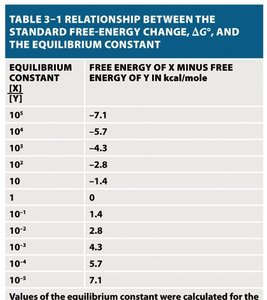
Equilibrium Constant [X]/[Y] | Free Energy of X minus Free Energy of Y (kcal/mole) |
|---|---|
105 | -7.1 |
104 | -5.7 |
103 | -4.3 |
102 | -2.8 |
101 | -1.4 |
1 | 0 |
10-1 | 1.4 |
10-2 | 2.8 |
10-3 | 4.3 |
10-4 | 5.7 |
10-5 | 7.1 |
Energetic Coupling and ATP
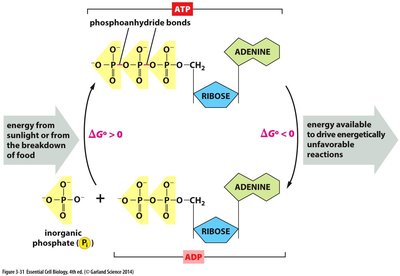
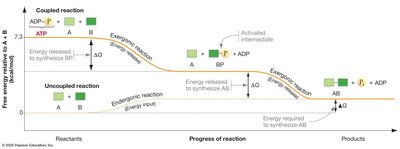
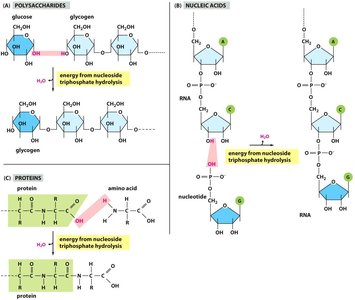
Nonspontaneous (endergonic) reactions can be driven by coupling them to spontaneous (exergonic) reactions. ATP (adenosine triphosphate) is the primary molecule used for energetic coupling in cells, transferring energy via phosphate groups.
Energetic Coupling: Exergonic reactions provide energy to drive endergonic reactions.
ATP Hydrolysis: ATP → ADP + Pi releases energy, which can be used to phosphorylate substrates.
Phosphorylation: Addition of a phosphate group increases the potential energy of substrates.
Enzymes: Kinases catalyze phosphorylation reactions.
Redox Reactions: Electron Transfer
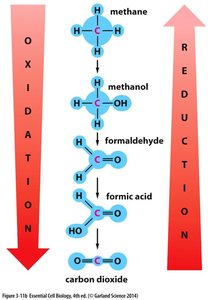
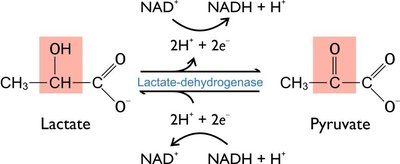
Reduction-oxidation (redox) reactions involve the transfer of electrons between molecules. Oxidation is the loss of electrons (exergonic), while reduction is the gain of electrons (endergonic). These reactions are often coupled, and electrons are usually transferred with protons (H+).
Oxidation: Loss of electrons or hydrogen; increases potential energy released.
Reduction: Gain of electrons or hydrogen; increases potential energy stored.
Enzymes: Dehydrogenases catalyze redox reactions.
Example: Lactate + NAD+ ⇌ Pyruvate + NADH + H+
Process | Definition | Example |
|---|---|---|
Oxidation | Loss of electrons/hydrogen | CH3OH → CH2O |
Reduction | Gain of electrons/hydrogen | CO2 → CH3OH |
Summary
Biological systems obey the laws of thermodynamics, transforming energy to drive life processes. Cells use energetic coupling, primarily via ATP, to drive nonspontaneous reactions. Redox reactions transfer energy through electron movement, and enzymes facilitate these processes, maintaining cellular order and function.