 Indietro
Energy and Metabolism: Foundations of Cellular Bioenergetics
Guida di studio - Note intelligenti
 Appunti personalizzati basati sui tuoi materiali, ampliati con definizioni chiave, esempi e contesto.
Energy & Metabolism
Introduction to Metabolism and Bioenergetics
Metabolism encompasses all chemical reactions within a cell, including those that generate or consume energy. Bioenergetics is the study of energy flow through living systems, such as cells, and is fundamental to understanding how organisms obtain, convert, and use energy to sustain life.
Metabolism is divided into two main types: anabolism (building up) and catabolism (breaking down).
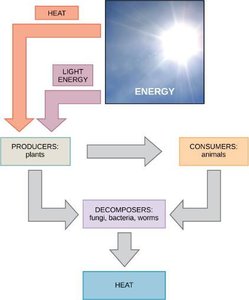
Energy transformations are central to metabolic processes, allowing cells to perform work and maintain order.
Metabolic Pathways
Organization of Metabolic Pathways
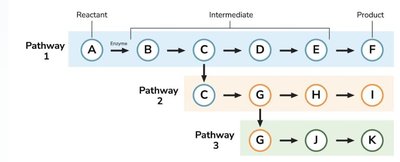
A metabolic pathway is a series of enzyme-catalyzed reactions that convert a starting molecule into a final product through a sequence of intermediates. Pathways can be linear, branched, or cyclic, and are tightly regulated to meet cellular needs.
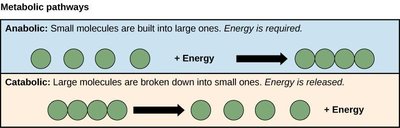
Catabolic pathways break down complex molecules into simpler ones, releasing energy (e.g., cellular respiration, fermentation).
Anabolic pathways build complex molecules from simpler ones, requiring energy input (e.g., photosynthesis, DNA replication).
Metabolic pathways are interconnected, allowing cells to efficiently manage resources and energy.
Anabolism vs. Catabolism
Metabolism is composed of both synthesis (anabolism) and degradation (catabolism) reactions. These processes are coupled to ensure energy balance within the cell.
Anabolic reactions require energy to build large molecules from small ones.
Catabolic reactions release energy by breaking down large molecules into smaller units.
Energy in Biological Systems
Forms of Energy
Energy is defined as the ability to do work or cause change. In biological systems, energy exists in various forms, including:
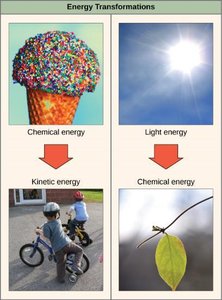
Kinetic energy: Energy of motion (e.g., movement of molecules, muscle contraction).
Potential energy: Stored energy due to position or structure (e.g., chemical bonds, concentration gradients).
Chemical energy: A form of potential energy stored in chemical bonds, especially important in biological molecules like ATP.
Thermodynamics in Biology
Biological systems obey the laws of thermodynamics, which govern energy transformations:
First Law of Thermodynamics: Energy cannot be created or destroyed, only transformed or transferred.
Second Law of Thermodynamics: Every energy transfer increases the entropy (disorder) of the universe; some energy is always lost as heat.
Heat energy is the energy transferred that is not used for work.
Enzymes: Structure, Function, and Regulation
Enzyme Structure and Function
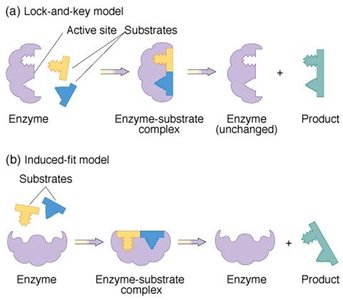
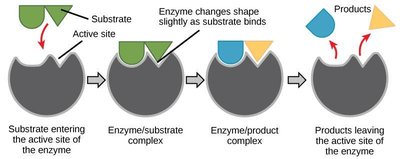
Enzymes are globular protein molecules that act as biological catalysts, speeding up chemical reactions without being consumed. They are highly specific for their substrates and often named with the suffix "-ase." The active site is the region where the substrate binds, and the induced-fit model describes how enzymes change shape to better fit the substrate during catalysis.
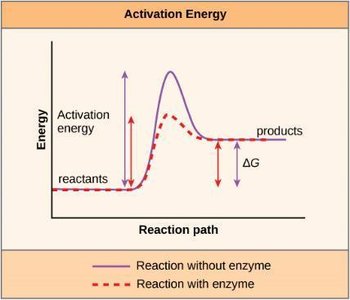
Enzymes lower the activation energy (Ea) required for a reaction, making it more likely to occur.
They do not change the overall free energy (ΔG) of the reaction.
Enzyme Regulation
Enzyme activity is regulated by environmental factors and molecules that affect enzyme structure and function:
Environmental factors: pH, temperature, and salinity can alter enzyme shape and activity.
Regulatory molecules: Can inhibit or activate enzymes, controlling metabolic pathways.
Cofactors: Inorganic ions (e.g., Fe2+, Ca2+) required for enzyme activity.
Coenzymes: Organic molecules (often vitamins) that assist enzyme function.
Types of Enzyme Inhibition
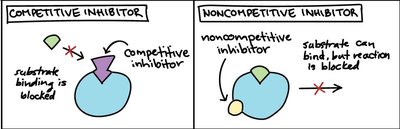
Competitive inhibition: Inhibitor binds to the active site, blocking substrate binding.
Noncompetitive inhibition: Inhibitor binds elsewhere, changing enzyme shape and preventing catalysis.
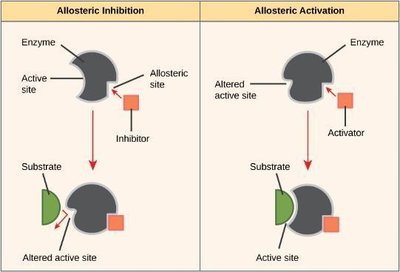
Allosteric inhibition: Inhibitor binds to an allosteric site, inducing a conformational change that reduces enzyme activity.
Allosteric activation: Activator binds to an allosteric site, enhancing enzyme activity by improving substrate fit.
Feedback Inhibition
Feedback inhibition is a regulatory mechanism where the end product of a metabolic pathway inhibits an upstream enzyme, preventing overproduction and conserving resources. This is a common method of metabolic control in cells.
Adenosine Triphosphate (ATP): The Energy Currency
Structure and Function of ATP
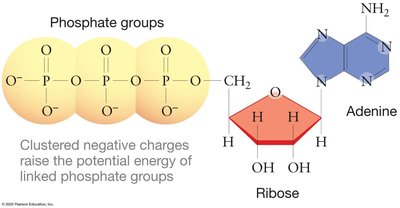
Adenosine triphosphate (ATP) is the primary energy carrier in cells. It consists of an adenine base, a ribose sugar, and three phosphate groups. The bonds between phosphate groups store significant potential energy due to repulsion between negatively charged phosphates.
ATP provides energy for most cellular activities and is also a building block for RNA synthesis.
ATP Hydrolysis and Energy Release
ATP is hydrolyzed (reacts with water), breaking the bond between the outermost phosphate group and releasing energy:
The reaction produces ADP (adenosine diphosphate) and inorganic phosphate (Pi).
This is a highly exergonic reaction, releasing about 7.3 kilocalories per mole of ATP.
Cells use the energy released from ATP hydrolysis to drive endergonic (energy-requiring) reactions by phosphorylation—transferring a phosphate group to another molecule, increasing its potential energy and making it more reactive.
Phosphorylation couples exergonic and endergonic reactions, enabling cellular work.
Summary Table: Anabolic vs. Catabolic Pathways
Pathway Type | Description | Energy Change | Example |
|---|---|---|---|
Anabolic | Builds large molecules from small ones | Requires energy input | Photosynthesis, DNA replication |
Catabolic | Breaks down large molecules into small ones | Releases energy | Cellular respiration, fermentation |
