Indietro
Energy and Metabolism: Principles and Mechanisms in Biological Systems
Guida di studio - Note intelligenti
 Appunti personalizzati basati sui tuoi materiali, ampliati con definizioni chiave, esempi e contesto.
Chapter 6: Energy and Metabolism
Flow of Energy in Biological Systems
All living organisms require energy to maintain order, grow, and reproduce. The study of how energy flows and changes within biological systems is governed by the principles of thermodynamics.
Thermodynamics is the branch of chemistry concerned with energy changes.
Cells and organisms are subject to the laws of physics and chemistry, especially regarding energy transformations.

Potential and Kinetic Energy
Energy exists in two main forms: potential and kinetic. These forms are interconvertible and essential for biological processes.
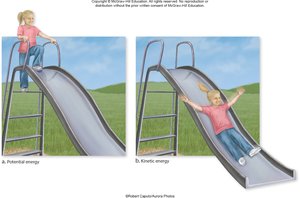
Potential energy is stored energy due to position or structure (e.g., a child at the top of a slide).
Kinetic energy is the energy of motion (e.g., the child sliding down).
Energy Flow in Ecosystems
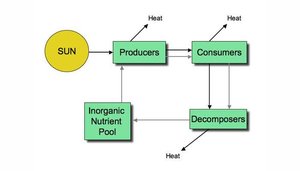
Energy enters ecosystems primarily through sunlight and flows through producers, consumers, and decomposers, with some energy lost as heat at each step.
Producers (e.g., plants) convert solar energy into chemical energy.
Consumers (e.g., animals) obtain energy by eating other organisms.
Decomposers recycle nutrients and energy from dead organisms.
Thermodynamics in Biology
First Law of Thermodynamics
The First Law of Thermodynamics states that energy cannot be created or destroyed, only transformed from one form to another. This principle underlies all biological energy transformations.
Energy input equals energy output plus energy lost as heat.
Cells convert energy from one form to another (e.g., chemical to mechanical).
Energy in Chemical Reactions
Anabolic and Catabolic Reactions
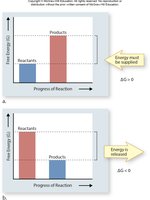
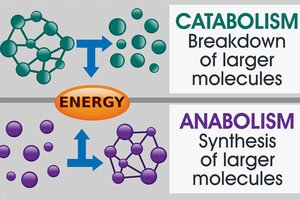
Metabolism encompasses all chemical reactions in a cell, divided into anabolic (building up) and catabolic (breaking down) pathways.
Anabolic reactions (endergonic): Build complex molecules from simpler ones; require energy input.
Catabolic reactions (exergonic): Break down complex molecules into simpler ones; release energy.
Activation Energy
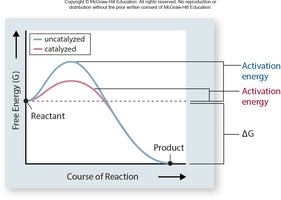
Activation energy is the minimum energy required to initiate a chemical reaction. It determines the rate at which reactions proceed.
Reactions with high activation energy proceed slowly.
Reaction rates can be increased by heating (raising energy of molecules) or by lowering activation energy using catalysts (e.g., enzymes).
ATP: The Energy Currency of the Cell
Structure and Function of ATP
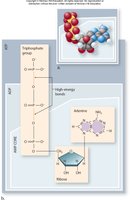
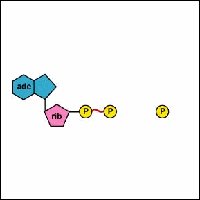
Adenosine triphosphate (ATP) is the primary energy carrier in cells. Its structure consists of adenine, ribose, and three phosphate groups.
ATP stores energy in its high-energy phosphate bonds.
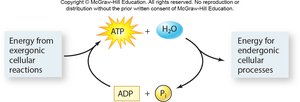
Hydrolysis of ATP releases energy for cellular work.
The ATP Cycle
ATP is continuously cycled in cells. It is hydrolyzed to ADP and inorganic phosphate, releasing energy, and then regenerated from ADP using energy from food molecules.
ATP hydrolysis drives endergonic (energy-requiring) reactions.
ATP is not suitable for long-term energy storage; fats and carbohydrates are used instead.
Enzymes: Biological Catalysts
Properties and Function of Enzymes
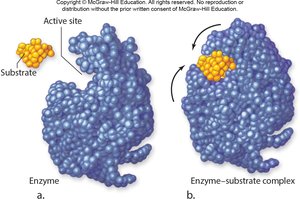
Enzymes are proteins that catalyze biochemical reactions by lowering activation energy, thus increasing reaction rates without being consumed.
Enzymes stabilize the transition state and facilitate substrate conversion to product.
Example: Carbonic anhydrase increases the rate of carbonic acid formation dramatically.
Factors Affecting Enzyme Activity
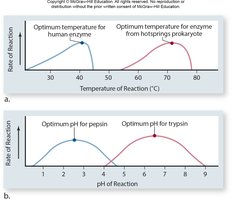
The rate of enzyme-catalyzed reactions depends on substrate and enzyme concentrations, as well as environmental conditions such as temperature and pH.
Each enzyme has an optimum temperature and pH for maximal activity.
Deviations from optimum conditions can denature the enzyme and reduce activity.
Enzyme Regulation and Inhibition
Enzyme Inhibitors
Enzyme activity can be regulated by inhibitors, which decrease enzyme function by different mechanisms.
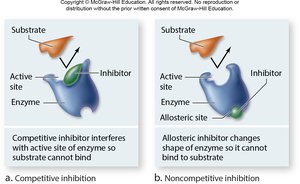
Competitive inhibitors bind to the active site, blocking substrate access.
Noncompetitive inhibitors bind to a site other than the active site (often the allosteric site), causing a conformational change that reduces enzyme activity.
Allosteric Regulation
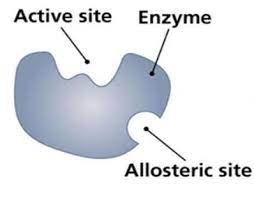
Allosteric enzymes can exist in active or inactive forms. Allosteric inhibitors or activators bind to the allosteric site, acting as chemical on/off switches for enzyme activity.
Allosteric inhibitor: Binds to allosteric site and reduces enzyme activity.
Allosteric activator: Binds to allosteric site and increases enzyme activity.
Biochemical Pathways and Feedback Inhibition
Biochemical Pathways
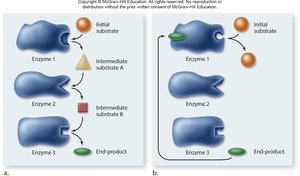
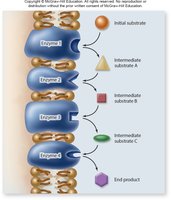
Cellular reactions are organized into metabolic pathways, where the product of one reaction serves as the substrate for the next. Many pathways are compartmentalized within specific organelles.
Pathways allow for regulation and efficient use of resources.
Feedback Inhibition
Feedback inhibition is a regulatory mechanism in which the end product of a pathway inhibits an enzyme involved earlier in the pathway, preventing overproduction and conserving resources.
As the end-product accumulates, it binds to an allosteric site on an enzyme, shutting down the pathway.
This ensures that raw materials and energy are not wasted.