Indietro
Energy and Metabolism: Study Notes for General Biology
Guida di studio - Note intelligenti
 Appunti personalizzati basati sui tuoi materiali, ampliati con definizioni chiave, esempi e contesto.
Energy and Metabolism
Flow of Energy in Living Systems
Energy is fundamental to all biological processes, enabling cells to perform work and maintain life. The study of energy transformations in biological systems is governed by the principles of thermodynamics.
Thermodynamics: Branch of chemistry concerned with energy changes. Cells obey the laws of physics and chemistry.
Energy: The capacity to do work. Exists in two main states:
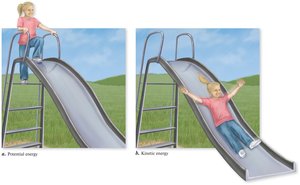
Kinetic energy: Energy of motion.
Potential energy: Stored energy.
Energy can take many forms: mechanical, heat, sound, electric current, light, or radioactivity.
Measuring Energy
Heat is the most convenient way to measure energy. The calorie is a unit of heat energy.
1 calorie: Heat required to raise 1 gram of water by 1°C.
Calorie (food labels): Actually a kilocalorie (1000 calories).
Energy Flow in Biological Systems
Energy enters the biological world primarily from the sun. Photosynthetic organisms capture solar energy and store it as potential energy in chemical bonds.
Breaking chemical bonds requires energy; energy stored in bonds can be used to form new bonds.
Redox Reactions
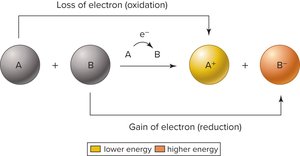
Oxidation-reduction (redox) reactions are essential for energy transfer in cells. These reactions involve the transfer of electrons between molecules.
Oxidation: Loss of electrons from an atom or molecule.
Reduction: Gain of electrons by an atom or molecule. The reduced form has a higher energy level than the oxidized form.
Redox reactions are always paired; one molecule is oxidized while another is reduced.
The Laws of Thermodynamics
Biological systems are governed by two fundamental laws of thermodynamics.
First Law: Energy cannot be created or destroyed; it can only change form. The total energy in the universe remains constant. Some energy is lost as heat during conversions.
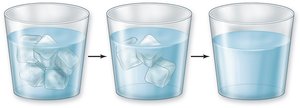
Second Law: Entropy (disorder) is continuously increasing. Energy transformations proceed spontaneously to convert matter from a more ordered/less stable form to a less ordered/more stable form.
Free Energy and Chemical Reactions
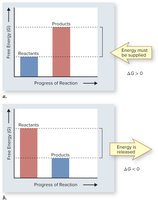
Free energy (G) is the energy available to do work in a system. The change in free energy () determines whether a reaction is spontaneous.
Formula: = enthalpy (energy in chemical bonds), = absolute temperature, = entropy (unavailable energy).
Change in Free Energy:
Positive : Products have more free energy than reactants; not spontaneous (endergonic).
Negative : Products have less free energy than reactants; spontaneous (exergonic).
Activation Energy
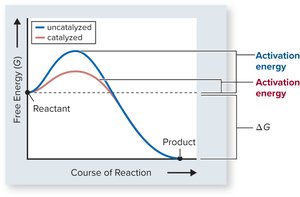
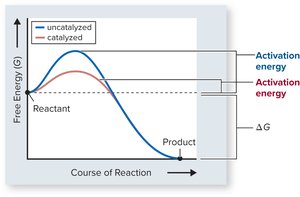
Activation energy is the extra energy required to destabilize existing bonds and initiate a chemical reaction. The rate of exergonic reactions depends on the activation energy required.
Higher activation energy means slower reaction rate.
Reaction rate can be increased by:
Increasing energy of reacting molecules (heating).
Lowering activation energy (catalysis).
Catalysts
Catalysts are substances that lower the activation energy of reactions without being consumed. They do not violate thermodynamic laws and cannot make endergonic reactions spontaneous.
Catalysts do not alter the proportion of reactant turned into product.
ATP: The Energy Currency of Cells
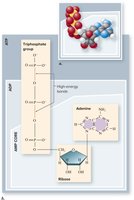
Adenosine triphosphate (ATP) is the primary energy carrier in cells. Its structure consists of ribose (a five-carbon sugar), adenine (a nitrogenous base), and three phosphate groups.
ATP bonds are unstable and release energy when broken.
ADP (adenosine diphosphate) has two phosphates; AMP (adenosine monophosphate) has one phosphate and is the lowest energy form.
The ATP Cycle
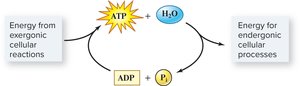
ATP hydrolysis drives endergonic reactions by coupling them to exergonic reactions, resulting in a net negative (spontaneous). ATP is not suitable for long-term energy storage due to unstable phosphate bonds.
Cells store only a few seconds' worth of ATP; fats and carbohydrates are better for long-term storage.
Enzymes: Biological Catalysts
Enzymes are mostly proteins (some are RNA) that stabilize temporary associations between substrates and facilitate chemical reactions. Enzymes are not changed or consumed in the reaction.
Example: Carbonic anhydrase increases reaction rate from 200 molecules/hour to 600,000 molecules/second.
Active Site and Induced Fit
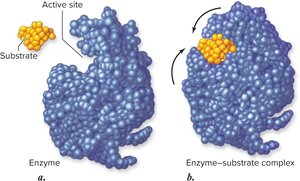
The active site is a pocket or cleft in the enzyme where substrate binding occurs, forming an enzyme–substrate complex. The precise fit applies stress to distort bonds and lower activation energy (induced fit).
The Catalytic Cycle of an Enzyme
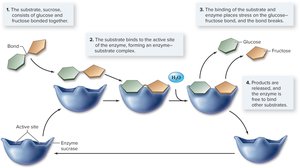
Enzymes operate in cycles, binding substrates, facilitating reactions, and releasing products.
Step 1: Substrate binds to active site.
Step 2: Enzyme–substrate complex forms.
Step 3: Bond is stressed and broken.
Step 4: Products are released; enzyme is ready for next cycle.
Forms of Enzymes
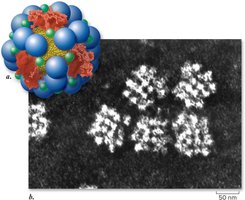
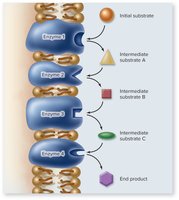
Enzymes may be suspended in the cytoplasm or attached to cell membranes and organelles. Multienzyme complexes allow efficient substrate transfer and control of reactions.
Product delivery to next enzyme is efficient.
Unwanted side reactions are prevented.
All reactions can be controlled as a unit.
Nonprotein Enzymes: Ribozymes
Some enzymes are RNA molecules (ribozymes). They catalyze reactions either on themselves (intramolecular) or on other molecules (intermolecular).
Enzyme Function and Environmental Effects
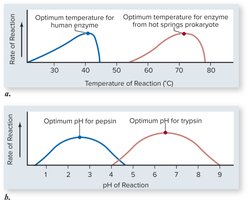
The rate of enzyme-catalyzed reactions depends on substrate and enzyme concentrations, as well as environmental conditions such as temperature and pH.
Optimum temperature and pH are required for maximum enzyme activity.
Enzyme Inhibition
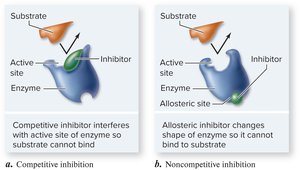
Enzyme activity can be decreased by inhibitors.
Competitive inhibitor: Competes with substrate for active site.
Noncompetitive inhibitor: Binds to a site other than the active site, causing a shape change that prevents substrate binding.
Allosteric Enzymes
Allosteric enzymes exist in active and inactive forms. Most noncompetitive inhibitors bind to allosteric sites, acting as chemical on/off switches.
Allosteric inhibitor: Reduces enzyme activity.
Allosteric activator: Increases enzyme activity.
Cofactors and Coenzymes
Cofactors assist enzymes and can be metal ions (e.g., zinc, molybdenum, manganese) often found in the active site. Coenzymes are nonprotein organic molecules (e.g., vitamins).
Metabolism: The Chemical Description of Cell Function
Metabolism is the sum of all chemical reactions in an organism. It includes:
Anabolic reactions (anabolism): Build up molecules, expending energy.
Catabolic reactions (catabolism): Break down molecules, harvesting energy.
Biochemical Pathways
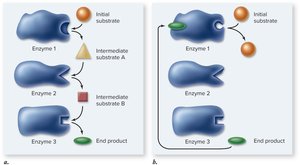
Biochemical reactions occur in sequences called pathways, where the product of one reaction is the substrate for the next. Many steps occur in specific organelles.
Feedback Inhibition
Feedback inhibition is a regulatory mechanism where the end-product of a pathway inhibits an enzyme early in the pathway, preventing waste of raw materials and energy.
End-product binds to an allosteric site, shutting down the pathway.