 Indietro
Energy, Enzymes, and Metabolism: An Introduction to Cellular Biochemistry
Guida di studio - Note intelligenti
 Appunti personalizzati basati sui tuoi materiali, ampliati con definizioni chiave, esempi e contesto.
Energy & Enzymes: An Introduction to Metabolism
Overview of Energy in Biological Systems
All living organisms rely on chemical reactions to sustain life, and these reactions are governed by the principles of energy transformation. Enzymes, as biological catalysts, play a central role in regulating the rate and specificity of these reactions.
Kinetic Energy (KE): The energy of motion, often observed as thermal energy (heat) in molecules.
Potential Energy (PE): The energy stored in chemical bonds, determined by the arrangement of electrons in covalent bonds.
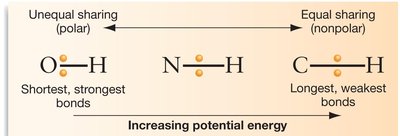
Example: Nonpolar covalent bonds (e.g., C–H) have higher potential energy than polar covalent bonds (e.g., O–H) due to more equal sharing of electrons.
Spontaneity of Chemical Reactions
Chemical reactions can be classified based on their energy changes and spontaneity:
Exergonic (Spontaneous) Reactions: Occur without input of energy. Products have less potential energy than reactants (ΔH < 0, exothermic) and/or increased disorder (ΔS > 0, increased entropy).
Endergonic (Nonspontaneous) Reactions: Require energy input. Products have more potential energy than reactants (ΔH > 0, endothermic) and/or decreased disorder (ΔS < 0, decreased entropy).
The spontaneity of a reaction is determined by the change in Gibbs free energy (ΔG):
ΔG < 0: Reaction is spontaneous (exergonic).
ΔG > 0: Reaction is nonspontaneous (endergonic).
Energetic Coupling in Cells
Cells drive nonspontaneous reactions by coupling them to spontaneous reactions, often through the transfer of electrons or phosphate groups.
Redox Reactions: Involve the transfer of electrons. The molecule losing electrons is oxidized, and the molecule gaining electrons is reduced ("LEO the lion says GER").
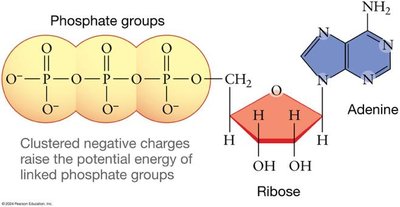
ATP Hydrolysis: The transfer of a phosphate group from ATP to another molecule releases energy, which can drive endergonic reactions.
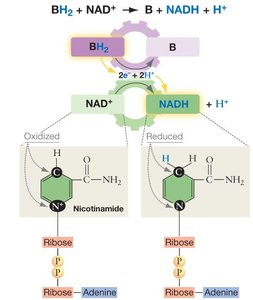
Example: NAD+ is reduced to NADH, storing high potential energy for cellular processes.
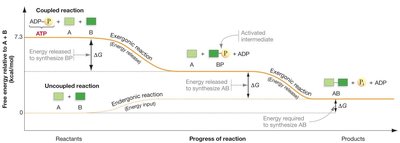
Example: ATP hydrolysis is coupled to an endergonic reaction, making the overall process spontaneous.
Enzymes and Reaction Rates
Activation Energy and the Role of Enzymes
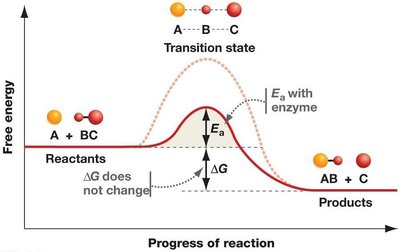
All chemical reactions require an initial input of energy, called activation energy (Ea), to reach the transition state. Enzymes lower this barrier, increasing the rate of reaction without being consumed.
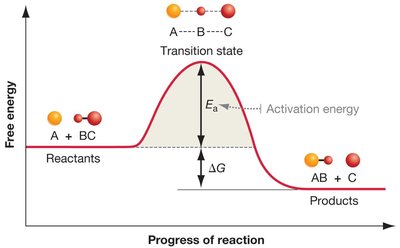
Transition State: The high-energy, unstable state that reactants must reach for the reaction to proceed.
Catalysts: Substances (like enzymes) that lower activation energy but do not change ΔG or the equilibrium of the reaction.
Mechanism of Enzyme Action
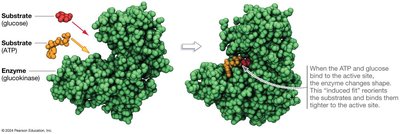
Enzymes accelerate reactions by binding substrates in their active site, stabilizing the transition state, and facilitating the conversion to products.
Induced Fit: Enzyme changes shape to better fit the substrate upon binding.
Enzyme-Substrate Complex: The temporary association between enzyme and substrate during catalysis.

Enzyme Kinetics and Substrate Concentration
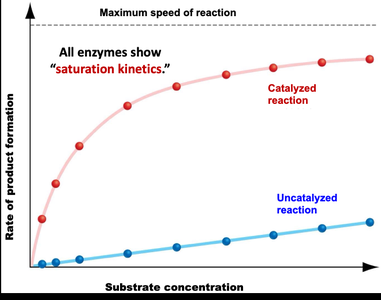
The rate of an enzyme-catalyzed reaction increases with substrate concentration until a maximum rate (Vmax) is reached, demonstrating saturation kinetics.
At low substrate concentrations: Reaction rate increases sharply with more substrate.
At high substrate concentrations: The enzyme becomes saturated, and the rate plateaus.
Factors Affecting Enzyme Activity
Enzyme activity is influenced by several factors:
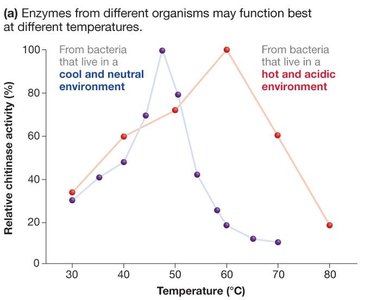
Temperature: Each enzyme has an optimal temperature for activity; too high or too low can denature the enzyme or slow the reaction.
pH: Each enzyme has an optimal pH; deviations can affect the ionization of amino acids and enzyme structure.
Concentration: Both enzyme and substrate concentrations affect reaction rates.
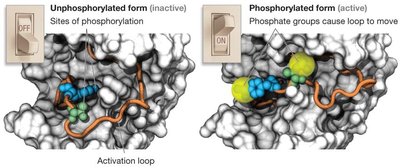
Enzyme Modifications: Chemical modifications, such as phosphorylation, can activate or deactivate enzymes.
Enzyme Helpers: Cofactors and Coenzymes
Many enzymes require non-protein molecules to function:
Cofactors: Inorganic ions (e.g., Zn2+, Mg2+, Fe2+) that assist enzyme activity.
Coenzymes: Organic molecules (e.g., vitamins, NADH, FADH2) that participate in catalysis.
Both types of helpers often interact with the active site and stabilize the transition state.
Regulation of Enzyme Activity
Mechanisms of Enzyme Regulation
Cells regulate enzyme activity to control metabolic pathways and respond to changing conditions.
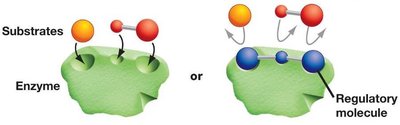
Competitive Inhibition: A molecule similar to the substrate binds to the active site, blocking substrate access.
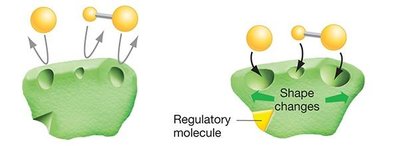
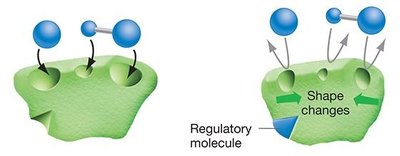
Allosteric Regulation: A regulatory molecule binds to a site other than the active site, causing a conformational change that affects enzyme activity.
Phosphorylation: Addition of a phosphate group can activate or deactivate enzymes by altering their structure.
Metabolic Pathways and Feedback Inhibition
Enzymes often function in metabolic pathways, where the product of one reaction becomes the substrate for the next. Feedback inhibition is a common regulatory mechanism in which the end product of a pathway inhibits an earlier enzyme, preventing overproduction.
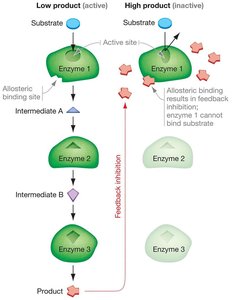
Example: When the concentration of the final product is high, it binds allosterically to the first enzyme in the pathway, shutting down further production.
Summary Table: Key Concepts in Enzyme Function and Regulation
Concept | Definition | Example |
|---|---|---|
Exergonic Reaction | Spontaneous, releases energy (ΔG < 0) | Cellular respiration |
Endergonic Reaction | Nonspontaneous, requires energy (ΔG > 0) | Photosynthesis |
Enzyme | Protein catalyst that lowers activation energy | Amylase, chitinase |
Cofactor | Inorganic ion helper | Mg2+ in DNA polymerase |
Coenzyme | Organic molecule helper | NADH, FADH2 |
Competitive Inhibition | Inhibitor binds active site | Sulfa drugs inhibiting folate synthesis |
Allosteric Regulation | Regulator binds elsewhere, changes enzyme shape | ATP inhibiting phosphofructokinase |
Feedback Inhibition | End product inhibits pathway | Isoleucine synthesis pathway |
Additional info: This guide integrates foundational concepts from Chapter 8 of a General Biology curriculum, focusing on energy transformation, enzyme structure and function, and regulatory mechanisms in metabolism. It is suitable for exam preparation and as a reference for understanding cellular biochemistry.
