 Indietro
Energy, Enzymes, and Metabolism: Study Guide for General Biology
Guida di studio - Note intelligenti
 Appunti personalizzati basati sui tuoi materiali, ampliati con definizioni chiave, esempi e contesto.
Energy and Chemical Reactions
Thermodynamics in Biology
Thermodynamics is the study of energy transformations and their effects on matter. In biological systems, these laws govern how energy is transferred and transformed during cellular processes.
First Law of Thermodynamics: Energy cannot be created or destroyed, only converted from one form to another.
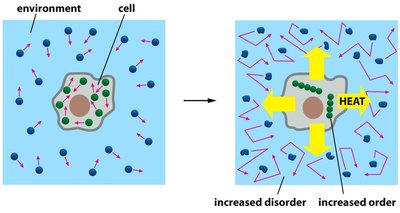
Second Law of Thermodynamics: Every energy transformation increases the entropy (disorder) of a system, resulting in a loss of usable energy.
Implication for Cells: Cells must continually acquire new energy to maintain life and order.
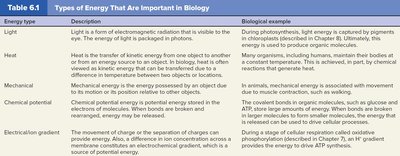
Types of Energy Important in Biology
Biological systems utilize various forms of energy to drive cellular processes. The main types include light, heat, mechanical, chemical potential, and electrochemical gradient.
Energy Type | Description | Biological Example |
|---|---|---|
Light | Electromagnetic radiation visible to the eye; energy is packaged in photons. | Photosynthesis: light captured by pigments to produce organic molecules. |
Heat | Transfer of kinetic energy between objects; often lost to the environment. | Organisms maintain body temperature via chemical reactions. |
Mechanical | Energy associated with movement of objects. | Muscle contraction, cell movement. |
Chemical Potential | Energy stored in chemical bonds. | ATP hydrolysis releases energy for cellular work. |
Electrochemical Gradient | Energy from charge separation across membranes. | ATP synthesis driven by gradients. |
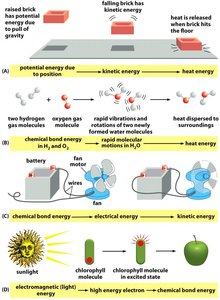
Kinetic vs. Potential Energy
Kinetic energy is the energy of motion, while potential energy is stored energy that can be transformed into other types. In cells, chemical potential energy is stored in bonds and released during reactions.
Kinetic Energy: Example: movement of molecules, muscle contraction.
Potential Energy: Example: energy stored in ATP, glucose.


Chemical Reactions and Free Energy
Chemical reactions involve the transformation of reactants into products. The direction and rate of these reactions are governed by energy changes and concentrations of reactants/products.
Free Energy (G): Usable energy that can do work.
Enthalpy (H): Total energy in a system.
Entropy (S): Unusable energy, often as heat.
The relationship is given by:
Where T is temperature in Kelvin.
Exergonic vs. Endergonic Reactions
The change in free energy () determines whether a reaction is spontaneous.
Exergonic Reaction: ; releases energy; spontaneous.
Endergonic Reaction: ; requires energy input; not spontaneous.
Equilibrium: ; no net change.
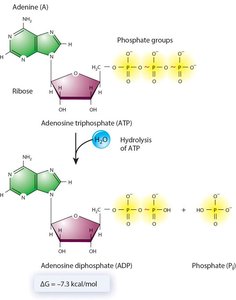
ATP: The Energy Currency of the Cell
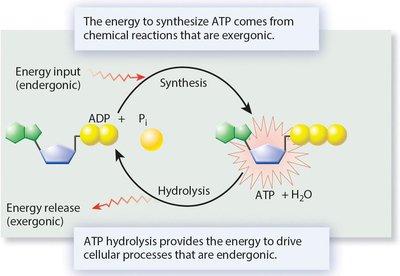
ATP (adenosine triphosphate) is the primary energy carrier in cells. Its hydrolysis is exergonic and provides energy for endergonic reactions.
Hydrolysis of ATP:
Coupling Reactions: Cells couple exergonic ATP hydrolysis to drive endergonic processes.
Enzymes and Ribozymes
Enzyme Characteristics
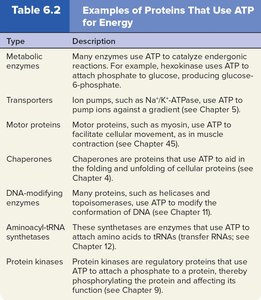
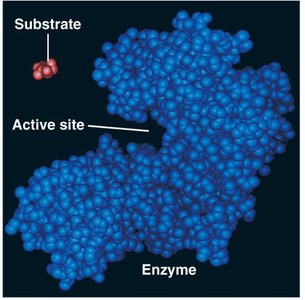
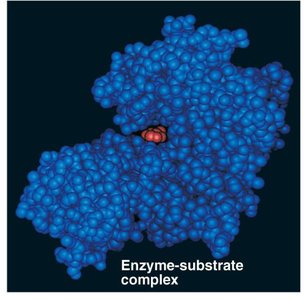
Enzymes are biological catalysts that speed up chemical reactions without being consumed. They are highly specific for their substrates due to their unique three-dimensional structure.
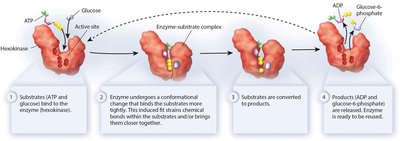
Active Site: Region where substrates bind and reactions occur.
Substrate: Reactant molecule that binds to the enzyme.
Product: Molecule released after the reaction.
Enzyme Function and Mechanism
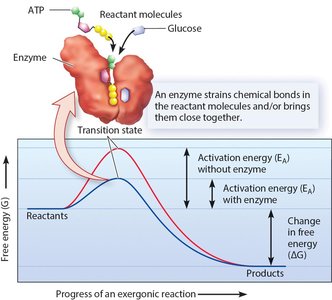
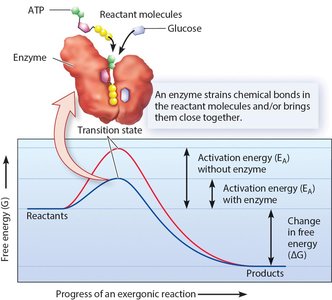
Enzymes lower the activation energy required for reactions, facilitating the transition state and increasing reaction rates. They do not alter the free energy change () of the reaction.
Activation Energy: Initial energy required to start a reaction.
Transition State: Temporary state during the reaction where bonds are strained.
Enzyme Inhibition
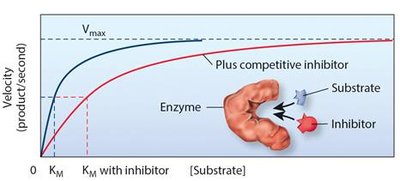
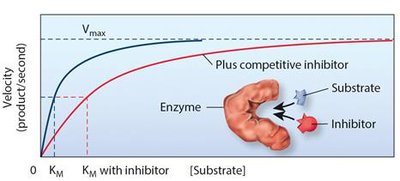
Enzyme activity can be regulated by inhibitors, which decrease the rate of reaction.
Competitive Inhibitors: Bind to the active site, preventing substrate binding. Increase (apparent affinity).
Noncompetitive Inhibitors: Bind to an allosteric site, changing enzyme shape and function. Decrease (maximum velocity).
Physical and Chemical Factors Affecting Enzyme Activity
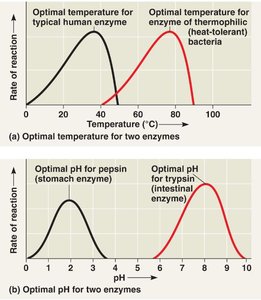
Enzyme activity is influenced by temperature, pH, and ionic conditions. Extreme conditions can denature enzymes, reducing their activity.
Optimal Conditions: Each enzyme has specific optimal temperature and pH.
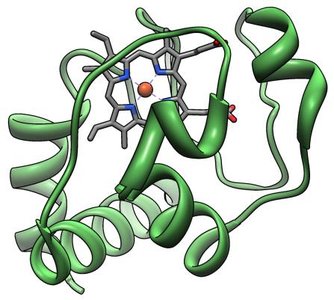
Cofactors: Inorganic ions required for enzyme function (e.g., Fe3+).
Prosthetic Groups: Permanently attached molecules aiding function (e.g., heme).
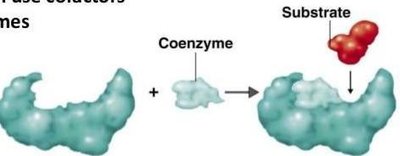
Coenzymes: Organic molecules temporarily binding to enzymes (e.g., NAD+).
Overview of Metabolism
Metabolic Pathways
Metabolism is the sum of all chemical reactions in a cell, organized into metabolic pathways. These pathways are either catabolic (breaking down molecules) or anabolic (building molecules).
Catabolic Pathways: Break down large molecules, releasing energy (exergonic).
Anabolic Pathways: Build larger molecules from smaller ones, requiring energy (endergonic).
Energy Intermediates: Molecules like ATP and NADH store and transfer energy within cells.
Oxidation-Reduction (Redox) Reactions
Redox reactions involve the transfer of electrons between molecules. Oxidation is the loss of electrons, while reduction is the gain of electrons. These reactions are essential for energy production in cells.
Electron Donor: Molecule that loses electrons (oxidized).
Electron Acceptor: Molecule that gains electrons (reduced).
Enzyme: Facilitates electron transfer.
Regulation of Metabolic Pathways
Metabolic pathways are regulated at multiple levels to ensure efficient cellular function.
Gene Regulation: Cells turn genes on/off based on conditions.
Cellular Regulation: Cell signaling pathways alter gene expression or enzyme activity.
Biochemical Regulation: Feedback inhibition, where the end product inhibits an early enzyme in the pathway.
Summary Table: Properties of Enzymes
Property | Description |
|---|---|
Catalyst | Speeds up reactions without being consumed |
Specificity | Highly specific for substrate due to active site structure |
Activation Energy | Lowers activation energy required for reaction |
Energetics | Does not change free energy (), only rate |
Regulation | Can be regulated by inhibitors, cofactors, and environmental conditions |
Example: Hexokinase catalyzes the phosphorylation of glucose using ATP, demonstrating enzyme specificity and function.
Additional info: Some details were inferred from standard biology textbooks to ensure completeness and clarity.
