 Indietro
Energy, Enzymes, and Metabolism: Study Notes
Guida di studio - Note intelligenti
 Appunti personalizzati basati sui tuoi materiali, ampliati con definizioni chiave, esempi e contesto.
Metabolism and Metabolic Pathways
Overview of Metabolism
Metabolism is the sum of all chemical reactions that occur within an organism, involving the transformation of matter and energy. These reactions are catalyzed by enzymes and are essential for growth, maintenance, and cellular function.
Substrates: The starting molecules in a chemical reaction.
Products: The molecules produced by the reaction.
Enzymatic reactions: Chemical reactions catalyzed by enzymes, increasing their speed and specificity.
Metabolic Pathways
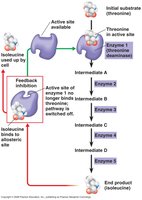
Metabolic pathways are series of interconnected enzymatic reactions, where the product of one reaction serves as the substrate for the next. Each step is catalyzed by a specific enzyme, ensuring regulation and efficiency.
Catabolism: Breakdown of molecules to release energy.
Anabolism: Synthesis of complex molecules from simpler ones, requiring energy input.
Energy intermediates: Molecules like ATP that store and transfer energy within cells.
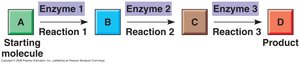
Energy Transformation in Biological Systems
Forms of Energy
Organisms transform energy from one form to another to sustain life. The main forms of energy relevant to biology include:
Kinetic energy: Energy of motion.
Thermal energy (heat): Kinetic energy associated with the random movement of atoms or molecules.
Light energy: Energy from sunlight, used in photosynthesis.
Potential energy: Stored energy due to position or structure.
Chemical energy: Potential energy stored in chemical bonds.
Laws of Thermodynamics
Thermodynamics is the study of energy transformations. Biological systems obey two fundamental laws:
First Law (Conservation of Energy): Energy cannot be created or destroyed, only transformed or transferred.
Second Law (Entropy): Every energy transfer increases the entropy (disorder) of the universe; some energy is always lost as heat.
Biological Order and Disorder
Living organisms maintain order and structure by consuming energy, but in doing so, they increase the overall disorder (entropy) of their surroundings.

Free Energy and Chemical Reactions
Free Energy (Gibbs Free Energy)
Free energy (G) is the portion of a system's energy that can perform work. The change in free energy (ΔG) during a reaction determines whether the process is spontaneous.
ΔG = ΔH – TΔS
ΔH: Change in enthalpy (total energy)
T: Absolute temperature (Kelvin)
ΔS: Change in entropy
Exergonic and Endergonic Reactions
Reactions can be classified based on their free energy change:
Exergonic reactions: Release energy (ΔG < 0), spontaneous.
Endergonic reactions: Require energy input (ΔG > 0), nonspontaneous.
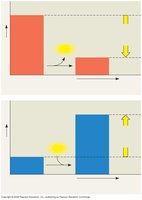
ATP: The Energy Currency of the Cell
Structure and Function of ATP
Adenosine triphosphate (ATP) is the primary energy carrier in cells. It consists of adenine, ribose, and three phosphate groups. The hydrolysis of ATP releases energy that can be used for cellular work.
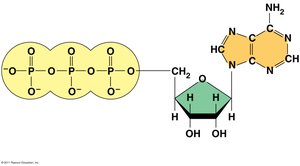
The ATP Cycle and Energy Coupling
ATP hydrolysis is an exergonic reaction that can be coupled to endergonic reactions, allowing cells to perform work. The ATP cycle involves the continual conversion of ATP to ADP and inorganic phosphate, and vice versa.
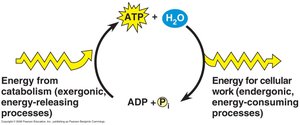
Enzymes and Catalysis
Activation Energy and Reaction Rates
Even spontaneous reactions may proceed slowly due to the activation energy barrier. Activation energy is the initial input of energy required to start a reaction by breaking existing bonds.
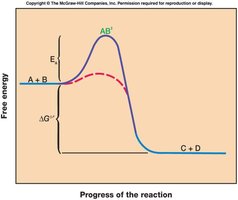
How Enzymes Work
Enzymes are biological catalysts that lower the activation energy of reactions, increasing their rate without being consumed. They are highly specific for their substrates, binding them at the active site to form an enzyme-substrate complex.
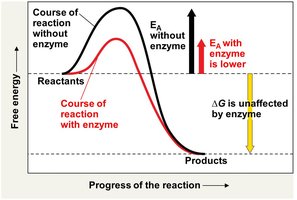
Mechanism of Enzyme Action
Substrates bind to the enzyme's active site.
The enzyme undergoes an induced fit, straining substrate bonds and facilitating the reaction.
Products are released, and the enzyme is free to catalyze another reaction.
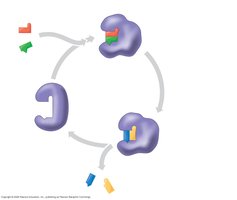
Enzyme Specificity and Induced Fit
Enzyme specificity is determined by the shape of the active site. The induced fit model describes how the enzyme changes shape to better fit the substrate upon binding.
Cofactors and Coenzymes
Many enzymes require non-protein helpers for activity:
Cofactors: Inorganic ions (e.g., Zn2+, Fe2+, Mg2+).
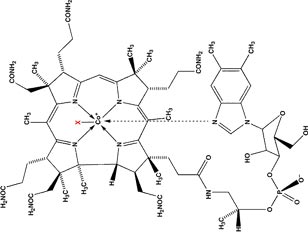
Coenzymes: Organic molecules (e.g., vitamins such as B12 and A).
Factors Affecting Enzyme Activity
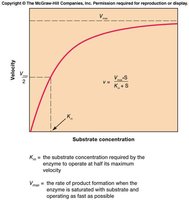
Substrate concentration: Increasing substrate increases reaction rate until enzymes are saturated.
Environmental factors: Temperature, pH, and ionic strength can affect enzyme structure and function.
Regulation of Enzyme Activity
Enzyme Inhibition
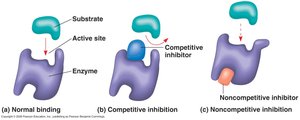
Competitive inhibitors: Bind to the active site, blocking substrate access; can be overcome by increasing substrate concentration.
Noncompetitive inhibitors: Bind to a different site, changing enzyme shape and reducing activity.
Allosteric Regulation
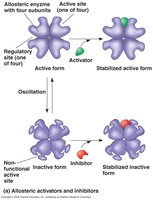
Allosteric regulation involves the binding of regulatory molecules at sites other than the active site, causing conformational changes that affect enzyme activity. Activators stabilize the active form, while inhibitors stabilize the inactive form.
Cooperativity
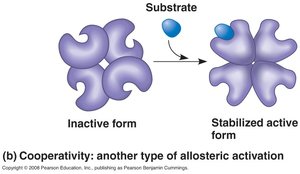
Cooperativity is a form of allosteric regulation where substrate binding to one active site increases the activity at other sites, often seen in multimeric enzymes.
Feedback Inhibition
Feedback inhibition is a regulatory mechanism where the end product of a metabolic pathway inhibits an enzyme involved earlier in the pathway, preventing overproduction and conserving resources.
Localization of Enzymes
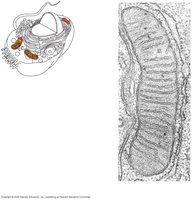
Enzymes may be compartmentalized within specific organelles in eukaryotic cells, allowing for regulation and efficiency of metabolic pathways. For example, enzymes involved in cellular respiration are localized in mitochondria.
Key Terms and Concepts Table
Term | Definition |
|---|---|
Metabolism | Sum of all chemical reactions in an organism |
Catabolism | Breakdown of molecules to release energy |
Anabolism | Synthesis of complex molecules, requires energy |
Enzyme | Protein catalyst that speeds up reactions |
ATP | Main energy currency of the cell |
Activation Energy | Energy required to initiate a reaction |
Allosteric Regulation | Regulation by binding at a site other than the active site |
Feedback Inhibition | End product inhibits an earlier step in a pathway |
