 Indietro
Energy, Enzymes, and Reaction Rates in General Biology
Guida di studio - Note intelligenti
 Appunti personalizzati basati sui tuoi materiali, ampliati con definizioni chiave, esempi e contesto.
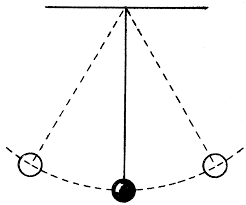
Q2. At which point in the swing does the pendulum have the most kinetic energy? The most potential energy?
Background
Topic: Energy Transformation in Physics/Biology
This question tests your understanding of kinetic and potential energy in a physical system, which is foundational for understanding energy transformations in biological processes.
Key Terms:
Kinetic Energy: The energy of motion. It is highest when the object is moving fastest.
Potential Energy: Stored energy due to position. It is highest when the object is at its maximum height.
Step-by-Step Guidance
Observe the diagram of the pendulum. The pendulum swings from one side to the other, passing through the lowest point in the middle.
Consider the speed of the pendulum at different points. Where is it moving fastest? Where is it momentarily stopped?
Recall that kinetic energy is highest when the pendulum is moving fastest, and potential energy is highest when it is at its maximum height (the endpoints).
Think about how energy is converted as the pendulum swings: at the endpoints, it has maximum potential energy and zero kinetic energy; at the lowest point, it has maximum kinetic energy and minimum potential energy.
Try solving on your own before revealing the answer!
Final Answer:
The pendulum has the most kinetic energy at the lowest point of its swing (center), and the most potential energy at the highest points (the endpoints of the swing).
This is because at the lowest point, the pendulum is moving fastest, and at the endpoints, it is momentarily stopped at its maximum height.
Q3. In your body, what has a lot of potential energy?
Background
Topic: Biological Energy Storage
This question is about identifying molecules in the body that store potential energy, which is later used for cellular processes.
Key Terms:
Potential Energy in Biology: Energy stored in chemical bonds, such as those in glucose, ATP, and fats.
ATP (Adenosine Triphosphate): The primary energy carrier in cells.
Glucose: A simple sugar used as a major energy source.
Fat (Triglycerides): Long-term energy storage molecules.
Step-by-Step Guidance
Think about the types of molecules your body uses to store energy for later use.
Recall that energy is stored in the chemical bonds of these molecules.
Consider which molecules are used for immediate energy (like ATP) and which are used for long-term storage (like fats).
Identify the main sources of potential energy in the body based on their roles in metabolism.
Try solving on your own before revealing the answer!
Final Answer:
Molecules such as ATP, glucose, and fats (triglycerides) have a lot of potential energy in the body. This energy is stored in their chemical bonds and can be released during metabolic processes.
Q4. What does this potential energy in your body get used for? (What is the potential energy getting converted into?)
Background
Topic: Energy Conversion in Cells
This question tests your understanding of how stored energy is used in biological processes.
Key Terms:
Cellular Work: Includes muscle contraction, active transport, biosynthesis, and more.
Conversion of Energy: Potential energy is converted into kinetic energy, heat, and other forms of work.
Step-by-Step Guidance
Think about the different activities your cells perform that require energy.
Recall that ATP is used to power cellular processes such as movement, transport, and synthesis.
Consider how energy stored in molecules is released and used for these processes.
Identify the main forms of energy that potential energy is converted into during cellular activities.
Try solving on your own before revealing the answer!
Final Answer:
The potential energy in your body is used for cellular work, such as muscle contraction, active transport, biosynthesis, and is converted into kinetic energy, heat, and other forms of energy needed for life processes.
Q5. Which has more potential energy, concentrated acid or diluted acid? When you dilute acid is this an exergonic or endergonic process?
Background
Topic: Chemical Energy and Thermodynamics
This question tests your understanding of energy changes during dilution and the concepts of exergonic and endergonic reactions.
Key Terms:
Potential Energy: Energy stored in chemical bonds and concentration gradients.
Exergonic Process: Releases energy.
Endergonic Process: Requires energy input.
Step-by-Step Guidance
Compare the energy stored in a concentrated acid versus a diluted acid. Which has more energy due to concentration?
Think about what happens when you dilute acid: energy is released, often as heat.
Recall the definitions of exergonic and endergonic processes.
Determine whether dilution releases energy (exergonic) or requires energy (endergonic).
Try solving on your own before revealing the answer!
Final Answer:
Concentrated acid has more potential energy than diluted acid. Diluting acid is an exergonic process because it releases energy, often as heat.
Q6. Describe the relationship between reaction speed and activation energy and how enzymes relate to that.
Background
Topic: Enzyme Catalysis and Activation Energy
This question tests your understanding of how enzymes affect the speed of chemical reactions by lowering activation energy.
Key Terms:
Activation Energy: The minimum energy required to start a chemical reaction.
Enzyme: A biological catalyst that speeds up reactions by lowering activation energy.
Step-by-Step Guidance
Recall that activation energy is the energy barrier that must be overcome for a reaction to proceed.
Understand that reactions with lower activation energy proceed faster.
Enzymes lower the activation energy, making reactions occur more quickly.
Think about how this applies to biological systems where enzymes are essential for life.
Try solving on your own before revealing the answer!
Final Answer:
Reaction speed increases as activation energy decreases. Enzymes lower the activation energy, allowing reactions to proceed faster in biological systems.
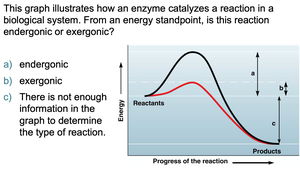
Q7. Which line (red or black) corresponds to a catalyzed reaction? Why?
Background
Topic: Reaction Energy Diagrams and Enzyme Catalysis
This question tests your ability to interpret energy diagrams and understand the effect of enzymes on reaction pathways.
Key Terms:
Catalyzed Reaction: A reaction with an enzyme, which lowers the activation energy.
Uncatalyzed Reaction: A reaction without an enzyme, with higher activation energy.
Step-by-Step Guidance
Examine the energy diagram. The y-axis represents energy, and the x-axis represents progress of the reaction.
Identify which line shows a lower peak (activation energy barrier).
Recall that the catalyzed reaction has a lower activation energy than the uncatalyzed reaction.
Determine which line (red or black) represents the catalyzed reaction based on the height of the energy barrier.
Try solving on your own before revealing the answer!
Final Answer:
The red line corresponds to the catalyzed reaction because it shows a lower activation energy barrier compared to the black line.
Q8. Describe the meanings of the a, b and c labeled regions on the diagram.
Background
Topic: Reaction Energy Diagrams
This question tests your ability to interpret labeled regions on an energy diagram for a chemical reaction.
Key Terms:
Activation Energy (a): The energy required to start the reaction.
Energy Difference (b): The difference in energy between reactants and products.
Products (c): The final energy state after the reaction.
Step-by-Step Guidance
Look at the diagram and identify the labeled regions a, b, and c.
Recall what each region typically represents in a reaction energy diagram.
Match each label to its corresponding concept: activation energy, energy difference, and product energy.
Think about how these regions relate to the overall reaction process.
Try solving on your own before revealing the answer!
Final Answer:
a: Activation energy (energy barrier to start the reaction) b: Energy difference between reactants and products c: Energy level of the products after the reaction
Q9. Is this reaction overall exergonic or endergonic? Will there be a difference in the amount of energy absorbed or released between the catalyzed and uncatalyzed reaction?
Background
Topic: Thermodynamics of Chemical Reactions
This question tests your understanding of exergonic and endergonic reactions and the effect of catalysis on energy changes.
Key Terms:
Exergonic Reaction: Releases energy; products have less energy than reactants.
Endergonic Reaction: Absorbs energy; products have more energy than reactants.
Catalysis: Lowers activation energy but does not change the overall energy released or absorbed.
Step-by-Step Guidance
Examine the energy diagram and compare the energy levels of reactants and products.
Determine whether the products have more or less energy than the reactants.
Recall the definitions of exergonic and endergonic reactions.
Consider whether catalysis changes the total energy released or absorbed in the reaction.
Try solving on your own before revealing the answer!
Final Answer:
This reaction is exergonic because the products have less energy than the reactants. There is no difference in the amount of energy released or absorbed between the catalyzed and uncatalyzed reaction; catalysis only lowers the activation energy.
Q10. Why do cells have so many different enzymes? For each possible answer explain why it is or is not correct
Background
Topic: Enzyme Specificity and Function
This question tests your understanding of why enzyme diversity is necessary in cells.
Key Terms:
Enzyme Specificity: Each enzyme catalyzes a specific reaction due to its unique active site.
Active Site: The region of the enzyme where the substrate binds.
Step-by-Step Guidance
Consider the role of enzyme shape and active site in determining which substrate an enzyme can bind.
Evaluate each possible answer for accuracy based on enzyme function and specificity.
Think about whether enzymes are used up in reactions or can be reused.
Assess whether enzymes are produced randomly or are encoded by specific genes.
Try solving on your own before revealing the answer!
Final Answer:
B is correct: The shape of an enzyme’s active site generally fits the specific substrate, so each enzyme is specific to a particular reaction. A is incorrect: Enzymes can be used multiple times. C is incorrect: Substrate molecules do not make new enzymes. D is incorrect: Enzymes are not randomly produced; they are encoded by genes.
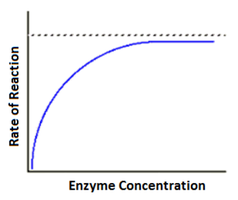
Q11. Describe how the rate of the reaction depends on substrate concentration.
Background
Topic: Enzyme Kinetics
This question tests your understanding of how substrate concentration affects the rate of enzyme-catalyzed reactions.
Key Terms:
Substrate: The molecule upon which an enzyme acts.
Reaction Rate: The speed at which a reaction occurs.
Saturation: When all enzyme active sites are occupied.
Step-by-Step Guidance
Consider what happens as substrate concentration increases: more substrate molecules are available for enzymes to act on.
Recall that at low substrate concentrations, the reaction rate increases rapidly as substrate concentration increases.
Think about what happens when substrate concentration becomes very high: all enzyme active sites are occupied.
Recognize that the reaction rate eventually levels off, reaching a maximum (Vmax).
Try solving on your own before revealing the answer!
Final Answer:
The rate of the reaction increases with substrate concentration at first, but eventually reaches a plateau (maximum rate) when all enzyme active sites are saturated.
Q12. Why do you think the graph eventually reaches a plateau in terms of reaction speed?
Background
Topic: Enzyme Saturation
This question tests your understanding of why enzyme-catalyzed reactions have a maximum rate.
Key Terms:
Enzyme Saturation: All active sites are occupied, so adding more substrate does not increase the rate.
Vmax: The maximum rate of an enzyme-catalyzed reaction.
Step-by-Step Guidance
Recall that enzymes have a limited number of active sites.
At high substrate concentrations, all active sites are occupied.
Once saturation is reached, the reaction rate cannot increase further.
Think about how this creates a plateau in the reaction rate graph.
Try solving on your own before revealing the answer!
Final Answer:
The graph reaches a plateau because all enzyme active sites are saturated, so the reaction rate cannot increase further even if more substrate is added.
Q13. How do you think adding an inhibitor would change the shape of the graph?
Background
Topic: Enzyme Inhibition
This question tests your understanding of how inhibitors affect enzyme activity and reaction rates.
Key Terms:
Inhibitor: A molecule that decreases enzyme activity.
Competitive Inhibition: Inhibitor competes with substrate for active site.
Noncompetitive Inhibition: Inhibitor binds elsewhere, changing enzyme shape.
Step-by-Step Guidance
Consider how inhibitors affect enzyme activity: they reduce the number of active sites available for substrate.
Think about how this would affect the reaction rate at different substrate concentrations.
Recall that the maximum rate (Vmax) may decrease, and the curve may shift downward.
Visualize how the graph would look with an inhibitor present compared to without.
Try solving on your own before revealing the answer!
Final Answer:
Adding an inhibitor would decrease the reaction rate and lower the plateau (Vmax) on the graph, resulting in a curve that does not reach as high as the uninhibited reaction.
