 Indietro
Energy, Enzymes, and Regulation in Biological Systems
Guida di studio - Note intelligenti
 Appunti personalizzati basati sui tuoi materiali, ampliati con definizioni chiave, esempi e contesto.
Energy and Metabolism in Cells
Types of Energy and Thermodynamics
Cells rely on energy transformations to perform work and sustain life. Energy exists in two main forms: potential energy (stored energy, often in chemical bonds) and kinetic energy (energy of motion). The laws of thermodynamics govern these transformations:
First Law of Thermodynamics: Energy cannot be created or destroyed, only transformed.
Second Law of Thermodynamics: Entropy (disorder) increases in a system; energy tends to disperse.
Biological reactions involve changes in enthalpy (H) and entropy (S). The Gibbs Free Energy (G) equation describes the energy available to do work:
Exergonic reactions: (spontaneous, energy-releasing)
Endergonic reactions: (non-spontaneous, energy-consuming)
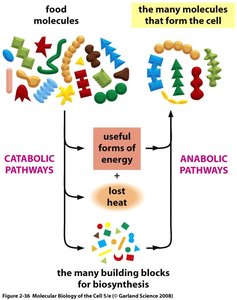
Catabolic pathways break down molecules and release energy, while anabolic pathways build molecules and require energy input.
ATP and Coupled Reactions
ATP as the Cellular Energy Currency
ATP (adenosine triphosphate) is the primary energy carrier in cells. Its hydrolysis ( kcal/mol) releases energy that can be used to drive endergonic reactions. Cells couple exergonic ATP hydrolysis to endergonic processes, such as biosynthesis, by transferring a phosphate group to substrates (phosphorylation).
Example: Synthesis of glutamine from glutamic acid and ammonia is endergonic, but becomes exergonic when coupled to ATP hydrolysis.
Enzymes: Biological Catalysts
Enzyme Structure and Function
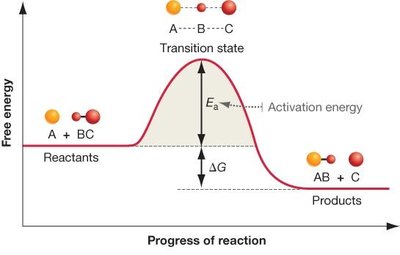
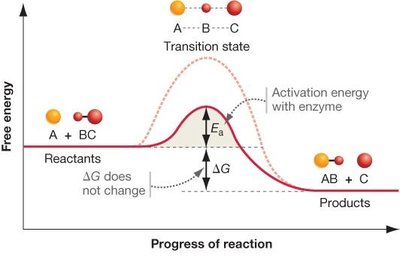
Enzymes are proteins that catalyze biological reactions by lowering the activation energy (Ea) required for the reaction to proceed. They do not change the overall of the reaction, but increase the rate by facilitating the transition state.
Substrate: The reactant acted upon by the enzyme.
Active site: Region of the enzyme where substrate binds; binding is highly specific.
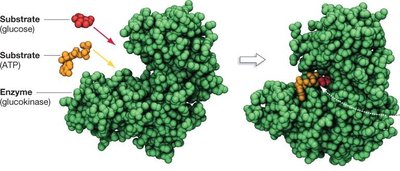
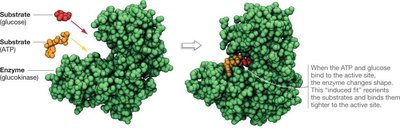
Induced fit: Substrate binding can change the enzyme's conformation, optimizing catalysis.
Mechanism of Enzyme Action
Enzyme-catalyzed reactions typically follow three steps:
Initiation: Substrates bind to the active site, forming an enzyme-substrate complex.
Transition State Facilitation: Enzyme stabilizes the transition state, lowering activation energy.
Termination: Products are released, and the enzyme returns to its original state.
Activation Energy and Reaction Progress
Enzymes lower the activation energy barrier, allowing more reactants to reach the transition state and increasing the reaction rate.
Factors Affecting Enzyme Activity
Substrate and Enzyme Concentration
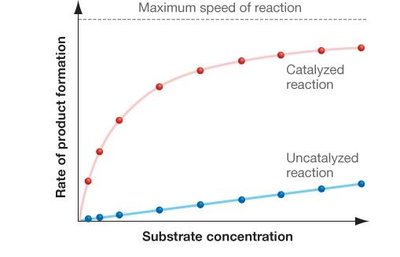
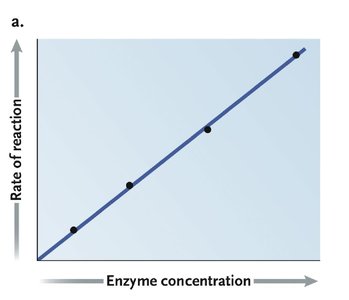
The rate of an enzyme-catalyzed reaction depends on substrate and enzyme concentrations:
Increasing substrate concentration increases reaction rate until the enzyme is saturated (Vmax).
Increasing enzyme concentration increases reaction rate linearly, provided substrate is not limiting.
Temperature and pH
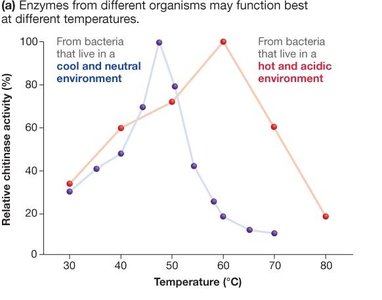
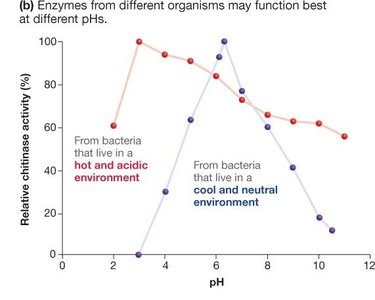
Enzyme activity is sensitive to temperature and pH:
Optimal temperature and pH vary by enzyme and organism.
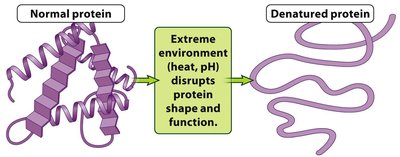
Extreme conditions can denature enzymes, disrupting their structure and function.
Regulation of Enzyme Activity
Non-covalent Regulation
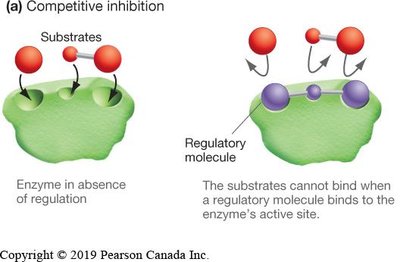
Competitive inhibition: Inhibitor binds to the active site, competing with substrate. This is concentration dependent.
Allosteric regulation: Regulatory molecule binds to a site other than the active site (allosteric site), causing a conformational change that increases or decreases enzyme activity.
Covalent Modifications
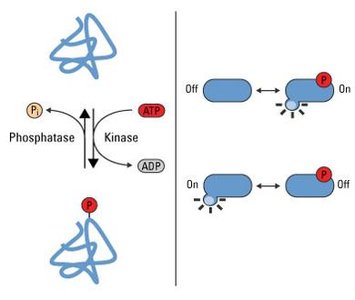
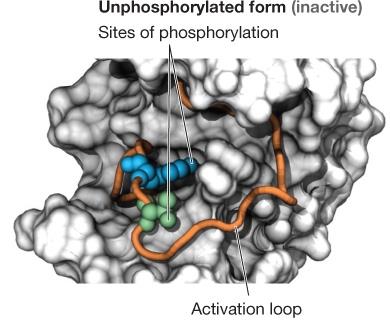
Enzyme activity can be regulated by covalent modifications, such as phosphorylation or changes in primary structure (amino acid sequence).
Phosphorylation can turn enzymes on or off, and is often reversible.
Feedback Inhibition in Metabolic Pathways
Feedback Inhibition Mechanism
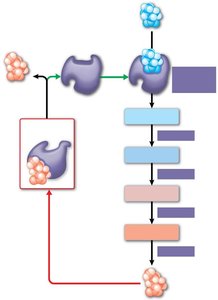
Many metabolic pathways are regulated by feedback inhibition, where the end product of a pathway inhibits an enzyme that acts early in the pathway. This prevents overproduction and conserves resources.
End product binds to an allosteric site on the enzyme, causing a conformational change that reduces activity.
This is a common regulatory mechanism in biosynthetic pathways.
Pathway Overview
Metabolic pathways consist of a series of enzyme-catalyzed steps, each producing intermediates that are further processed. Regulation ensures efficient use of resources and prevents accumulation of unnecessary products.

Summary Table: Enzyme Regulation Mechanisms
Regulation Type | Mechanism | Effect | Example |
|---|---|---|---|
Competitive Inhibition | Inhibitor binds active site | Decreases activity | Drug inhibition of enzymes |
Allosteric Regulation | Regulator binds allosteric site | Increases or decreases activity | Feedback inhibition |
Covalent Modification | Phosphorylation, amino acid changes | Turns enzyme on/off | Protein kinases |
Feedback Inhibition | End product inhibits early enzyme | Halts pathway | Amino acid biosynthesis |
Additional info: These notes expand on brief points from the original materials, providing definitions, examples, and mechanisms for enzyme regulation and energy transformation in cells. All images included directly reinforce the explanations given in the adjacent paragraphs.
