 Indietro
Energy, Metabolism, and Enzymes in Cells
Guida di studio - Note intelligenti
 Appunti personalizzati basati sui tuoi materiali, ampliati con definizioni chiave, esempi e contesto.
Energy and Metabolism in Cells
Introduction to Metabolism
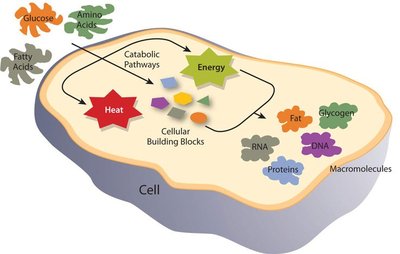
Metabolism encompasses all chemical reactions that occur within living cells, enabling them to manage matter and energy efficiently. These reactions are essential for the breakdown and synthesis of biomolecules, cellular maintenance, and energy production.
Metabolism: The sum of all chemical reactions in a living system.
Includes both catabolic (breakdown) and anabolic (synthesis) pathways.
Manages the recycling of cellular components and the production of ATP.
Managing Matter and Energy
Cells must constantly rebuild, rearrange, and recycle molecules to maintain function and structure. Metabolism allows cells to:
Break down nutrients into smaller molecules for reuse.
Build larger molecules for growth and repair.
Recycle old or damaged cellular components.
Capture, transfer, and utilize energy for cellular work.
Forms of Energy in Cells
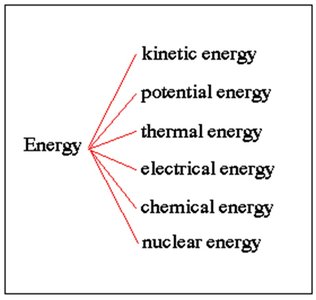
Energy is the capacity to cause change or perform work. In biological systems, energy exists in several forms:
Potential energy: Stored energy, such as in ion gradients or chemical bonds.
Chemical energy: A type of potential energy stored in the arrangement of atoms and electrons within molecules (e.g., glucose).
Kinetic energy: Energy of motion, such as vesicle transport or muscle contraction.
Thermal energy: Kinetic energy associated with the random movement of atoms and molecules; heat is the transfer of thermal energy.
Energy Transformations and Thermodynamics
The Laws of Thermodynamics
Energy transformations in cells are governed by the laws of thermodynamics:
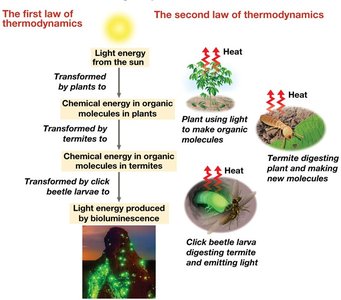
First Law of Thermodynamics: Energy cannot be created or destroyed, only transformed from one form to another.
Example: Photosynthesis transforms light energy into chemical energy; cellular respiration transfers chemical energy from food into ATP.
Second Law of Thermodynamics: Every energy transfer increases the entropy (disorder) of the universe. Energy transformations are never 100% efficient; some energy is always lost as heat.
Cells use energy to maintain order, but the total entropy of the universe still increases.
Metabolic Pathways and Chemical Reactions
Metabolic Pathways
A metabolic pathway is a series of enzyme-catalyzed reactions where the product of one reaction becomes the substrate for the next. These pathways allow for the efficient and regulated transformation of molecules within the cell.
Each step is catalyzed by a specific enzyme.
Pathways can be linear, branched, or cyclical.

Anabolism and Catabolism
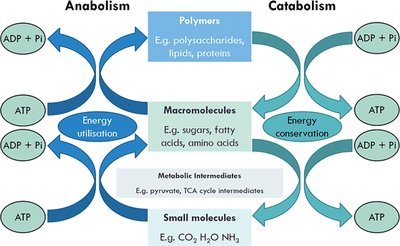
Metabolic reactions are classified as either anabolic or catabolic:
Anabolism | Catabolism | |
|---|---|---|
Definition | Builds larger molecules from smaller ones | Breaks larger molecules into smaller ones |
Energy | Requires net input of energy | Often releases net usable energy |
Example | Protein synthesis | Glucose breakdown |
Chemical Reactions in Cells
Chemical reactions rearrange atoms by breaking and forming bonds. The direction and energy changes of these reactions are critical for metabolism.
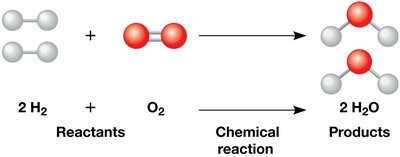
Reactants are transformed into products.
Breaking bonds requires energy; forming bonds releases energy.
Reactions tend toward lower free energy and greater stability.
Free Energy and Reaction Spontaneity
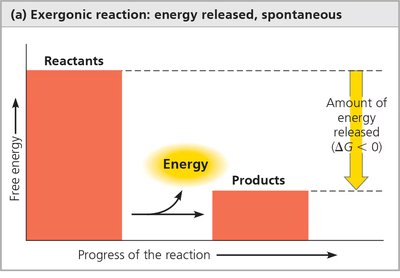
Free energy (G) is the energy available to do work. The change in free energy () determines whether a reaction is energetically favorable (spontaneous) or requires energy input (nonspontaneous).
Negative : Exergonic, spontaneous, energy-releasing (e.g., glucose breakdown).
Positive : Endergonic, nonspontaneous, energy-requiring (e.g., protein synthesis).
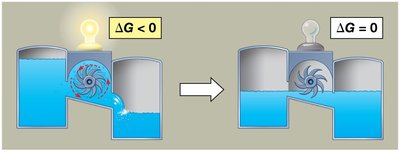
: Reaction is at equilibrium.
Chemical Equilibrium
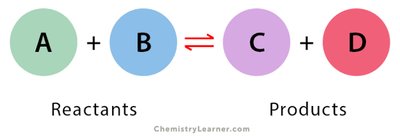
A reversible reaction reaches equilibrium when the forward and reverse reactions occur at the same rate. At equilibrium, there is no net change in reactant or product concentrations, and .
Cells avoid equilibrium by continuously using and producing molecules.
Energy Coupling and ATP
Energy Coupling in Cells
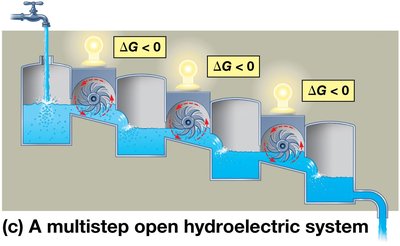
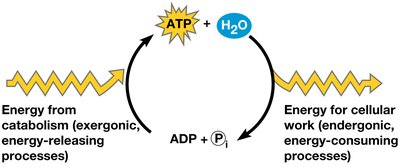
Cells power endergonic reactions by coupling them to exergonic reactions. The most common energy source for coupling is ATP hydrolysis.
ATP hydrolysis releases free energy to drive cellular work.
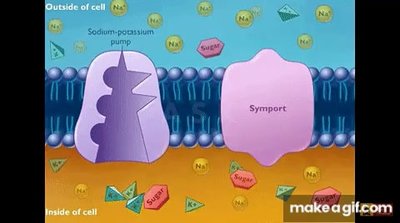
Other sources include ion gradients and electron carriers.
ATP: The Energy Currency of the Cell
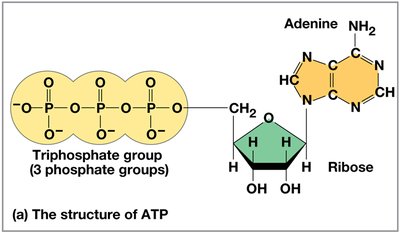
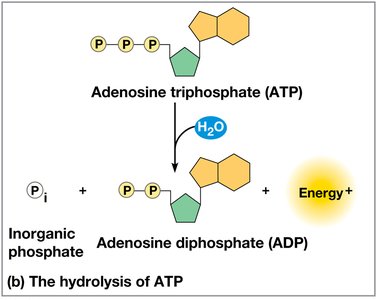
ATP (adenosine triphosphate) is the primary immediate energy source for cellular work. It consists of adenine, ribose, and three phosphate groups.
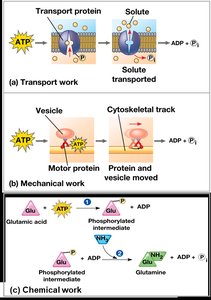
ATP powers transport, mechanical, and chemical work in cells.
ATP Hydrolysis and the ATP Cycle
ATP hydrolysis converts ATP into ADP and inorganic phosphate (), releasing energy. ATP is regenerated from ADP and using energy from catabolic reactions.
ATP hydrolysis:
The ATP cycle links energy-releasing and energy-consuming processes.
Enzymes and Biological Catalysis
Enzymes: The Cell’s Catalysts
Enzymes are proteins that act as biological catalysts, speeding up chemical reactions without being consumed. They lower the activation energy required for reactions to proceed.
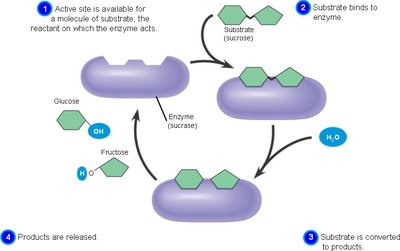
Example: Sucrase catalyzes the breakdown of sucrose into glucose and fructose.
Activation Energy and Enzyme Function
Every chemical reaction requires an initial input of energy, called activation energy (E_a), to begin. Enzymes lower this barrier, allowing reactions to occur more rapidly and at lower temperatures.
Without enzymes, most cellular reactions would be too slow to sustain life.
How Enzymes Lower Activation Energy
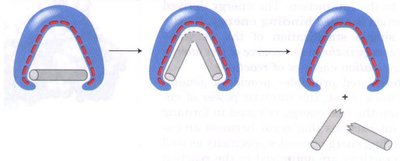
Enzymes lower activation energy by:
Bringing substrates together in the correct orientation.
Straining or weakening specific bonds in the substrate.
Providing a favorable microenvironment in the active site.
Temporarily forming bonds with the substrate.
Enzyme Specificity and the Catalytic Cycle
Each enzyme has a unique active site that binds specific substrates, giving enzymes their specificity. The catalytic cycle involves substrate binding, conversion to product, and release.
Substrate enters the active site.
Enzyme-substrate complex forms (lock-and-key or induced fit).
Reaction occurs; product is formed.
Product is released; enzyme is free for another cycle.
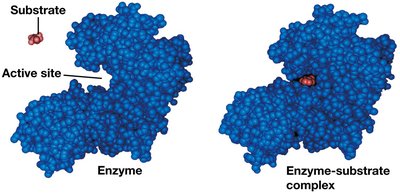
Enzyme Kinetics: Reaction Rates
The rate of an enzyme-catalyzed reaction depends on substrate concentration. At low substrate levels, increasing substrate increases the rate; at high levels, the enzyme becomes saturated and the rate plateaus (Vmax).
Factors Affecting Enzyme Activity
Temperature: Increases reaction rate up to an optimal point; high temperatures denature enzymes.
pH: Each enzyme has an optimal pH; deviations can denature the enzyme.
Enzyme Inhibition and Regulation
Competitive inhibitors: Bind to the active site, blocking substrate binding.
Non-competitive inhibitors: Bind elsewhere, changing enzyme shape and reducing activity.
Allosteric regulation: Regulatory molecules bind to allosteric sites, stabilizing active or inactive forms of the enzyme.
Summary Table: Types of Metabolic Reactions
Type | Description | Energy Change | Example |
|---|---|---|---|
Anabolic | Builds larger molecules from smaller ones | Requires energy input | Protein synthesis |
Catabolic | Breaks larger molecules into smaller ones | Releases energy | Glucose breakdown |
