 Indietro
Energy, Metabolism, and Enzymes: Study Notes for General Biology
Guida di studio - Note intelligenti
 Appunti personalizzati basati sui tuoi materiali, ampliati con definizioni chiave, esempi e contesto.
Energy and Metabolism
Metabolism and Metabolic Pathways
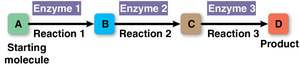
Metabolism encompasses all chemical reactions occurring within an organism. These reactions are organized into metabolic pathways, where a specific molecule is transformed through a series of steps, each catalyzed by a unique enzyme, to yield a final product.
Anabolic pathways build complex molecules from simpler ones, consuming energy (e.g., protein synthesis from amino acids).
Catabolic pathways break down complex molecules into simpler compounds, releasing energy (e.g., cellular respiration).
Enzymes are biological catalysts that speed up reactions without being consumed.
Metabolic pathway example: A → B → C → D, each step catalyzed by a specific enzyme.
Energy: Forms and Transformations
Kinetic and Potential Energy
Energy is the capacity to cause change and is essential for biological work. It exists in two primary forms:
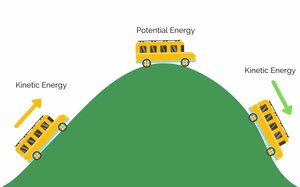
Kinetic energy: Energy of motion (e.g., movement of molecules).
Thermal energy: A type of kinetic energy due to random movement of atoms/molecules.
Potential energy: Energy stored due to an object's position or structure (e.g., chemical energy in bonds).
Energy Transformations in Biological Systems
Biological systems transform energy from one form to another, such as converting chemical energy from food into kinetic energy for movement, and then into potential energy when climbing.
Laws of Thermodynamics
The First Law of Thermodynamics
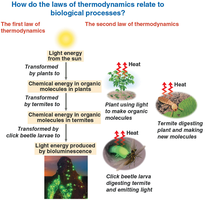
The first law states that energy cannot be created or destroyed, only transferred or transformed. This principle is known as the conservation of energy.
The Second Law of Thermodynamics
Every energy transfer increases the entropy (disorder) of the universe. Some energy is always lost as heat, making it unavailable for work.
Entropy: A measure of disorder or randomness.
Spontaneous processes increase entropy and occur without energy input.
Nonspontaneous processes decrease entropy and require energy input.
Free Energy and Spontaneity
Gibbs Free Energy (ΔG)
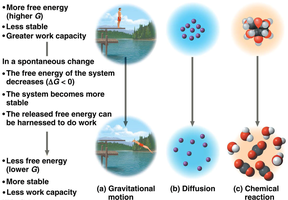
Free energy is the portion of a system's energy available to do work. The change in free energy (ΔG) determines whether a process is spontaneous.
ΔG = ΔH – TΔS
ΔG = change in free energy
ΔH = change in enthalpy (total energy)
ΔS = change in entropy
T = temperature in Kelvin
Spontaneous vs. Nonspontaneous Processes
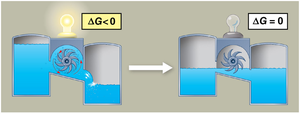
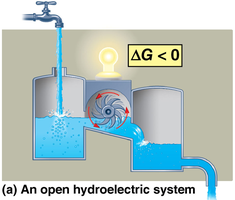
Spontaneous: ΔG < 0 (energetically favorable)
Nonspontaneous: ΔG ≥ 0 (requires energy input)
Equilibrium and Metabolism
At equilibrium, forward and reverse reactions occur at the same rate, and no work can be done. Living cells avoid equilibrium by maintaining a constant flow of materials.
Types of Chemical Reactions
Exergonic and Endergonic Reactions
Exergonic reactions: Release free energy (ΔG negative), occur spontaneously.
Endergonic reactions: Absorb free energy (ΔG positive), are nonspontaneous.
The magnitude of ΔG indicates the amount of work a reaction can perform or the energy required.
Cellular Work and ATP
Types of Cellular Work
Transport work: Pumping substances across membranes.
Mechanical work: Movement, such as muscle contraction.
Chemical work: Driving endergonic reactions.
ATP: Structure and Function
ATP (adenosine triphosphate) consists of ribose, adenine, and three phosphate groups. It is the primary energy currency of the cell, coupling exergonic and endergonic reactions.
ATP Hydrolysis and Energy Coupling
Hydrolysis of ATP releases energy by breaking the terminal phosphate bond.
Phosphorylation transfers a phosphate group to another molecule, making it more reactive.
ATP is regenerated from ADP by adding a phosphate group, using energy from catabolic reactions.
Enzymes and Catalysis
Role of Enzymes
Enzymes are biological catalysts that lower the activation energy (EA) required for reactions, allowing them to proceed at moderate temperatures.
Enzymes do not change ΔG; they only speed up reactions.
Activation energy is the initial energy needed to break reactant bonds.
Substrate Specificity and Active Sites
The substrate is the reactant an enzyme acts upon.
The active site is the region of the enzyme that binds the substrate.
Induced fit: The enzyme changes shape to better fit the substrate.
Factors Affecting Enzyme Activity
Temperature: Each enzyme has an optimal temperature for activity.
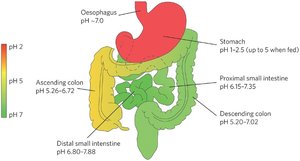
pH: Each enzyme has an optimal pH, often reflecting its environment (e.g., pepsin in the stomach, trypsin in the intestine).
Cofactors and Coenzymes
Cofactors are nonprotein helpers for enzymes, either inorganic (metal ions) or organic (coenzymes).
Enzyme Inhibition
Competitive inhibitors: Resemble the substrate and bind to the active site, blocking substrate access.
Noncompetitive inhibitors: Bind elsewhere on the enzyme, altering its shape and reducing activity.
Regulation of Enzyme Activity
Allosteric regulation: Regulatory molecules bind at one site, affecting function at another.
Cooperativity: Substrate binding at one active site enhances activity at others.
Feedback inhibition: End product of a pathway inhibits an earlier step, preventing overproduction.
Localization: Enzymes may be compartmentalized or form complexes for efficiency.
Summary Table: Types of Enzyme Inhibition
Type | Binding Site | Effect | Can be Overcome by Substrate? |
|---|---|---|---|
Competitive | Active site | Blocks substrate | Yes |
Noncompetitive | Other site | Changes enzyme shape | No |
Conclusion
Energy transformations, metabolic pathways, and enzyme regulation are fundamental to cellular function. Understanding these concepts is essential for studying biological processes and their underlying chemistry.
