 Indietro
Energy, Metabolism, and Enzymes: Study Notes for General Biology
Guida di studio - Note intelligenti
 Appunti personalizzati basati sui tuoi materiali, ampliati con definizioni chiave, esempi e contesto.
Energy & Enzymes: Metabolism
Thermodynamics and Energy in Biology
Biological systems rely on the principles of thermodynamics to understand how energy is transferred and transformed within living organisms. Energy is essential for cellular processes, and its flow is governed by fundamental laws.
Energy (E): The capacity to do work. It exists in various forms, including kinetic energy (energy of motion) and potential energy (stored energy due to position or structure).
Calorie: A unit of energy commonly used to measure the energy content in food.
Kinetic Energy: Associated with moving objects, such as muscle contraction or cellular transport.
Potential Energy: Stored in chemical bonds, such as those in glucose or ATP.
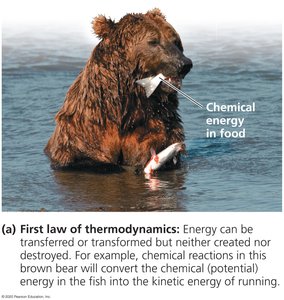
Example: The chemical energy stored in food (potential energy) is converted into kinetic energy when an animal moves.
Laws of Thermodynamics
First Law of Thermodynamics: Energy cannot be created or destroyed, only transformed from one form to another. In biological systems, chemical energy from food is converted into kinetic energy and heat.
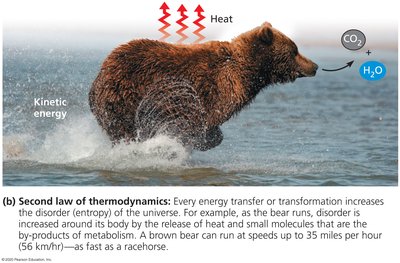
Second Law of Thermodynamics: Every energy transfer increases the disorder (entropy) of the universe. Some energy is lost as heat during metabolic processes, making less energy available for work.
Entropy: A measure of molecular disorder or randomness. As energy is transformed, entropy increases.
Example: As a bear runs, chemical energy is converted to kinetic energy and heat, increasing entropy.
Chemical Reactions and Metabolism
Metabolism and Metabolic Pathways
Metabolism is the sum of all chemical reactions in a cell. These reactions are organized into metabolic pathways, where each step is catalyzed by a specific enzyme.
Reactant: The starting material in a chemical reaction.
Product: The result of a chemical reaction.
Metabolic Pathway: A series of interconnected reactions, each controlled by a different enzyme, leading to a final product.
Types of Chemical Reactions
Chemical reactions in cells can be classified based on their energy changes:
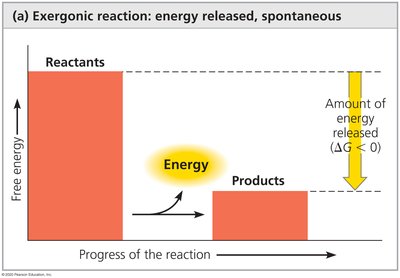
Exergonic Reaction: Releases energy; reactants have more free energy than products. These reactions are spontaneous and often drive cellular work.
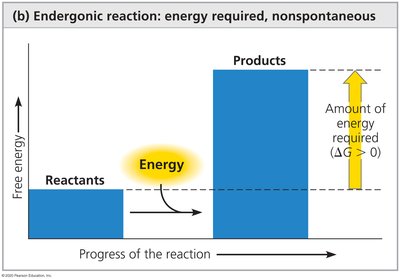
Endergonic Reaction: Requires energy input; products have more free energy than reactants. These reactions are nonspontaneous and require energy from another source.
Example: Cellular respiration is exergonic, while photosynthesis is endergonic.
Coupled Reactions
Cells often couple exergonic and endergonic reactions to efficiently manage energy. The energy released from exergonic reactions is used to drive endergonic processes.
ATP: The Energy Currency of the Cell
Structure and Function of ATP
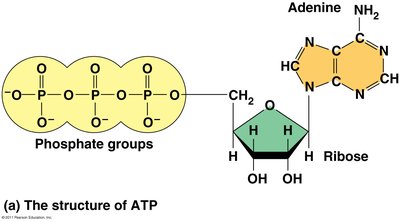
ATP (Adenosine Triphosphate) is the primary energy carrier in cells. It consists of adenine, ribose, and three phosphate groups. The high-energy bonds between phosphate groups store potential energy.
Phosphorylation: The process of adding a phosphate group to ADP to form ATP.
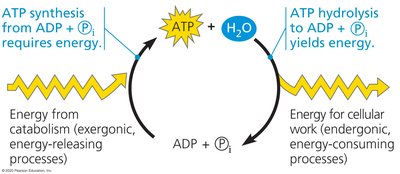
ATP Hydrolysis: The breakdown of ATP into ADP and inorganic phosphate, releasing energy for cellular work.
ATP Cycle
The ATP cycle involves the continuous synthesis and breakdown of ATP, linking catabolic (energy-releasing) and anabolic (energy-consuming) processes.
Equation: (requires energy)
Equation: (releases energy)
Enzymes: Biological Catalysts
Enzyme Structure and Function
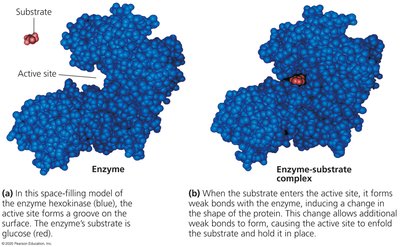
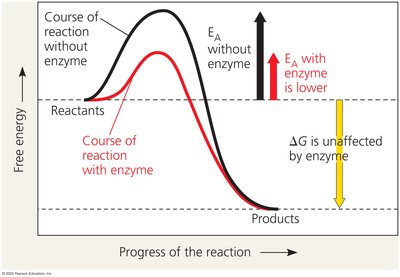
Enzymes are proteins that catalyze chemical reactions by lowering the activation energy required. Each enzyme has an active site where the substrate binds, often described by the "lock and key" or "induced fit" models.
Active Site: The region of the enzyme where substrate binding and catalysis occur.
Substrate: The molecule upon which the enzyme acts.
Induced Fit Model: The enzyme changes shape to better fit the substrate, facilitating the reaction.
Reusability: Enzymes are not consumed in the reaction and can be used repeatedly.
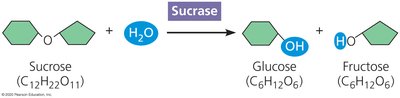
Example: The enzyme sucrase catalyzes the breakdown of sucrose into glucose and fructose.
Activation Energy and Enzyme Action
Activation energy is the energy required to start a chemical reaction. Enzymes lower this barrier, making reactions proceed faster and with less energy input.
Course of Reaction: With an enzyme, the activation energy is reduced, but the overall change in free energy () remains the same.
Factors Affecting Enzyme Activity
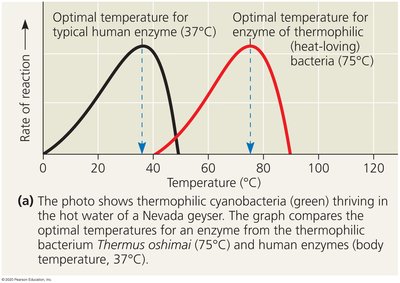
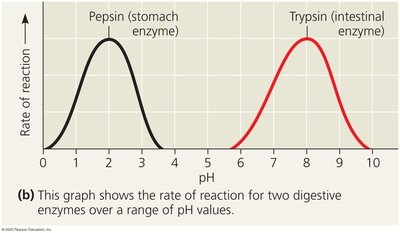
Enzyme activity is influenced by environmental conditions such as pH and temperature. Each enzyme has an optimum range for these factors, outside of which activity declines and the enzyme may denature.
Optimum Temperature: The temperature at which enzyme activity is highest.
Optimum pH: The pH at which enzyme activity is highest.
Denaturation: Loss of enzyme structure and function due to extreme conditions.
Enzyme Inhibition
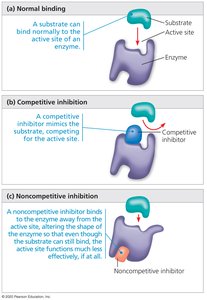
Enzyme activity can be regulated by inhibitors. Competitive inhibitors bind to the active site, blocking substrate access. Noncompetitive inhibitors bind elsewhere, altering enzyme shape and function. Allosteric inhibition involves binding to a regulatory site, affecting enzyme activity.
Feedback Inhibition: The end product of a metabolic pathway inhibits an earlier step, preventing overproduction.
Summary Table: Types of Chemical Reactions
Type of Reaction | Energy Change | Spontaneity | Example |
|---|---|---|---|
Exergonic | Energy released () | Spontaneous | Cellular respiration |
Endergonic | Energy required () | Nonspontaneous | Photosynthesis |
1Additional info: Academic context was added to clarify definitions, examples, and mechanisms for completeness and exam preparation.
