 Indietro
Energy, Metabolism, Cellular Respiration, and Photosynthesis: Study Guide for Chapters 8, 9, and 10
Guida di studio - Note intelligenti
 Appunti personalizzati basati sui tuoi materiali, ampliati con definizioni chiave, esempi e contesto.
Energy and Metabolism
Kinetic and Potential Energy
Energy is fundamental to biological processes. Kinetic energy is the energy of motion, while potential energy is stored energy due to position or structure. In cells, chemical energy—the energy stored in chemical bonds—is a type of potential energy. Photosynthesis stores energy in glucose, while cellular respiration releases it for cellular work.
Kinetic energy: Movement of molecules, electrons, or photons.
Potential energy: Stored in chemical bonds (e.g., glucose).
Chemical energy: Used in both photosynthesis (storage) and cellular respiration (release).
Example: Glucose contains high potential energy; breaking its bonds releases kinetic energy for cellular processes.
First and Second Laws of Thermodynamics
The first law states that energy cannot be created or destroyed, only transformed. The second law states that every energy transfer increases entropy (disorder). In biology, these laws explain how energy is transferred and lost as heat during metabolic reactions.
First law: Energy input from sunlight is stored in glucose (photosynthesis); energy in glucose is released (cellular respiration).
Second law: Some energy is lost as heat, increasing entropy.
Exergonic and Endergonic Reactions
Exergonic reactions release energy (e.g., breakdown of glucose), while endergonic reactions require energy input (e.g., synthesis of glucose in photosynthesis).
Exergonic: Cellular respiration, ATP hydrolysis.
Endergonic: Photosynthesis, ATP synthesis.
Energetic Coupling
Cells use exergonic reactions to drive endergonic reactions. This is called energetic coupling. For example, ATP hydrolysis (exergonic) powers many endergonic cellular processes.
Example: ATP hydrolysis drives active transport and biosynthesis.
Enzymes and Metabolic Pathways
Enzymes are biological catalysts that lower activation energy and speed up reactions. They are essential for metabolic pathways, which are series of enzyme-catalyzed reactions. Metabolism includes all chemical reactions in a cell, divided into catabolic (breakdown) and anabolic (synthesis) pathways.
Enzyme regulation: Allosteric regulation (enzyme activity modulated by molecules binding at sites other than the active site), competitive inhibition (inhibitor competes with substrate for active site), and feedback inhibition (end product inhibits pathway).
Example: Phosphofructokinase is regulated by ATP in glycolysis.
ATP, ADP, and Phosphorylation
ATP (adenosine triphosphate) is the cell’s energy currency. ADP (adenosine diphosphate) is formed when ATP loses a phosphate group. Phosphorylation is the addition of a phosphate group, often activating or deactivating molecules.
ATP hydrolysis: (releases energy)
Phosphorylation: (requires energy)
Oxidation-Reduction (Redox) Reactions
Oxidation is loss of electrons; reduction is gain of electrons. Electron carriers like NAD+, FAD, and NADP+ are reduced to NADH, FADH2, and NADPH, storing energy for later use.
Oxidized: Lower energy (e.g., NAD+).
Reduced: Higher energy (e.g., NADH).
Example:
Cellular Respiration
Overview and Equation
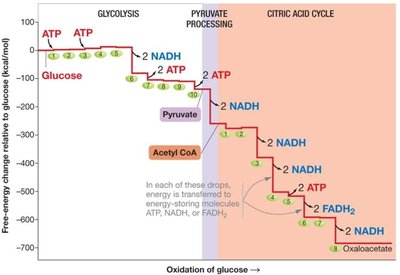
Cellular respiration is the process by which cells extract energy from glucose. It consists of glycolysis, pyruvate processing, citric acid cycle, and electron transport chain.
Overall equation:
Glycolysis
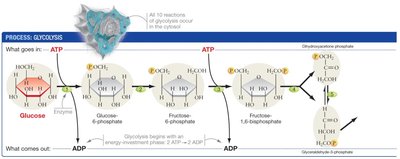
Glycolysis occurs in the cytosol and converts glucose to pyruvate, producing ATP and NADH.
Location: Cytosol
Inputs: Glucose, ATP, NAD+
Outputs: Pyruvate, ATP, NADH
Pyruvate Processing
Pyruvate is transported into the mitochondrial matrix and converted to acetyl-CoA, producing NADH and CO2.
Location: Mitochondrial matrix
Outputs: Acetyl-CoA, NADH, CO2
Citric Acid Cycle (Krebs Cycle)
The citric acid cycle occurs in the mitochondrial matrix, oxidizing acetyl-CoA to CO2 and producing NADH, FADH2, and ATP.
Location: Mitochondrial matrix
Outputs: CO2, NADH, FADH2, ATP
Purpose: Complete oxidation of glucose derivatives; transfer electrons to carriers.
Electron Transport Chain and Chemiosmosis
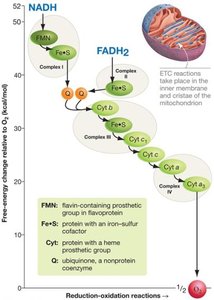
The electron transport chain (ETC) is located in the inner mitochondrial membrane. Electrons from NADH and FADH2 are transferred through protein complexes, creating a proton gradient. ATP synthase uses this gradient to synthesize ATP.
Final electron acceptor: O2 (forms H2O)
Electron carriers: NADH, FADH2
ATP production: Most ATP is made here via oxidative phosphorylation.
Fermentation
Fermentation occurs when oxygen is absent. It regenerates NAD+ so glycolysis can continue, producing lactic acid or ethanol.
Shared pathway: Glycolysis
Purpose: Regenerate NAD+
ATP yield: Much lower than cellular respiration
Example: Yeast undergoes ethanol fermentation.
Photosynthesis
Chloroplast Structure and Function
Photosynthesis occurs in chloroplasts. Thylakoids are membrane-bound sacs; thylakoid space is their interior; stroma is the fluid outside thylakoids. Light reactions occur in thylakoid membranes; Calvin cycle occurs in stroma.
Chlorophyll: Pigment in thylakoid membrane; absorbs light for electron transport chain.
Photosynthesis Equation
Overall equation:
Light Reactions and Electron Transport Chain
Light reactions use photosystems II and I to transfer electrons from water to NADP+, forming NADPH and ATP. Oxygen is produced from water splitting.
Photosystem II: Splits water, releases O2, transfers electrons.
Electron transport chain: Pumps H+ into thylakoid space.
Photosystem I: Transfers electrons to NADP+ to form NADPH.
ATP synthase: Uses H+ gradient to make ATP (photophosphorylation).
Calvin Cycle
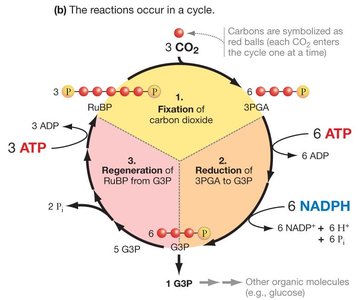
The Calvin cycle fixes carbon from CO2, using ATP and NADPH to produce G3P, which can be converted to glucose. It occurs in the stroma.
Carbon fixation: Catalyzed by rubisco; CO2 is incorporated into RuBP.
Reduction: 3PGA is reduced to G3P using ATP and NADPH.
Regeneration: RuBP is regenerated from G3P.
G3P: 3-carbon sugar; 2 G3P make 1 glucose.
Big Picture Comparison: Cellular Respiration vs. Photosynthesis
Cellular respiration: Oxidizes glucose, transfers electrons to O2, produces ATP.
Photosynthesis: Reduces CO2, transfers electrons from water to NADP+, produces glucose and O2.
Electron transport chain: Both processes use ETC, H+ gradient, and ATP synthase, but differ in electron sources and final acceptors.
Environmental Impact
CO2 removal: Plants remove CO2 from atmosphere; deforestation increases atmospheric CO2.
Global warming: Increased CO2 contributes to climate change.
Key Enzyme Functions
Hexokinase: Phosphorylates glucose.
Phosphofructokinase: Phosphorylates fructose-6-phosphate.
Glyceraldehyde-3-phosphate dehydrogenase: Oxidizes G3P, produces NADH.
Pyruvate dehydrogenase: Oxidizes pyruvate, produces NADH.
Citrate synthase: Synthesizes citrate in citric acid cycle.
Alpha-ketoglutarate dehydrogenase: Oxidizes alpha-ketoglutarate.
Summary Table: Cellular Respiration vs. Photosynthesis
Process | Electron Source | Final Electron Acceptor | Main Products |
|---|---|---|---|
Cellular Respiration | Glucose | O2 | CO2, H2O, ATP |
Photosynthesis | H2O | NADP+ | Glucose, O2 |
Additional info:
Some explanations and context were inferred to ensure completeness and clarity for exam preparation.
Images included are directly relevant to the explanation of glycolysis, citric acid cycle, electron transport chain, and Calvin cycle.
