 Indietro
Energy, Reactions, and Enzymes in Cells: Study Notes
Guida di studio - Note intelligenti
 Appunti personalizzati basati sui tuoi materiali, ampliati con definizioni chiave, esempi e contesto.
Energy, Reactions, and Enzymes
Types of Energy in Biological Systems
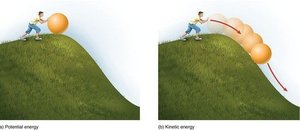
Energy is the capacity to do work or promote change. In biological systems, energy exists primarily as potential energy and kinetic energy.
Potential Energy: Energy due to position or structure. For example, a molecule's covalent bonds store chemical potential energy.
Kinetic Energy: Energy due to motion. Molecules moving faster at higher temperatures possess more kinetic energy.
Example: Holding a ball at the top of a hill (potential energy); releasing it and watching it roll (kinetic energy).
Free Energy and Gibbs Free Energy (G)
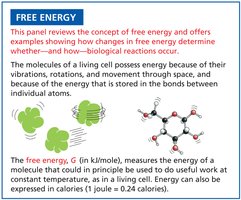
Free energy is the energy in a molecule available to do work. Gibbs Free Energy (G) quantifies this energy, and changes in G (ΔG) determine whether reactions are energetically favorable.
Gibbs Free Energy Change (ΔG): The difference in free energy between products and reactants.
Formula:
Example: Biological reactions often involve changes in free energy as molecules are transformed.
Covalent Bonds and Energy Release
Covalent bonds can be polar or nonpolar, affecting the amount of energy released when broken.
Polar Covalent Bonds: Electrons are held tightly by one atom, releasing less energy when broken.
Nonpolar Covalent Bonds: Electrons are shared equally, releasing more energy when broken.
Example: Methane (CH4) contains nonpolar bonds with higher potential energy compared to CO2 (polar bonds).
Exergonic and Endergonic Reactions
Biological reactions are classified based on their free energy changes:
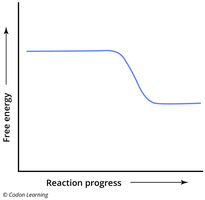
Exergonic Reactions: Release energy; ΔG is negative. Products have lower free energy than reactants. Energetically favorable.
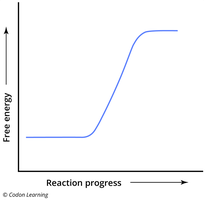
Endergonic Reactions: Require energy input; ΔG is positive. Products have higher free energy than reactants. Energetically unfavorable.
Example: Breakdown of glucose (exergonic); synthesis of proteins (endergonic).
Activation Energy and Transition State
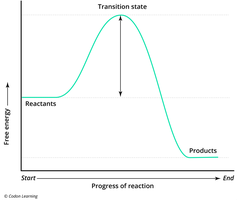
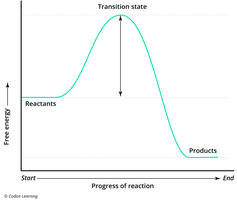
For a reaction to proceed, reactants must reach a transition state, requiring an input of activation energy (Ea).
Activation Energy (Ea): The energy required to initiate a reaction.
Transition State: A high-energy, unstable state that reactants must achieve before forming products.
ΔG does not include activation energy; it only reflects the net change in free energy.
Anabolic and Catabolic Reactions
Metabolic reactions are categorized as anabolic or catabolic:
Anabolic Reactions: Build larger molecules from smaller ones; usually endergonic (require energy).
Catabolic Reactions: Break down larger molecules into smaller ones; usually exergonic (release energy).
Example: Protein synthesis (anabolic); glucose breakdown during respiration (catabolic).
Condensation and Hydrolysis
These are specific types of reactions:
Condensation: Anabolic; joins molecules, often releasing water.
Hydrolysis: Catabolic; splits molecules using water.
Enzymes: Biological Catalysts
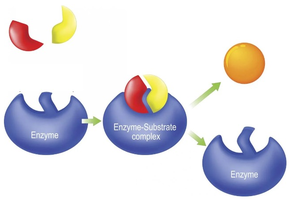
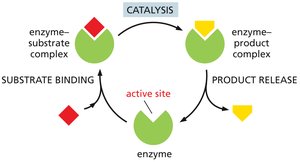
Enzymes are proteins that catalyze biological reactions by lowering activation energy, thus increasing reaction rates without altering ΔG.
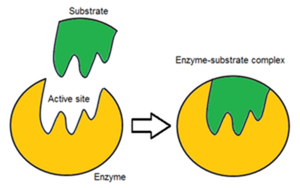
Active Site: The region on the enzyme where substrates bind and reactions occur.
Enzyme-Substrate Complex: Temporary association between enzyme and substrate during catalysis.
Enzymes are highly specific and reusable.
Effect of Enzymes on Reaction Graphs
Enzymes lower the activation energy required for a reaction, making it proceed faster, but do not change the overall ΔG.
Cofactors and Coenzymes
Some enzymes require additional molecules for activity:
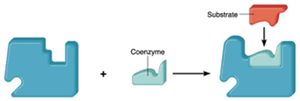
Cofactors: Inorganic ions (e.g., Mg2+, Zn2+) that assist enzyme function, often binding near the active site.
Coenzymes: Organic molecules (e.g., vitamins) that bind to the active site and improve substrate binding.
Example: Vitamin C acts as a coenzyme for certain enzymes.
Enzyme Regulation
Cells regulate enzyme activity to control metabolic pathways:
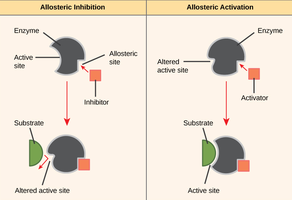
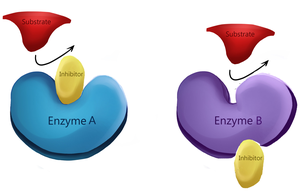
Allosteric Regulation: A molecule binds to a site other than the active site, changing enzyme shape and activity. Can activate or inhibit the enzyme.
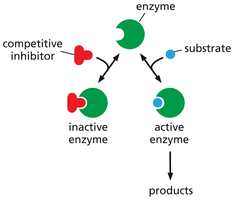
Competitive Inhibition: An inhibitor binds to the active site, blocking substrate access.
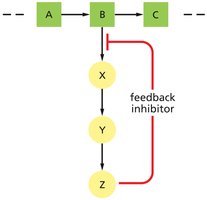
Negative Feedback Inhibition: The end product of a pathway inhibits an early enzyme, preventing overproduction.
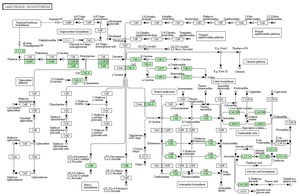
Metabolic Pathways and Enzyme Networks
Cellular metabolism consists of interconnected pathways, each step catalyzed by a specific enzyme. Regulation ensures efficient resource use and prevents waste.

Feedback Inhibition in Metabolic Pathways
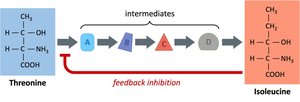
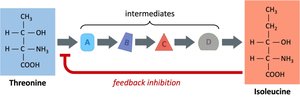
Feedback inhibition is a key regulatory mechanism where the final product inhibits an early enzyme in the pathway, maintaining homeostasis.
Example: Isoleucine synthesis from threonine is regulated by feedback inhibition.
Summary Table: Types of Reactions and Energy Changes
Reaction Type | ΔG | Energy Requirement | Example |
|---|---|---|---|
Exergonic | Negative | Releases energy | Glucose breakdown |
Endergonic | Positive | Requires energy input | Protein synthesis |
Anabolic | Usually positive | Builds molecules | DNA synthesis |
Catabolic | Usually negative | Breaks molecules | Fat breakdown |
Quick Check Questions
At the moment a book is held above your head, it has mostly: Potential energy.
Which bond type generally stores more chemical potential energy? Nonpolar covalent bonds.
Which statement best describes an exergonic reaction? Energy is released during the reaction.
Which process is catabolic? Glucose breakdown during respiration.
If ΔG for a reaction is negative, the reaction is: Exergonic.
What is the main function of enzymes? Lower activation energy.
A competitive inhibitor works by: Binding to the active site.
An allosteric inhibitor affects enzyme activity by: Binding elsewhere and changing enzyme shape.
Additional info: Academic context was added to clarify the relationship between energy types, reaction classifications, enzyme mechanisms, and regulatory processes. All images included directly reinforce the explanations provided.
