 Indietro
Enzyme Function, Regulation, and Metabolic Pathways: Study Notes for General Biology
Guida di studio - Note intelligenti
 Appunti personalizzati basati sui tuoi materiali, ampliati con definizioni chiave, esempi e contesto.
Enzyme Function & Regulation
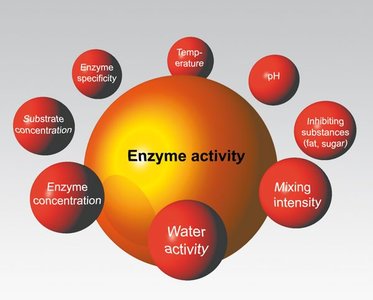
Overview of Enzyme Activity
Enzymes are biological catalysts that accelerate chemical reactions in living organisms by lowering the activation energy required for the reaction to proceed. Their activity is influenced by several factors, which determine how efficiently they catalyze reactions.
Enzyme specificity: Each enzyme is specific to its substrate due to the unique shape of its active site.
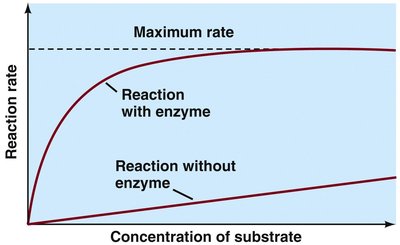
Substrate concentration: Increasing substrate concentration increases reaction rate until the enzyme becomes saturated.
Enzyme concentration: More enzyme molecules can increase the rate of reaction if substrate is available.
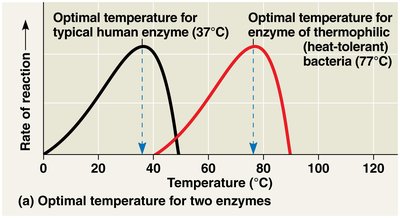
Temperature: Enzyme activity increases with temperature up to an optimal point, after which activity declines due to denaturation.
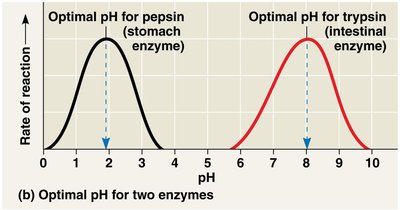
pH: Each enzyme has an optimal pH; deviations can reduce activity or denature the enzyme.
Water activity: Water is essential for enzyme function and substrate interaction.
Mixing intensity: Proper mixing ensures substrate and enzyme interaction.
Inhibiting substances: Certain molecules (e.g., fat, sugar) can inhibit enzyme activity.
Metabolism and Energy
Metabolic Reactions: Anabolism and Catabolism
Metabolism encompasses all chemical reactions in an organism, divided into two main types:
Anabolism: The synthesis of complex molecules from simpler ones, requiring energy input. These are endergonic reactions (ΔG > 0).
Catabolism: The breakdown of complex molecules into simpler ones, releasing energy. These are exergonic reactions (ΔG < 0).
Example: Photosynthesis (anabolic) and cellular respiration (catabolic) are linked processes in metabolism.
Energy in Biological Systems
Potential energy: Stored energy in chemical bonds, gradients, or charge imbalances.
Kinetic energy: Energy of movement, such as heat or motion.
Thermodynamics in Biology
Laws of Thermodynamics
First Law: Energy cannot be created or destroyed, only transformed.
Second Law: Disorder (entropy) tends to increase; some energy is lost as heat in biological processes.
Activation Energy and Reaction Progress
Energy Diagrams and Activation Energy
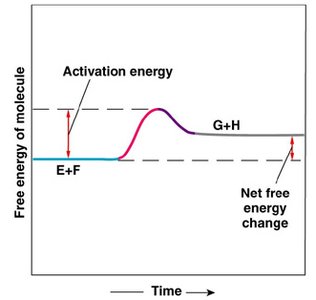
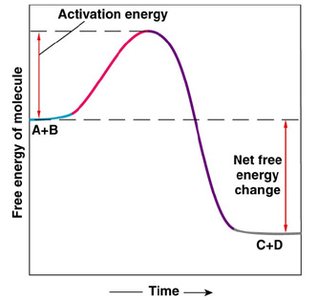
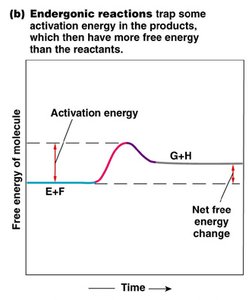
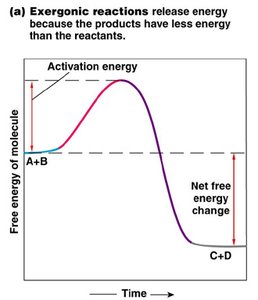
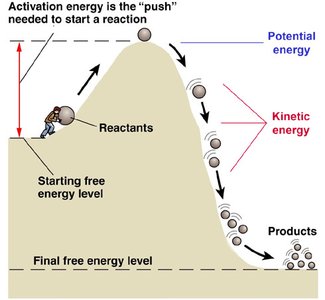
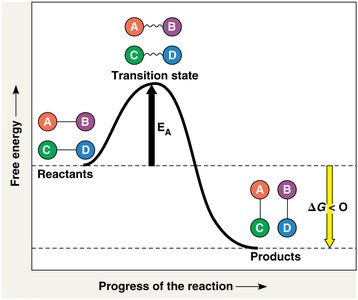
Chemical reactions require an initial input of energy, called activation energy (EA), to reach the transition state. The net change in free energy (ΔG) determines whether a reaction is exergonic or endergonic.
Exergonic reactions: Release energy; products have less free energy than reactants (ΔG < 0).
Endergonic reactions: Require energy input; products have more free energy than reactants (ΔG > 0).
Enzyme Catalysis
How Enzymes Work
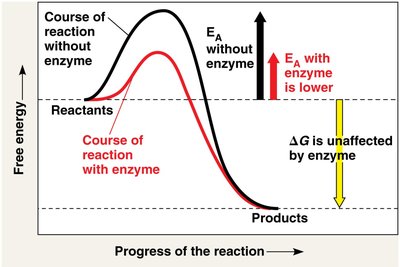
Enzymes lower the activation energy required for reactions, allowing them to proceed faster. They do not change the net free energy (ΔG) of the reaction.
Catalyst: A substance that speeds up a reaction without being consumed.
Enzyme: A biological macromolecule (usually a protein) that acts as a catalyst.
Activation energy: The energy required to initiate a reaction.
Enzyme-Substrate Interaction: Induced Fit Model
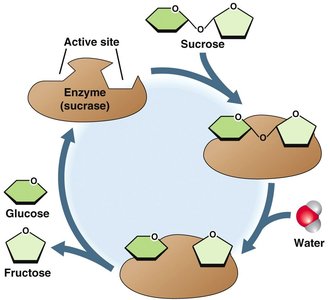
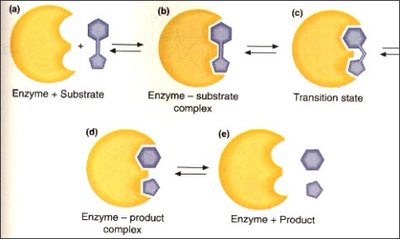
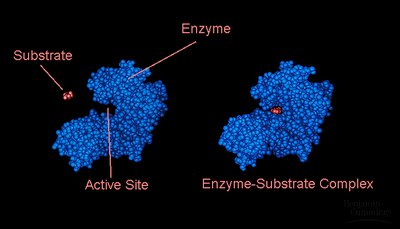
Enzymes bind substrates at their active site, forming an enzyme-substrate complex. The active site changes shape slightly to fit the substrate tightly, a process called induced fit.
Active site: The region of the enzyme where substrate binds.
Substrate: The reactant molecule acted upon by the enzyme.
Induced fit: The enzyme changes shape to better accommodate the substrate.
Mechanisms of Enzyme Action
Enzymes facilitate reactions by:
Inducing strain on substrate bonds (exergonic reactions).
Orienting substrates for optimal interaction (endergonic reactions).
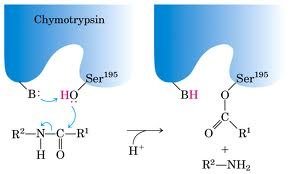
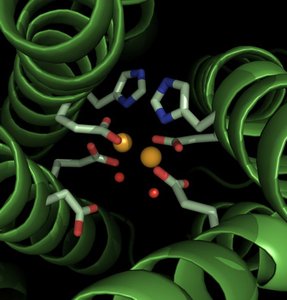
Providing a conducive microenvironment for the reaction.
Involving side chains (R groups) in catalysis.
Enzyme Kinetics
Reaction Rate and Saturation
The rate of enzyme-catalyzed reactions increases with substrate concentration until the enzyme becomes saturated (Vmax).
Saturation: All enzyme molecules are bound to substrate; maximum reaction rate is reached.
Factors Affecting Enzyme Activity
Temperature and pH
Enzymes have optimal temperature and pH ranges. Deviations can reduce activity or cause denaturation.
Optimal temperature: Human enzymes typically function best at 37°C; thermophilic enzymes at higher temperatures.
Optimal pH: Enzymes like pepsin (stomach) function at low pH, while trypsin (intestine) functions at higher pH.
Denaturation
Extreme temperature or pH can denature enzymes, disrupting their structure and function. Example: Cooking an egg denatures its proteins, changing its texture. 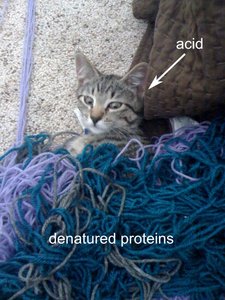

Enzyme Regulation
Allosteric Regulation
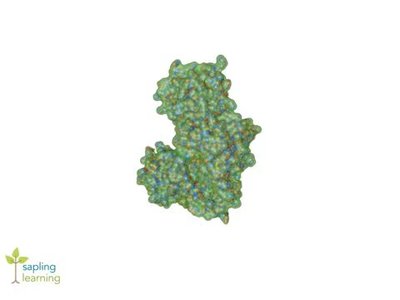
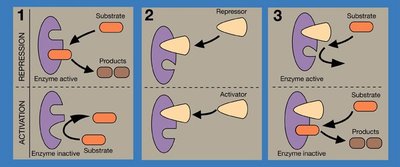
Enzymes can be regulated by molecules binding to sites other than the active site (regulatory binding sites), causing conformational changes that affect activity.
Allosteric regulation: Regulation of enzyme activity by binding of regulatory molecules at allosteric sites.
Allosteric activator: Turns enzyme activity "on".
Allosteric inhibitor: Turns enzyme activity "off".
Cofactors and Coenzymes
Some enzymes require additional molecules for activity:
Cofactors: Inorganic ions (e.g., zinc, iron) that assist enzyme function.
Coenzymes: Organic molecules (e.g., vitamins) that assist enzyme function.
Enzyme Inhibition
Types of Inhibition
Irreversible inhibition: Inhibitor binds covalently to the enzyme, permanently inactivating it.
Reversible inhibition: Inhibitor binds non-covalently and can dissociate.
Competitive inhibition: Inhibitor binds to the active site, blocking substrate binding.
Noncompetitive inhibition: Inhibitor binds to a different site, altering enzyme shape and function.
Metabolic Pathways
Linear and Cyclic Pathways
Metabolic pathways are series of enzyme-catalyzed reactions.
Linear pathway: Substrate is converted to end product through a series of steps.
Cyclic pathway: Substrate is regenerated at the end of the cycle.
Feedback Inhibition
The end product of a pathway can inhibit an enzyme earlier in the pathway, regulating the pathway's activity. Example: Feedback inhibition is common in amino acid biosynthesis.
Terminology
Key Terms
Activation energy
Active site
Allosteric regulation
Allosteric activator
Allosteric inhibitor
Catalyst
Coenzyme
Cofactor
Competitive inhibitor
ΔG
Energy barrier
Enzyme
Enzyme-substrate complex
Feedback inhibition
Induced fit
Irreversible inhibition
Metabolic pathway
Noncompetitive inhibitor
Products
Regulatory binding site
Regulatory molecule
Reversible inhibition
Ribozyme
Saturated
Substrates
Transition state
ATP & Redox Reactions
ATP Structure and Function
ATP (Adenosine Triphosphate): The primary energy carrier in cells.
ATP consists of adenosine, ribose, and three phosphate groups.
Formation of ATP from ADP + Pi is an endergonic reaction (requires energy input).
Redox Reactions
Oxidation: Loss of electrons or hydrogen atoms.
Reduction: Gain of electrons or hydrogen atoms.
In a redox reaction, the oxidizing agent accepts electrons, and the reducing agent donates electrons.
Example: In Na + Cl → Na+ + Cl-, sodium is oxidized (reducing agent), chlorine is reduced (oxidizing agent).
Summary Table: Types of Enzyme Regulation
Type | Mechanism | Effect |
|---|---|---|
Allosteric Regulation | Regulatory molecule binds to site other than active site | Activates or inhibits enzyme |
Competitive Inhibition | Inhibitor binds to active site | Blocks substrate binding |
Noncompetitive Inhibition | Inhibitor binds elsewhere | Changes enzyme shape, reduces activity |
Irreversible Inhibition | Inhibitor binds covalently | Permanently inactivates enzyme |
Summary Table: Anabolic vs. Catabolic Pathways
Pathway | Reaction Type | Energy Change | Example |
|---|---|---|---|
Anabolic | Building complex molecules | Endergonic (ΔG > 0) | Photosynthesis |
Catabolic | Breaking down molecules | Exergonic (ΔG < 0) | Cellular respiration |
Key Equations
Gibbs Free Energy
ΔG = ΔH - TΔS
ATP Formation
ADP + Pi + energy → ATP
Redox Reaction Example
Additional info:
Enzyme regulation is essential for maintaining homeostasis and metabolic balance.
Feedback inhibition prevents overproduction of metabolic products.
Enzyme denaturation is irreversible and results in loss of function.
