 Indietro
Enzyme Kinetics Post-Lab Study Guide
Guida di studio - Note intelligenti
 Appunti personalizzati basati sui tuoi materiali, ampliati con definizioni chiave, esempi e contesto.
Q1. What did you observe about the reaction rates in relation to enzyme dilution, substrate concentration (DOPA), temperature, and pH?
Background
Topic: Enzyme Kinetics
This question tests your understanding of how different factors—enzyme concentration, substrate concentration, temperature, and pH—affect the rate of enzyme-catalyzed reactions. These are foundational concepts in biochemistry and cell biology, especially when studying enzyme activity and regulation.
Key Terms and Concepts:
Enzyme Kinetics: The study of the rates of enzyme-catalyzed reactions.
Substrate: The molecule upon which an enzyme acts.
Reaction Rate: The speed at which the substrate is converted to product.
Optimal Conditions: The specific conditions (e.g., temperature, pH) where enzyme activity is highest.
Step-by-Step Guidance
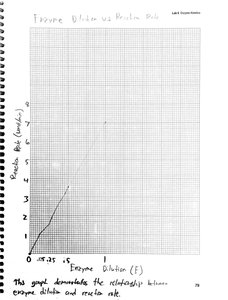
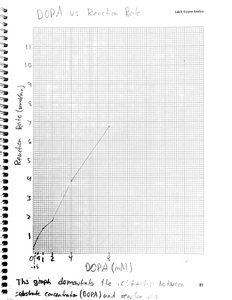
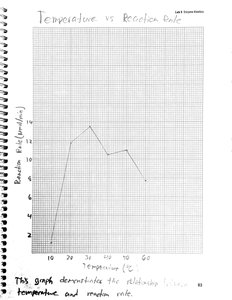
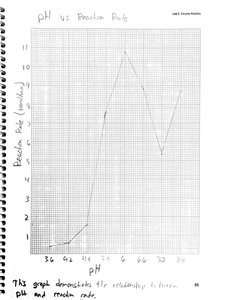
Review the graphs provided for each variable: enzyme dilution, substrate concentration (DOPA), temperature, and pH. Observe the trends in reaction rate as each variable changes.
For enzyme dilution, note how increasing or decreasing the enzyme concentration affects the reaction rate. Consider why more enzyme might speed up the reaction.
For substrate concentration, look for a point where increasing DOPA no longer increases the reaction rate significantly. This is related to enzyme saturation.
For temperature and pH, identify the values at which the reaction rate is highest. Think about why extreme temperatures or pH values might decrease enzyme activity.
Summarize your observations for each variable, but do not state the exact optimal values yet.
Try solving on your own before revealing the answer!
Final Answer:
1. Enzyme dilution: The reaction rate increased with higher enzyme concentrations, showing that more enzyme leads to a faster reaction until other factors become limiting.
2. Substrate concentration (DOPA): The reaction rate increased with more substrate, but eventually plateaued, indicating enzyme saturation (all active sites occupied).
3. Temperature: The reaction rate was highest at an intermediate temperature (around 30°C), with lower rates at both lower and higher temperatures, reflecting the enzyme's optimal temperature range.
4. pH: The reaction rate peaked at a specific pH (around pH 6), with lower rates at more acidic or basic conditions, showing the enzyme's optimal pH.
These observations are consistent with typical enzyme behavior: activity increases with more enzyme or substrate up to a point, and each enzyme has optimal temperature and pH conditions for maximal activity.
Q2. Explain why the reaction rate plateaus at high substrate concentrations.
Background
Topic: Enzyme Saturation and Michaelis-Menten Kinetics
This question tests your understanding of why increasing substrate concentration does not always lead to a proportional increase in reaction rate. This is a key concept in enzyme kinetics, often described by the Michaelis-Menten model.
Key Terms and Concepts:
Enzyme Saturation: The state where all enzyme active sites are occupied by substrate molecules.
Vmax: The maximum reaction rate achieved by the system, at maximum (saturating) substrate concentration.
Michaelis-Menten Equation:
Where is the reaction rate, is substrate concentration, is the maximum rate, and is the Michaelis constant.
Step-by-Step Guidance
Recall that enzymes have a limited number of active sites where substrates can bind.
As substrate concentration increases, more active sites are occupied, and the reaction rate increases.
At high substrate concentrations, all active sites become occupied—this is enzyme saturation.
Once saturation is reached, adding more substrate does not increase the reaction rate further, because the enzyme is working at its maximum capacity ().
Think about how this relates to the shape of the reaction rate vs. substrate concentration graph (it levels off at high [S]).
Try solving on your own before revealing the answer!
Final Answer:
The reaction rate plateaus at high substrate concentrations because all enzyme active sites are occupied—this is called enzyme saturation. At this point, the enzyme is working as fast as possible (at ), and adding more substrate cannot increase the rate further. This is why the reaction rate graph levels off at high substrate concentrations.
Q3. How do temperature and pH affect enzyme activity, and what are the optimal conditions for the enzyme studied?
Background
Topic: Enzyme Activity and Environmental Effects
This question tests your understanding of how environmental factors like temperature and pH influence enzyme structure and function, and how to determine optimal conditions for enzyme activity.
Key Terms and Concepts:
Optimal Temperature: The temperature at which an enzyme's activity is highest.
Optimal pH: The pH at which an enzyme's activity is highest.
Denaturation: Loss of enzyme structure (and function) at extreme temperatures or pH values.
Step-by-Step Guidance
Examine the temperature vs. reaction rate and pH vs. reaction rate graphs to identify where the reaction rate peaks.
Consider why enzyme activity increases with temperature up to a point, then decreases at higher temperatures (think about enzyme structure and denaturation).
Similarly, consider why enzyme activity is highest at a specific pH and decreases at more acidic or basic values (think about changes in enzyme shape or charge).
Identify the temperature and pH values where the reaction rate is highest, but do not state the exact values yet.
Try solving on your own before revealing the answer!
Final Answer:
Enzyme activity increases with temperature up to an optimal point (around 30°C for this enzyme), then decreases due to denaturation at higher temperatures. Similarly, enzyme activity is highest at an optimal pH (around pH 6 for this enzyme), and decreases at more acidic or basic pH values due to changes in enzyme structure. The optimal conditions for this enzyme are approximately 30°C and pH 6.
