 Indietro
Enzymes and Metabolism: Structure, Function, and Regulation
Guida di studio - Note intelligenti
 Appunti personalizzati basati sui tuoi materiali, ampliati con definizioni chiave, esempi e contesto.
C1.1 Enzymes and Metabolism
Introduction to Enzymes and Metabolism
Enzymes are essential biological catalysts that facilitate and regulate metabolic reactions in living organisms. Metabolism encompasses all chemical reactions occurring within cells, divided into anabolic (building up) and catabolic (breaking down) pathways. Understanding enzyme function and regulation is fundamental to studying cellular processes.
Enzymes as Biological Catalysts
Definition and Properties of Enzymes
- Enzymes are proteins that act as catalysts, speeding up chemical reactions without being consumed. - Each enzyme is highly specific to its substrate due to the unique structure of its active site. - Enzymes lower the activation energy required for reactions, enabling biological processes to occur efficiently at physiological conditions.
Examples of Enzymes
- Sucrase: breaks down sucrose into glucose and fructose. - Proteases: break down proteins. - Lipases: break down lipids. - DNA polymerase: builds DNA. - Amylase: breaks down starch. 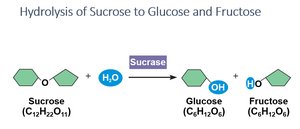
Metabolism: Anabolism and Catabolism
Overview of Metabolic Pathways
Metabolism consists of interconnected pathways that manage the energy and material needs of cells. - Anabolism: Synthesis of complex molecules from simpler ones; requires energy (endergonic). - Catabolism: Breakdown of complex molecules into simpler ones; releases energy (exergonic). 
Synthesis and Breakdown of Polymers
Dehydration Synthesis and Hydrolysis
Cells build and degrade polymers using two fundamental reactions: - Dehydration synthesis (condensation): Joins two monomers by removing a water molecule. - Hydrolysis: Breaks polymers into monomers by adding water. - Enzymes facilitate both reactions, ensuring efficiency and specificity. 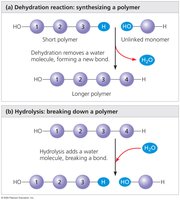
Enzyme Structure and Substrate Specificity
Active Site and Induced Fit
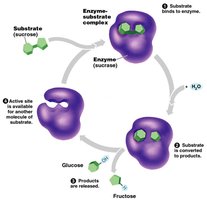
The active site of an enzyme is the region where substrate molecules bind and undergo a chemical reaction. - Substrate specificity: The enzyme's 3D structure determines which substrates it can bind. - Induced fit: The enzyme changes shape slightly to accommodate the substrate, optimizing the reaction. - Lock and key model: The substrate fits precisely into the enzyme's active site. 

Catalysis at the Active Site
Mechanism of Enzyme Action
- Substrates collide with enzymes, forming an enzyme-substrate (ES) complex. - The active site lowers the activation energy (), converting substrates to products. - After releasing products, the enzyme is available for new substrate molecules.
Enzyme Specificity and Reusability
Substrate Specificity and Enzyme Efficiency
- Each enzyme is substrate-specific due to the fit between the active site and substrate. - Substrates are held in the active site by weak interactions (hydrogen bonds, ionic bonds). - Enzymes are not consumed in reactions; a single enzyme can catalyze thousands of reactions per second.
Immobilized Enzymes
Industrial Applications and Advantages
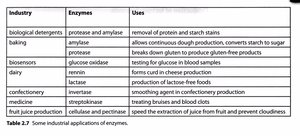
Immobilized enzymes are used extensively in industry for their efficiency and ease of product recovery. - Enzymes can be attached to surfaces, trapped in gels, or bonded in aggregates. - Advantages include easier product collection, increased enzyme stability, and high enzyme concentration. 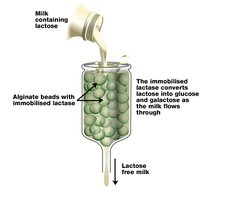
Industrial Applications of Enzymes
Industry | Enzymes | Uses |
|---|---|---|
Biological detergents | Protease, amylase | Removal of protein and starch stains |
Baking | Amylase | Converts starch to sugar, allows dough production |
Biosensors | Glucose oxidase | Testing for glucose in blood samples |
Dairy | Rennin, lactase | Curd formation, lactose-free milk production |
Confectionery | Invertase | Smoothing agent in confectionery production |
Medicine | Streptokinase | Treating bruises and blood clots |
Fruit juice production | Cellulase, pectinase | Extraction of juice, prevention of cloudiness |
Denaturation of Enzymes
Loss of Structure and Function
Enzymes are proteins, and their function depends on their three-dimensional structure. - Denaturation: Alterations in pH, salt concentration, temperature, or other environmental factors can cause a protein to unravel, losing its native structure and biological activity. 
Factors Affecting Enzyme Activity
Environmental and Chemical Influences
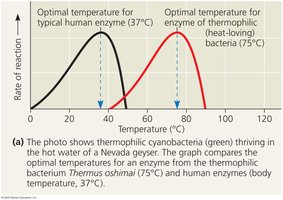
Several factors influence the rate of enzyme-catalyzed reactions: - Enzyme concentration: More enzymes increase reaction rate until substrate becomes limiting. - Substrate concentration: More substrate increases reaction rate until all enzyme active sites are saturated. - Temperature: Reaction rate increases with temperature up to an optimum, then decreases due to denaturation. - pH: Each enzyme has an optimal pH; deviations can disrupt structure and function. - Salinity: Changes in salt concentration can affect enzyme activity. - Inhibitors/Activators: Chemicals that decrease or increase enzyme activity, respectively.
Effect of Temperature
- At low temperatures, molecules move slowly, resulting in fewer collisions. - As temperature increases, molecular agitation increases, leading to more collisions and higher reaction rates. - At optimum temperature, the greatest number of collisions occurs. - At high temperatures, weak bonds are disrupted, causing denaturation. 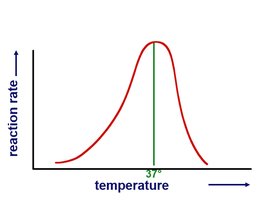
Effect of pH
- Each enzyme has an optimal pH for maximum activity. - Changes in pH alter amino acid interactions and charges, disrupting bonds and 3D shape. - Most human enzymes function at pH 6-8; pepsin (stomach) at pH 3, trypsin (intestines) at pH 8. 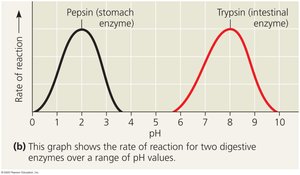
Effect of Substrate Concentration
- Increasing substrate concentration increases reaction rate until all enzyme active sites are engaged (saturation). - At saturation, the reaction rate reaches its maximum. 
Effect of Enzyme Concentration
- Increasing enzyme concentration increases reaction rate until substrate becomes limiting. - Not all enzyme molecules can find substrate when substrate is limited. 
Summary Table: Factors Affecting Enzyme Activity
Factor | Effect |
|---|---|
Enzyme concentration | Increases reaction rate until substrate is limiting |
Substrate concentration | Increases reaction rate until enzyme is saturated |
Temperature | Increases reaction rate to optimum, then decreases due to denaturation |
pH | Optimal pH for each enzyme; deviations decrease activity |
Salinity | Extreme changes can denature enzymes |
Inhibitors/Activators | Decrease or increase enzyme activity |
Key Equations
Activation Energy and Enzyme Catalysis
- Activation energy (): The energy barrier that must be overcome for a reaction to proceed. - Enzymes lower , increasing the rate of reaction. Additional info: is the change in free energy, is the change in enthalpy, is temperature, and is the change in entropy.
Conclusion
Enzymes are vital for life, enabling efficient and regulated metabolic reactions. Their activity is influenced by environmental and chemical factors, and their specificity and reusability make them indispensable in both biological and industrial contexts.
