 Indietro
Enzymes and Metabolism: Structure, Function, and Regulation
Guida di studio - Note intelligenti
 Appunti personalizzati basati sui tuoi materiali, ampliati con definizioni chiave, esempi e contesto.
C1.1 Enzymes and Metabolism
Introduction to Enzymes and Metabolism
Enzymes are essential biological catalysts that facilitate and regulate metabolic reactions in living organisms. Metabolism encompasses all chemical reactions occurring within cells, divided into anabolic (building up) and catabolic (breaking down) pathways. Understanding enzyme function and regulation is fundamental to General Biology.
Enzymes are proteins that speed up chemical reactions without being consumed.
Metabolism includes both anabolism (endergonic, energy-requiring synthesis) and catabolism (exergonic, energy-releasing breakdown).
Enzymes are highly specific for their substrates and reactions.
Enzyme Function and Specificity
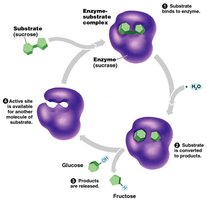
Enzymes interact with substrates at their active sites, forming enzyme-substrate complexes that lower activation energy and convert substrates into products.
Active site: The region of the enzyme where substrate binding occurs.
Induced fit: Enzyme changes shape to better fit the substrate, facilitating catalysis.
Lock and key model: The enzyme's 3D structure fits the substrate precisely.
Enzymes are reusable and not consumed in the reaction.


Examples of Enzymes and Their Functions
Enzymes catalyze a variety of biological reactions, each with specific substrates.
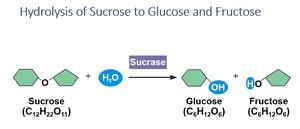
Sucrase: Breaks down sucrose into glucose and fructose.
Proteases: Break down proteins.
Lipases: Break down lipids.
DNA polymerase: Synthesizes DNA.
Amylase: Breaks down starch.
Metabolism: Anabolism and Catabolism
Metabolic pathways are interconnected, with anabolism building molecules and catabolism breaking them down.
Anabolism: Synthesis of complex molecules; requires energy.
Catabolism: Breakdown of complex molecules; releases energy.

Synthesis and Breakdown of Polymers
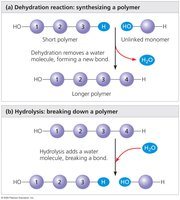
Cells synthesize and degrade polymers using dehydration synthesis and hydrolysis, processes facilitated by enzymes.
Dehydration synthesis: Joins monomers by removing water.
Hydrolysis: Breaks polymers into monomers by adding water.
Immobilized Enzymes and Industrial Applications
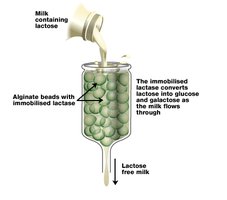
Immobilized enzymes are used in industry for increased efficiency and stability.
Enzymes can be immobilized in gels or on surfaces, making product collection easier.
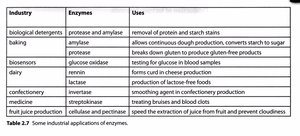
Applications include baking, cheese making, brewing, detergents, and medicine.
Industry | Enzymes | Uses |
|---|---|---|
Biological detergents | Protease, amylase | Removal of protein and starch stains |
Baking | Amylase | Converts starch to sugar, dough production |
Biosensors | Glucose oxidase | Testing for glucose in blood |
Dairy | Rennin, lactase | Cheese production, lactose-free milk |
Medicine | Streptokinase | Treating blood clots |
Fruit juice production | Cellulase, pectinase | Extraction and clarity of juice |
Denaturation of Enzymes
Environmental changes such as pH, temperature, and salt concentration can denature enzymes, rendering them inactive.
Denaturation: Loss of protein's native structure due to environmental stress.
Denatured enzymes cannot catalyze reactions.

Factors Affecting Enzyme Activity
Enzyme activity is influenced by several factors, including enzyme and substrate concentration, temperature, pH, and salinity.
Enzyme concentration: More enzymes increase reaction rate until substrate becomes limiting.
Substrate concentration: More substrate increases reaction rate until enzymes are saturated.
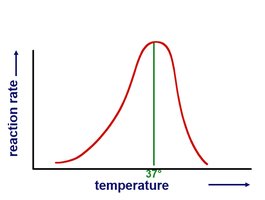
Temperature: Reaction rate increases with temperature up to an optimum, then decreases due to denaturation.
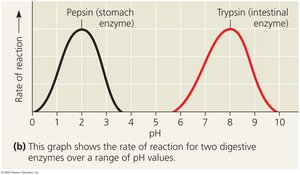
pH: Each enzyme has an optimal pH; deviations disrupt structure and function.
Salinity: Changes in salt concentration can affect enzyme structure and activity.
Inhibitors/Activators: Chemicals that decrease or increase enzyme activity.
Effect of Temperature
Low temperature: Slow molecular movement, fewer collisions.
Optimum temperature: Maximum reaction rate.
High temperature: Denaturation occurs, reaction rate drops.

Effect of pH
Optimal pH varies by enzyme (e.g., pepsin pH 3, trypsin pH 8).
Changes in pH alter amino acid interactions and enzyme shape.
Effect of Substrate Concentration
Increasing substrate increases reaction rate until enzymes are saturated.
At saturation, maximum rate is reached.

Effect of Enzyme Concentration
Increasing enzyme increases reaction rate until substrate becomes limiting.

Summary Table: Factors Affecting Enzyme Activity
Factor | Effect |
|---|---|
Enzyme concentration | Increases rate until substrate is limiting |
Substrate concentration | Increases rate until enzyme is saturated |
Temperature | Increases rate to optimum, then decreases due to denaturation |
pH | Optimal pH for each enzyme; extremes cause denaturation |
Salinity | Changes can disrupt enzyme structure |
Inhibitors/Activators | Decrease/increase enzyme activity |
Key Equations
Activation Energy Reduction: Enzymes lower the activation energy () required for reactions.
General Enzyme Reaction:
Conclusion
Enzymes are vital for life, enabling and regulating metabolic reactions. Their activity is influenced by environmental and chemical factors, and their specificity and efficiency make them indispensable in both biological systems and industrial applications. Understanding enzyme structure, function, and regulation is foundational for further study in biology.
