 Indietro
Enzymes and the Regulation of Metabolism
Guida di studio - Note intelligenti
 Appunti personalizzati basati sui tuoi materiali, ampliati con definizioni chiave, esempi e contesto.
Enzymes and Metabolic Reactions
Spontaneous Reactions and Catalysts
Spontaneous reactions are chemical processes that occur without the input of additional energy. However, these reactions can be extremely slow in biological systems. Catalysts are substances that increase the rate of a reaction without being consumed in the process. In biological systems, most catalysts are enzymes.
Enzymes: Biological Catalysts
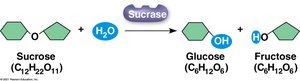
Enzymes are macromolecules, typically proteins, that act as biological catalysts. They accelerate specific chemical reactions by lowering the activation energy required for the reaction to proceed. For example, the enzyme sucrase catalyzes the hydrolysis of sucrose into glucose and fructose, a reaction that would otherwise occur very slowly at room temperature.
The Activation Energy Barrier
Chemical Reactions and Activation Energy
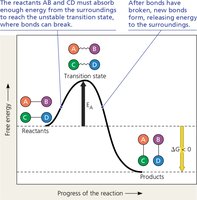
All chemical reactions involve the breaking and forming of chemical bonds. The activation energy (E_A) is the initial energy investment required to start a reaction. This energy is often supplied by heat from the surroundings, which pushes reactants into a high-energy, unstable transition state where bonds can break and new ones can form.
Role of Enzymes in Lowering Activation Energy
Enzymes catalyze reactions by lowering the activation energy barrier, allowing reactions to occur at moderate temperatures. Importantly, enzymes do not change the overall free energy change (ΔG) of a reaction; they simply make it proceed faster.
Enzyme Structure and Specificity
Substrate Specificity and the Active Site
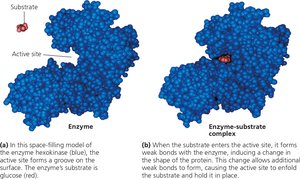
Each enzyme is specific to its substrate—the reactant it acts upon. The active site is a region on the enzyme, often a pocket or groove, where the substrate binds. The shape and chemical environment of the active site are complementary to the substrate, ensuring specificity. The enzyme-substrate complex forms when the substrate binds to the active site, allowing the enzyme to catalyze the reaction.
Mechanism of Enzyme Action
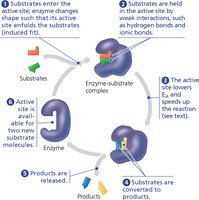
The catalytic cycle of an enzyme involves several steps:
Substrates enter the active site, and the enzyme changes shape to enfold the substrates (induced fit).
Substrates are held in the active site by weak interactions.
The active site lowers the activation energy and speeds up the reaction.
Substrates are converted to products.
Products are released, and the active site is available for new substrates.
Factors Affecting Enzyme Activity
Substrate Concentration
The rate of an enzyme-catalyzed reaction increases with substrate concentration, but only up to a point. When all enzyme active sites are occupied (enzyme saturation), the reaction rate plateaus. To increase the rate further, more enzyme molecules must be added.
Temperature and pH
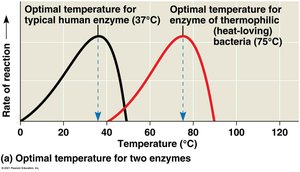
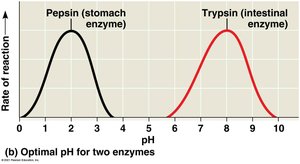
Each enzyme has an optimal temperature and pH at which it functions most efficiently. Increasing temperature generally increases reaction rate up to the enzyme's optimal temperature, beyond which the enzyme denatures and loses activity. Similarly, each enzyme has an optimal pH, and deviations from this pH can reduce activity or denature the enzyme.
Cofactors and Enzyme Inhibition
Cofactors
Cofactors are nonprotein molecules that assist enzymes in catalysis. They can be inorganic (such as metal ions like zinc, iron, or copper) or organic. Organic cofactors are called coenzymes, and many vitamins serve as coenzymes or their precursors.
Enzyme Inhibitors
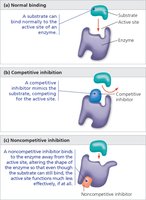
Certain chemicals can inhibit enzyme activity. Competitive inhibitors resemble the substrate and bind to the active site, blocking substrate access. This inhibition can be overcome by increasing substrate concentration. Noncompetitive inhibitors bind to a different part of the enzyme, causing a conformational change that reduces the enzyme's activity regardless of substrate concentration.
Regulation of Enzyme Activity
Allosteric Regulation
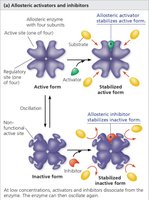
Allosteric regulation occurs when a regulatory molecule binds to a site other than the active site, causing a change in enzyme activity. This can either inhibit or activate the enzyme. Allosteric enzymes often have multiple subunits and active sites, allowing for complex regulation.
Cooperativity
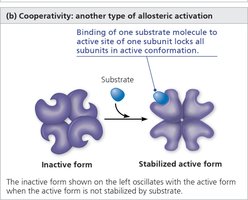
Cooperativity is a form of allosteric activation where binding of a substrate to one active site stabilizes the active form of all subunits, enhancing enzyme activity.
Feedback Inhibition
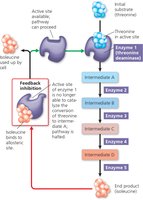
Feedback inhibition is a regulatory mechanism in which the end product of a metabolic pathway inhibits an enzyme involved earlier in the pathway. This prevents the cell from producing more product than needed, conserving resources.
Summary Table: Types of Enzyme Regulation
Type of Regulation | Mechanism | Effect |
|---|---|---|
Competitive Inhibition | Inhibitor binds active site | Blocks substrate; reversible by adding substrate |
Noncompetitive Inhibition | Inhibitor binds elsewhere | Changes enzyme shape; not reversible by substrate |
Allosteric Regulation | Regulator binds allosteric site | Can activate or inhibit enzyme |
Feedback Inhibition | End product inhibits pathway | Prevents overproduction of product |
Practice Questions
An enzyme speeds up a chemical reaction by lowering the energy of activation.
If cytoplasmic pH drops from 7.2 to 4.0, enzymes would probably denature and enzymatic activity would decline.
A mutation in a gene can alter all properties of the enzyme, including substrate affinity, amino acid sequence, allosteric regulation, and optimal pH.
Some enzymes couple ATP hydrolysis to ion transport by using energy from ATP hydrolysis to change enzyme shape, forcing ionic transport.
If an enzyme is saturated with substrate, the most effective way to increase product yield is to add more enzyme.
Some bacteria are active in hot springs because their enzymes have high optimal temperatures.
Feedback inhibition is when the end product of a pathway inhibits an enzyme earlier in the pathway.
Feedback inhibition and allosteric regulation often induce structural changes in the enzyme, influencing its activity.
