 Indietro
Enzymes: Structure, Function, and Experimental Analysis
Guida di studio - Note intelligenti
 Appunti personalizzati basati sui tuoi materiali, ampliati con definizioni chiave, esempi e contesto.
Enzymes: Structure, Function, and Experimental Analysis
Introduction to Enzymes
Enzymes are biological catalysts that accelerate chemical reactions in living organisms by lowering the activation energy required for the reaction. They are essential for metabolic processes and are typically proteins with highly specific functions.
Catalyst: A substance that increases the rate of a chemical reaction without being consumed.
Enzyme: A catalytic protein that facilitates biochemical reactions.
Example: The hydrolysis of sucrose by the enzyme sucrase.


Activation Energy and Enzyme Function
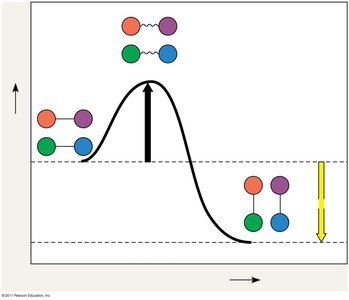
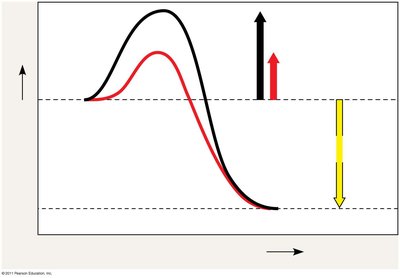
Every chemical reaction involves breaking and forming bonds. The initial energy required to start a reaction is called activation energy (EA). Enzymes lower this energy barrier, allowing reactions to proceed more rapidly.
Activation Energy (EA): The minimum energy required to initiate a chemical reaction.
Enzyme Action: Enzymes lower EA but do not affect the change in free energy () of the reaction.
Enzyme Stability: Enzymes are not consumed or altered during the reaction.
Substrate Specificity and Enzyme-Substrate Complex
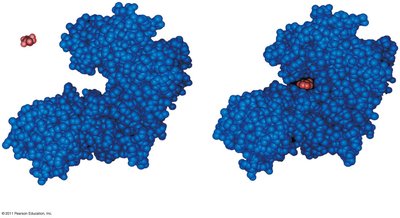
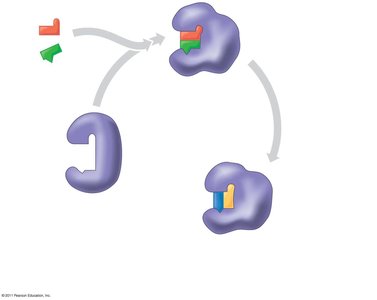
Enzymes are highly specific for their substrates, the reactants they act upon. The substrate binds to the enzyme's active site, forming an enzyme-substrate complex. The induced fit model describes how the enzyme changes shape to better accommodate the substrate.
Substrate: The reactant that an enzyme acts upon.
Active Site: The region of the enzyme where the substrate binds.
Induced Fit: The enzyme adjusts its shape to enhance catalysis when the substrate binds.
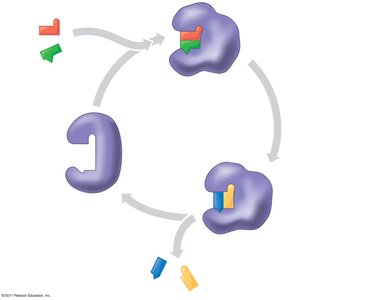
Catalysis in the Enzyme’s Active Site
Enzymes facilitate reactions by lowering the activation energy through several mechanisms:
Orienting substrates correctly
Straining substrate bonds
Providing a favorable microenvironment
Covalently bonding to the substrate
Factors Affecting Enzyme Activity
Enzyme activity is influenced by substrate concentration, enzyme concentration, temperature, pH, and the presence of specific chemicals.
Substrate Concentration: Increasing substrate concentration increases reaction rate up to a point, after which the rate plateaus.
Enzyme Concentration: Enzymes remain unchanged after the reaction and can continue to catalyze as long as substrate is available.
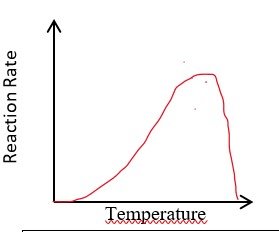
Temperature: Each enzyme has an optimal temperature for activity. Increasing temperature increases reaction rate until the enzyme denatures.
pH: Enzymes have an optimal pH. Deviations from this pH can reduce activity or denature the enzyme.
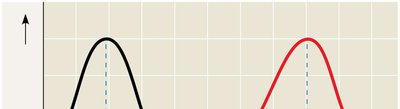
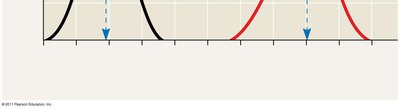
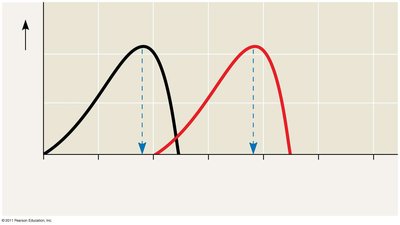
Experimental Analysis of Enzyme Activity
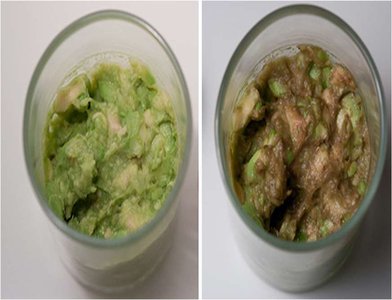
Experiments can be designed to measure the effects of substrate concentration, enzyme concentration, pH, and temperature on enzyme activity. Catecholase is an enzyme used in such experiments, with catechol as the substrate and benzoquinone as the product.
Catecholase: Enzyme found in potatoes, catalyzes the conversion of catechol to benzoquinone.
Benzoquinone: Product of catechol oxidation, responsible for browning in fruits and vegetables.
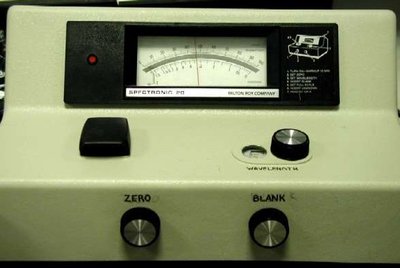
Spectrophotometer: Instrument used to measure absorbance, which correlates with product concentration.


Beer’s Law and Spectrophotometry
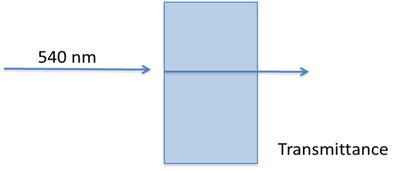
Beer’s law states that the amount of light absorbed by a solution is proportional to the concentration of the absorbing solute. Absorbance (A) is measured at a specific wavelength (λ), typically 540 nm for benzoquinone.
Beer’s Law:
Transmittance: The amount of light passing through a solution.
Absorbance: The amount of light absorbed by the solution.
Laboratory Techniques and Procedures
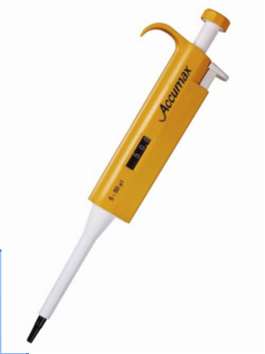
Proper laboratory techniques are essential for accurate measurement of enzyme activity. This includes correct pipetting, calibration of spectrophotometers, and careful timing of reactions.
Pipetting: Use graduated or plunger-type pipettes for precise measurement of liquids.
Calibration: Zero and blank the spectrophotometer before measurements.
Timing: Stagger addition of reactants and measure absorbance at consistent intervals.
Summary Table: Factors Affecting Enzyme Activity
Factor | Effect on Enzyme Activity | Optimal Condition |
|---|---|---|
Substrate Concentration | Increases rate until saturation | High, but not excessive |
Enzyme Concentration | Increases rate with more enzyme | Enough enzyme to match substrate |
Temperature | Increases rate to optimal, then decreases | Optimal temperature (e.g., 37°C for human enzymes) |
pH | Increases rate to optimal, then decreases | Optimal pH (e.g., pH 2 for pepsin, pH 8 for trypsin) |
Clean Up and Safety
Proper clean-up and safety procedures are essential in enzyme experiments. Always wear gloves when handling toxic substrates like catechol, and follow laboratory protocols for disposal and equipment maintenance.
Dispose of liquids down the drain.
Rinse and clean test tubes thoroughly.
Turn off hot plates and thermometers; leave spectrophotometers on.
Wash hands after completing experiments.
