 Indietro
Enzymes: Structure, Function, and Regulation
Guida di studio - Note intelligenti
 Appunti personalizzati basati sui tuoi materiali, ampliati con definizioni chiave, esempi e contesto.
Enzymes and Activation Energy
Definition and Role of Enzymes
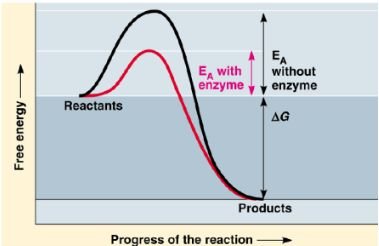
Enzymes are organic catalytic proteins that accelerate chemical reactions in biological systems by lowering the activation energy (E_A) required for the reaction to proceed. They are not consumed or permanently altered during the reaction, allowing them to be reused multiple times.
Catalyst: A substance that increases the rate of a chemical reaction without being consumed.
Activation Energy (E_A): The minimum energy required to initiate a chemical reaction.
Enzymes lower the activation energy, making reactions proceed faster and under milder conditions.
Exergonic and Endergonic Reactions
Chemical reactions can be classified based on their energy changes:
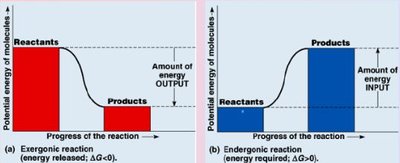
Exergonic Reaction: Releases energy; occurs spontaneously after activation energy is reached. The change in free energy (ΔG) is negative, and products have less energy than reactants.
Endergonic Reaction: Requires an input of energy; nonspontaneous. The change in free energy (ΔG) is positive, and products have more energy than reactants.
Enzyme Structure and Mechanism
Active Site and Substrate Binding
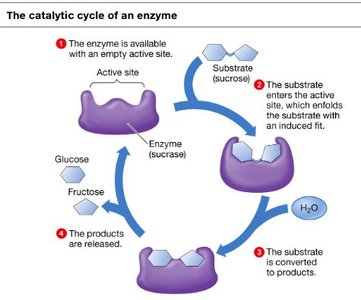
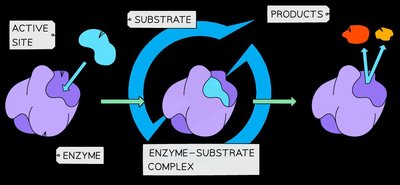
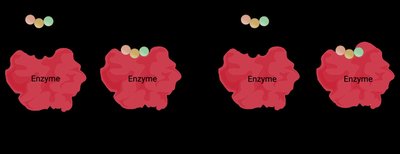
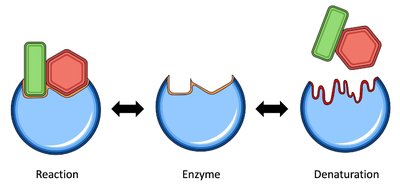
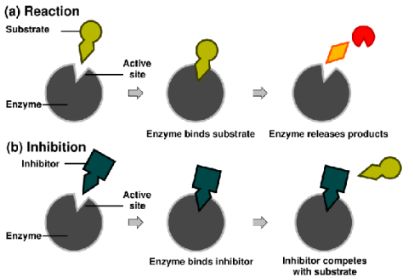
Enzymes possess a specific region called the active site, where the substrate binds to form an enzyme-substrate complex. The substrate is the molecule upon which the enzyme acts.
Enzyme names often end in -ase and are frequently named after their substrate (e.g., sucrase acts on sucrose).
Enzymes are highly specific due to the unique shape of their active site.
Most enzyme-catalyzed reactions are reversible.
Models of Enzyme Action
Lock and Key Model: The substrate fits perfectly into the enzyme's active site, like a key in a lock.
Induced Fit Model: The active site molds itself around the substrate for a tighter fit, enhancing catalysis.
Types of Enzymes
Catabolic vs. Anabolic Enzymes
Enzymes are classified based on the type of reaction they catalyze:
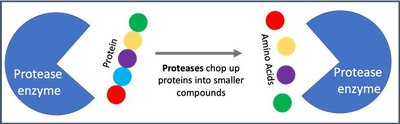
Catabolic Enzymes: Break down large molecules into smaller components (e.g., proteases hydrolyze proteins, lactase breaks down lactose).
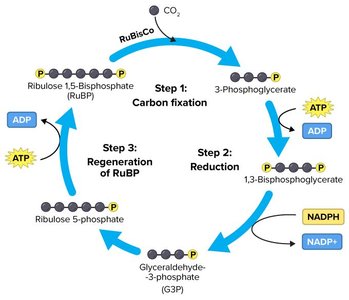
Anabolic Enzymes: Build larger molecules from smaller building blocks (e.g., ATP synthase forms ATP, Rubisco is involved in the Calvin cycle of photosynthesis).
Factors Affecting Enzyme Activity
Concentration, Temperature, and pH
Enzyme activity is influenced by several factors:
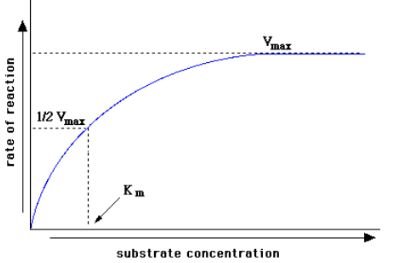
Substrate/Enzyme Concentration: Increasing concentration increases reaction rate until the enzyme is saturated.
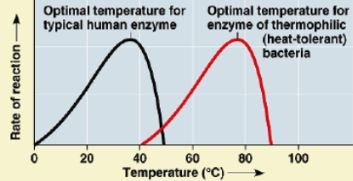
Temperature: Activity increases with temperature up to an optimal point, then decreases due to denaturation.
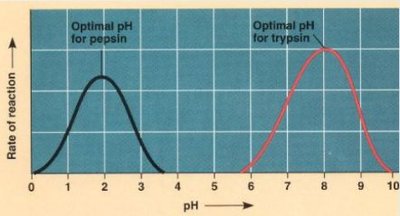
pH: Each enzyme has an optimal pH; activity decreases outside this range.
Denaturation
Denaturation is the loss of enzyme structure and function due to extreme temperature or pH, resulting in the inability to bind substrates.
Cofactors and Coenzymes
Helpers in Enzyme Activity
Cofactors: Inorganic ions (e.g., zinc, iron, copper) required for enzyme activity.
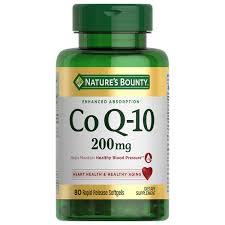
Coenzymes: Organic molecules (often derived from vitamins) that assist enzymes (e.g., CoQ10/ubiquinone).
Enzymes are only active when all necessary cofactors and coenzymes are present.
Regulation of Enzyme Activity
Competitive and Noncompetitive Inhibition
Competitive Inhibitors: Molecules similar in shape to the substrate compete for the active site, blocking substrate binding.
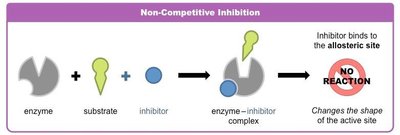
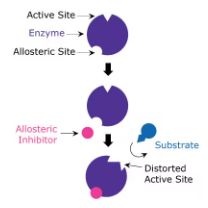
Noncompetitive Inhibitors: Bind to a site other than the active site (allosteric site), changing the enzyme's shape and reducing activity.
Some drugs and poisons act as enzyme inhibitors (e.g., penicillin, sarin).
Allosteric Regulation and Cooperativity
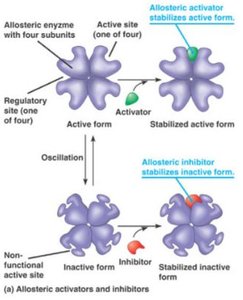
Allosteric Regulation: Regulatory molecules bind to an allosteric site, altering enzyme activity by changing its conformation.
Allosteric Activators: Stabilize the active form of the enzyme.
Allosteric Inhibitors: Stabilize the inactive form, preventing catalysis.
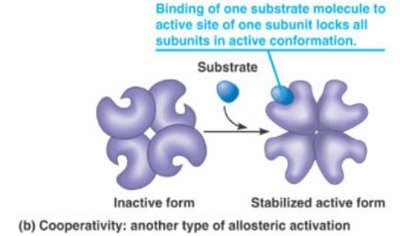
Cooperativity: Binding of one substrate molecule enhances the binding of additional substrate molecules to other subunits.
Reversible and Irreversible Inhibition
Reversible Inhibitors: Bind temporarily to the enzyme and can dissociate, allowing enzyme function to resume.
Irreversible Inhibitors: Form covalent bonds with the enzyme, permanently inactivating it.
Feedback Inhibition
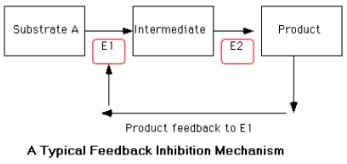
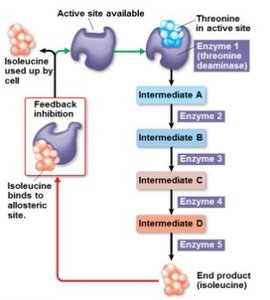
Feedback inhibition is a regulatory mechanism in which the end product of a metabolic pathway inhibits an enzyme involved early in the pathway, preventing overproduction of the product.
Helps maintain homeostasis and efficient resource use in cells.
Type of Regulation | Mechanism | Example |
|---|---|---|
Competitive Inhibition | Inhibitor binds to active site | Penicillin inhibiting bacterial enzymes |
Noncompetitive Inhibition | Inhibitor binds to allosteric site | Sarin inhibiting acetylcholinesterase |
Allosteric Regulation | Activator/inhibitor binds to allosteric site | Phosphofructokinase in glycolysis |
Feedback Inhibition | End product inhibits early enzyme | Isoleucine synthesis pathway |
Additional info: Enzyme kinetics can be described by the Michaelis-Menten equation: , where is the reaction rate, is the maximum rate, is substrate concentration, and is the substrate concentration at half-maximal velocity.
