 Indietro
Evolution: Life on Earth and the Foundations of Evolutionary Biology
Guida di studio - Note intelligenti
 Appunti personalizzati basati sui tuoi materiali, ampliati con definizioni chiave, esempi e contesto.
Evolution and Life on Earth
Introduction to Evolutionary Biology
Evolutionary biology explores how life on Earth has diversified and adapted over time. The publication of Charles Darwin's The Origin of Species in 1859 marked the beginning of modern evolutionary science. Darwin's ideas were influenced by his travels, observations, and the works of other scientists. 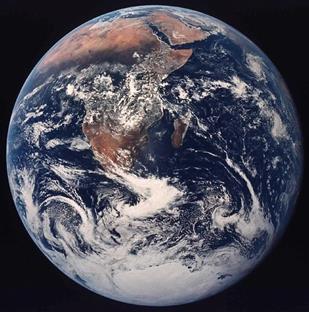
Descent with Modification
The process of evolution is defined as the accumulation of differences from ancestors as species adapt to various environments. Darwin summarized this as "descent with modification," meaning that species share a common ancestry but diverge as they adapt. - **Key Point 1:** Species accumulate differences from their ancestors over generations. - **Key Point 2:** Adaptation to different environments leads to diversity. - **Example:** The diversity of life arises from shared ancestry and accumulated differences. 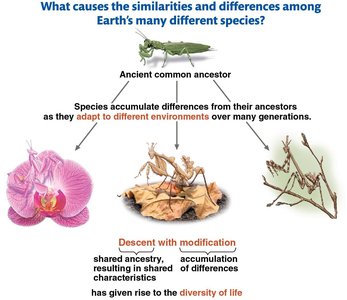
Historical Foundations of Evolutionary Theory
Timeline of Key Scientific Contributions
The development of evolutionary theory involved contributions from many scientists: - **1795:** Hutton proposes gradualism. - **1798:** Malthus publishes on population principles. - **1809:** Lamarck publishes his hypothesis of evolution. - **1812:** Cuvier studies vertebrate fossils. - **1830:** Lyell publishes Principles of Geology. - **1831–1836:** Darwin travels on HMS Beagle. - **1858:** Wallace sends Darwin his hypothesis of natural selection. - **1859:** Darwin publishes The Origin of Species. 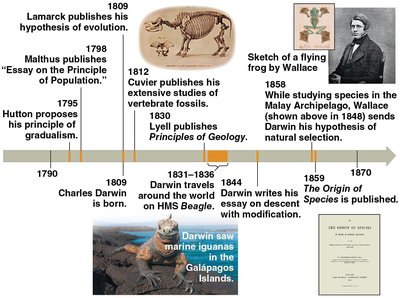
Darwin's Observations and the Galápagos Islands
Darwin's travels, especially to the Galápagos Islands, provided crucial evidence for his theory. He observed unique species, such as the Galápagos tortoise, which contributed to his understanding of adaptation and speciation. 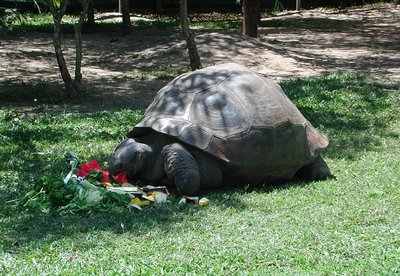
Evidence for Evolution
Fossils and Sedimentary Rock
Fossils are preserved remains or traces of ancient organisms, often found in sedimentary rock layers called strata. - **Key Point 1:** Older strata contain fossils less similar to current organisms. - **Key Point 2:** Fossil evidence shows the appearance and disappearance of species over time. 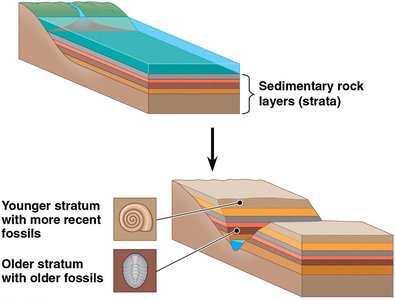
Geological Processes and Earth's Age
Scientists like Hutton and Lyell proposed that slow, continuous geological processes shape Earth's features, suggesting that Earth is much older than previously thought. 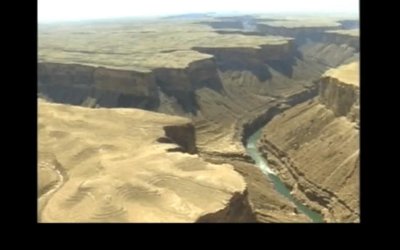
Early Hypotheses of Evolution
Lamarck's Hypothesis
Jean-Baptiste de Lamarck proposed that evolution occurs through use and disuse of body parts and the inheritance of acquired characteristics. However, this mechanism is not supported by experimental evidence. - **Key Point 1:** Use and disuse lead to changes in body parts. - **Key Point 2:** Acquired traits are inherited (not supported by evidence). 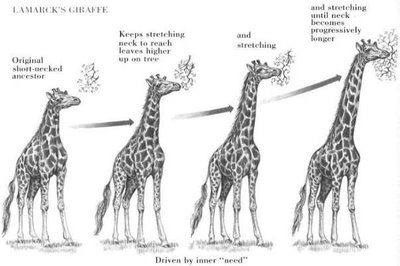
Darwin's Theory of Natural Selection
Darwin's Voyage and Observations
Darwin's journey on HMS Beagle allowed him to observe diverse species and collect evidence for natural selection. 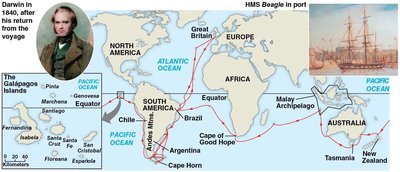
Galápagos Finches and Adaptation
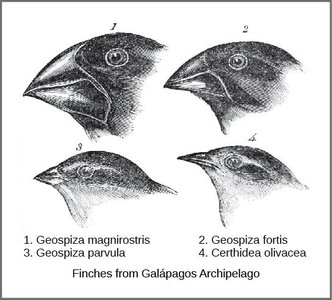
Darwin observed that finch species on the Galápagos Islands had different beak shapes, adapted to their specific food sources. - **Key Point 1:** Beak shape varies among finch species. - **Key Point 2:** Adaptation to food sources drives evolutionary change. 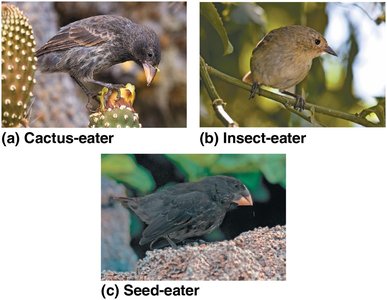
Natural Selection Explained
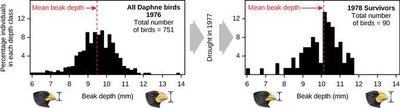
Natural selection is the process by which individuals with advantageous traits survive and reproduce at higher rates. Over time, these traits become more common in the population. - **Key Point 1:** Survival and reproduction depend on inherited traits. - **Key Point 2:** Favorable traits increase in frequency. - **Example:** Finches with beak shapes suited to available food sources survive droughts better.
Descent with Modification and Evolutionary Trees
Darwin's Tree of Life
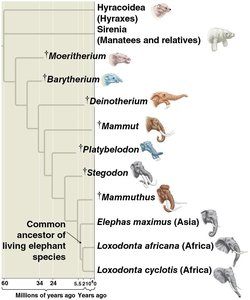
Darwin viewed the history of life as a branching tree, with all organisms related by descent from a common ancestor. Branches represent living groups, while gaps and forks indicate extinct groups and common ancestors. 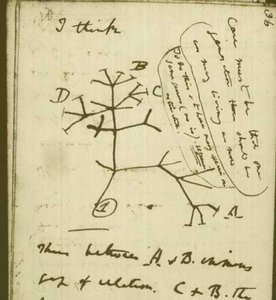
Morphological Gaps and Extinction
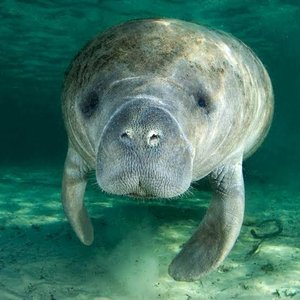
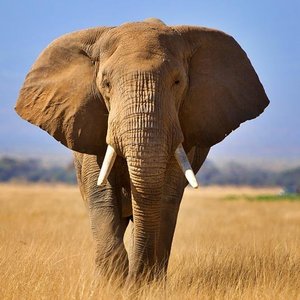
Large gaps between related groups are explained by branching and extinction events. For example, elephants, hyraxes, and manatees share a common ancestor, but extinction of intermediate species explains their differences. 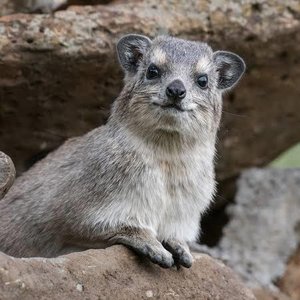
Artificial Selection and Adaptation
Artificial Selection
Humans modify species through artificial selection, breeding individuals with desired traits. This process has produced crops, livestock, and pets that differ greatly from their wild ancestors. - **Key Point 1:** Artificial selection is human-driven. - **Key Point 2:** Results in rapid changes in species traits.
Key Features of Natural Selection
Principles of Natural Selection
- **Individuals with certain heritable traits survive and reproduce at higher rates.** - **Natural selection increases the frequency of favorable adaptations.** - **If the environment changes, new adaptations may arise, leading to new species.**
Direct Observations of Evolutionary Change
Natural Selection in Response to Introduced Species
Soapberry bugs in Florida evolved different beak lengths to match the fruit of their primary food sources, demonstrating rapid evolutionary change.
Evolution of Drug-Resistant Bacteria
Bacteria such as Staphylococcus aureus have evolved resistance to antibiotics like penicillin and methicillin, illustrating natural selection in action. - **Key Point 1:** Resistance evolves rapidly in species with short generation times. - **Key Point 2:** Natural selection favors traits advantageous in the current environment.
Homology and Evidence for Common Ancestry
Anatomical Homologies
Homologous structures are anatomical similarities that reflect common ancestry, even if their functions differ. - **Example:** Mammalian forelimbs have similar bone arrangements but serve different purposes.
Comparative Embryology
Embryos of vertebrates share features such as post-anal tails and pharyngeal arches, which develop into different adult structures.
Vestigial Structures
Vestigial structures are remnants of features that served functions in ancestors, such as leg bones in snakes.
Molecular Homologies
All life shares a genetic code and specific genes, providing molecular evidence for common ancestry.
Evolutionary Trees and Convergent Evolution
Evolutionary Trees
Evolutionary trees illustrate relationships among groups based on shared homologies and common ancestors.
Convergent Evolution
Convergent evolution occurs when distantly related groups independently evolve similar traits due to adaptation to similar environments. - **Example:** Sugar gliders and flying squirrels have analogous traits but are not closely related.
The Fossil Record and Biogeography
The Fossil Record
Fossils provide evidence for the extinction, origin, and change of species over time.
Biogeography
Biogeography studies the geographic distribution of species, influenced by continental drift and historical events. - **Example:** Freshwater fish in South America and Australia share ancestors from the time of Pangea.
Speciation and Evolutionary Patterns
Speciation
Speciation is the process by which one species splits into two or more, forming a bridge between microevolution and macroevolution. - **Stages of Speciation:** 1. Isolation of populations 2. Divergence in traits 3. Reproductive isolation upon secondary contact
Adaptive Radiation
Adaptive radiation occurs when a single ancestral species rapidly diversifies into new species, each adapted to different ecological niches. - **Example:** Hawaiian honeycreepers and African cichlids.
Summary Table: Key Concepts in Evolution
Concept | Definition | Example |
|---|---|---|
Descent with Modification | Species accumulate differences from ancestors | Galápagos finches |
Natural Selection | Individuals with advantageous traits survive and reproduce | Drug-resistant bacteria |
Homology | Similarity due to common ancestry | Mammalian forelimbs |
Convergent Evolution | Independent evolution of similar traits | Sugar glider and flying squirrel |
Speciation | Splitting of one species into two or more | Adaptive radiation in honeycreepers |
Additional info: These notes expand on the original content by providing definitions, examples, and context for each concept, ensuring completeness and academic quality for exam preparation.
