 Indietro
Evolution, Phylogeny, and Genetic Variation Exam #2
Guida di studio - Note intelligenti
 Appunti personalizzati basati sui tuoi materiali, ampliati con definizioni chiave, esempi e contesto.
Evolution and Natural Selection
Drug-Resistant Bacteria and Natural Selection
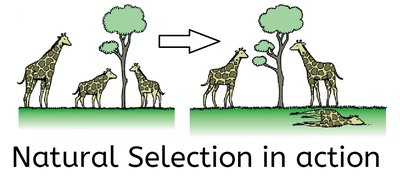
Evolution by natural selection is a fundamental mechanism by which populations adapt to their environments. The evolution of drug-resistant bacteria, such as Staphylococcus aureus (MRSA), provides a clear example of this process.
Natural Selection: Antibiotic treatment creates selective pressure, favoring bacteria with resistance genes.
MRSA: Methicillin-resistant S. aureus strains survive and reproduce in the presence of methicillin, leading to increased frequency of resistance alleles.
Key Principle: Natural selection does not create new traits but selects for traits already present in the population.
Rapid Evolution: Species with short generation times, such as bacteria, can evolve quickly.
Example: MRSA strains evolved resistance to penicillin and methicillin within a few years of their introduction.
Evidence for Evolution
Types of Scientific Evidence
Multiple lines of evidence support the theory of evolution:
Direct Observations: Examples include the evolution of drug resistance in bacteria.
Homology: Similarities in anatomical structures and molecular sequences due to common ancestry.
Fossil Record: Provides evidence of gradual changes in species over time.
Biogeography: The geographic distribution of species reflects evolutionary history.
Homology and Homologous Structures
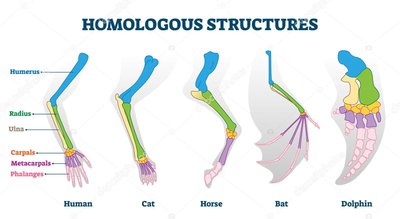
Homology refers to similarity resulting from common ancestry. Homologous structures are anatomical features that are similar in different species but may serve different functions.
Example: The forelimbs of humans, cats, horses, bats, and dolphins share a common structural arrangement, despite their different functions.
Convergent and Divergent Evolution
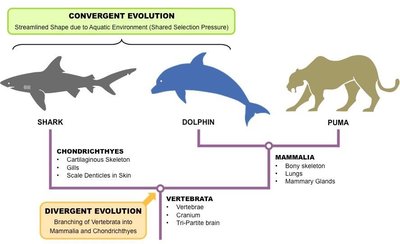
Convergent evolution occurs when unrelated species evolve similar traits due to similar environmental pressures. Divergent evolution occurs when related species evolve different traits.
Convergent Evolution: Streamlined body shapes in sharks and dolphins.
Divergent Evolution: Branching of vertebrate lineages into mammals and cartilaginous fishes.
Phylogeny and Systematics
Phylogeny and Classification
Phylogeny is the evolutionary history of a species or group of related species. Systematics is the scientific discipline that classifies organisms and determines their evolutionary relationships.
Taxonomy: The ordered division and naming of organisms.
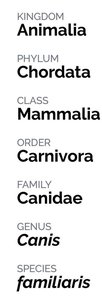
Hierarchical Classification: Species are grouped into increasingly broad categories: species, genus, family, order, class, phylum, kingdom, domain.
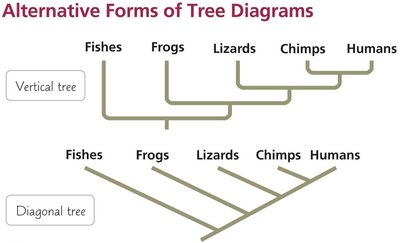
Phylogenetic Trees
Phylogenetic trees are branching diagrams that represent evolutionary relationships. Each branch point represents the divergence of two lineages from a common ancestor.
Sister Taxa: Groups that share an immediate common ancestor.
Rooted Tree: Includes a branch representing the most recent common ancestor of all taxa.
Basal Taxon: A lineage that diverges early in the history of a group.
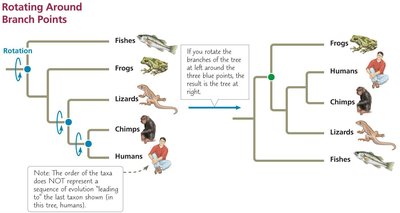
Tree Rotation: The order of taxa at branch tips does not represent the sequence of evolution; branches can be rotated without changing relationships.
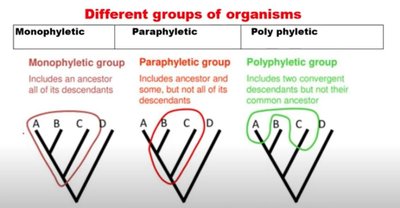
Monophyletic, Paraphyletic, and Polyphyletic Groups
Classification of groups based on evolutionary relationships:
Monophyletic: Includes an ancestor and all its descendants.
Paraphyletic: Includes an ancestor and some, but not all, descendants.
Polyphyletic: Includes convergent descendants but not their common ancestor.
Genetic Variation and Evolution of Populations
Genetic Variation
Variation in heritable traits is essential for evolution by natural selection. Genetic variation arises from differences in DNA sequences among individuals.
Phenotypic Variation: Can be discrete (either-or) or continuous (gradations).
Gene Variability: Quantified as the average percent of loci that are heterozygous.
Nucleotide Variability: Measured at the molecular level of DNA.
Sources of Genetic Variation
Mutation: Changes in DNA sequence can create new alleles.
Gene Duplication: Can produce new genetic material.
Sexual Reproduction: Arranges existing genes in new combinations.
Mutation and Allele Formation
Point Mutations: Single nucleotide changes; may be harmful, neutral, or beneficial.
Neutral Variation: Mutations that do not confer a selective advantage or disadvantage.
Mechanisms Altering Allele Frequencies
Natural Selection
Natural selection is the only mechanism that consistently causes adaptive evolution. It increases the frequency of alleles that improve reproductive advantage.
Adaptive Evolution: Traits that enhance survival or reproduction increase in frequency.
Genetic Drift
Genetic drift is the random fluctuation of allele frequencies, especially significant in small populations.
Founder Effect: Occurs when a few individuals become isolated from a larger population.
Bottleneck Effect: Results from a drastic reduction in population size due to environmental change.
Effects: Loss of genetic variation, fixation of harmful alleles.
Gene Flow
Gene flow is the movement of alleles among populations, often reducing genetic variation among populations over time.
Example: Migration of banded snakes maintains disadvantageous alleles on islands.
Summary Table: Hierarchical Classification
Level | Example |
|---|---|
Domain | Eukarya |
Kingdom | Animalia |
Phylum | Chordata |
Class | Mammalia |
Order | Carnivora |
Family | Canidae |
Genus | Canis |
Species | familiaris |
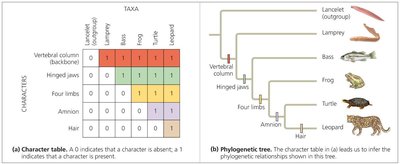
Phylogenetic Tree Construction
Character Table and Tree
Phylogenetic trees can be constructed using character tables that indicate the presence or absence of traits.
Additional info:
Some images and content were inferred to provide context for evolutionary mechanisms and phylogenetic relationships.
Equations and formulas were not directly present in the source but can be added for population genetics, e.g., Hardy-Weinberg equilibrium:
