 Indietro
Chap 20
Guida di studio - Note intelligenti
 Appunti personalizzati basati sui tuoi materiali, ampliati con definizioni chiave, esempi e contesto.
Evolution and Evidence for Evolution
Introduction to Evolution and Natural Selection
Evolution is the process by which populations of organisms change over generations through variations in heritable traits. Natural selection is the primary mechanism driving adaptive evolution, where traits that enhance survival and reproduction become more common in successive generations.
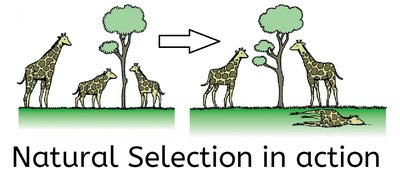
Natural Selection: Differential survival and reproduction of individuals due to differences in phenotype.
Example: The evolution of long necks in giraffes, where individuals with longer necks could reach more food and were more likely to survive and reproduce.
Evolution of Drug-Resistant Bacteria
Antibiotic resistance in bacteria is a direct observation of evolution in action. Bacteria such as Staphylococcus aureus have evolved resistance to antibiotics like penicillin and methicillin due to natural selection acting on genetic variation within populations.
Key Point: Resistance arises from pre-existing genetic variation; antibiotics select for resistant individuals.
Example: Methicillin-resistant S. aureus (MRSA) strains survive and reproduce in the presence of methicillin, leading to the spread of resistance.
Types of Evidence for Evolution
Multiple lines of evidence support the theory of evolution:
Direct observations (e.g., antibiotic resistance)
Homology (similarities due to common ancestry)
The fossil record
Biogeography
Homology
Homology refers to similarities among organisms due to shared ancestry. Anatomical and molecular homologies provide strong evidence for evolution.
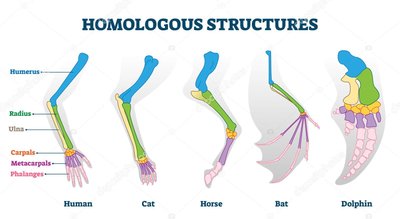
Homologous structures: Anatomical features with similar underlying structures but different functions, inherited from a common ancestor.
Example: The forelimbs of humans, cats, horses, bats, and dolphins share the same bone arrangement but serve different functions.
Convergent and Divergent Evolution
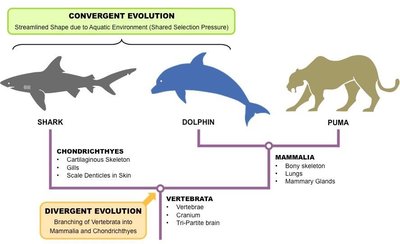
Convergent evolution occurs when unrelated species evolve similar traits independently, often due to similar environmental pressures. Divergent evolution refers to the accumulation of differences between closely related species, leading to speciation.
Convergent evolution: Example—sharks (fish) and dolphins (mammals) have streamlined bodies adapted to aquatic life, despite distant ancestry.
Divergent evolution: Example—forelimbs of mammals adapted for different functions.
Phylogeny and Systematics
Phylogeny and Classification
Phylogeny is the evolutionary history of a species or group of related species. Systematics is the scientific discipline focused on classifying organisms and determining their evolutionary relationships.
Taxonomy: The ordered division and naming of organisms.
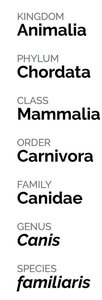
Hierarchical classification: Species are grouped into increasingly broad categories: species, genus, family, order, class, phylum, kingdom, domain.
Phylogenetic Trees
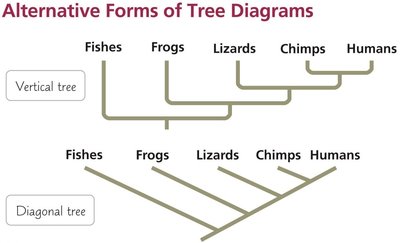
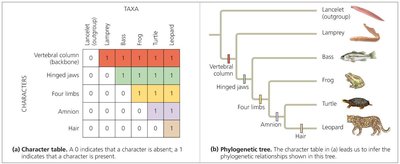
Phylogenetic trees are branching diagrams that represent hypotheses about evolutionary relationships. Each branch point (node) represents the divergence of two lineages from a common ancestor.
Sister taxa: Groups that share an immediate common ancestor.
Rooted tree: Includes a branch representing the most recent common ancestor of all taxa in the tree.
Basal taxon: A lineage that diverges early in the history of a group.
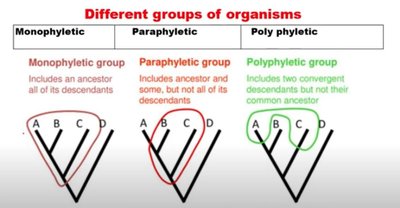
Monophyletic, Paraphyletic, and Polyphyletic Groups
Classification of groups in phylogenetic trees:
Group Type | Definition |
|---|---|
Monophyletic | Includes ancestor and all descendants |
Paraphyletic | Includes ancestor and some, but not all, descendants |
Polyphyletic | Includes descendants but not their common ancestor |
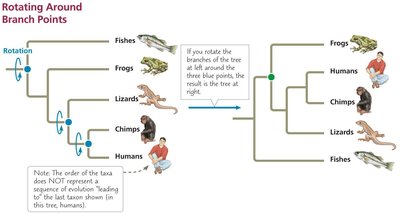
Rotating Branch Points in Trees
The order of taxa at the tips of a phylogenetic tree does not represent the sequence of evolution. Branches can be rotated around nodes without changing the relationships depicted.
Genetic Variation and Evolution in Populations
Genetic Variation
Genetic variation is the raw material for evolution. It refers to differences in the genetic makeup (DNA sequences) among individuals in a population.
Gene variability: Average percent of loci that are heterozygous.
Nucleotide variability: Measured at the molecular level of DNA.
Phenotypic variation: May reflect genetic variation or environmental influences.
Sources of Genetic Variation
Genetic variation arises from:
Mutation: Changes in DNA sequence (e.g., point mutations).
Gene duplication: Extra copies of genes can evolve new functions.
Sexual reproduction: Shuffles existing genes into new combinations.
Mechanisms That Alter Allele Frequencies
Three main mechanisms alter allele frequencies in populations:
Natural selection: Favors alleles that increase reproductive success.
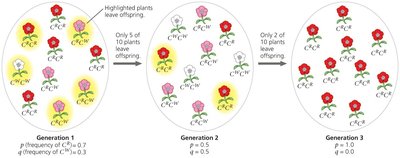
Genetic drift: Random fluctuations in allele frequencies, especially in small populations.
Gene flow: Movement of alleles among populations via migration or gamete transfer.
Genetic Drift
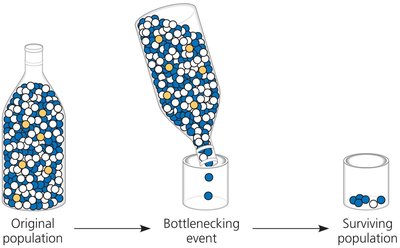
Genetic drift is a random process that can lead to significant changes in allele frequencies, particularly in small populations. It can result in the loss of genetic variation and fixation of harmful alleles.
Founder effect: When a few individuals start a new population, allele frequencies may differ from the original population.
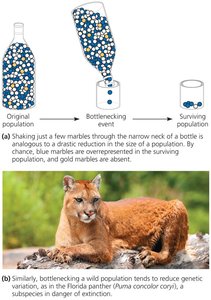
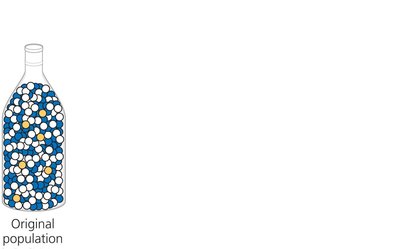
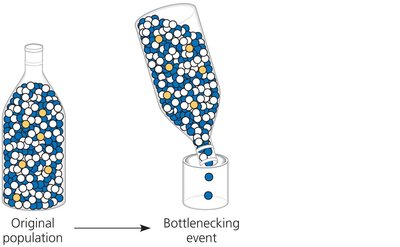
Bottleneck effect: A drastic reduction in population size leads to a loss of genetic diversity.
Gene Flow
Gene flow is the transfer of alleles between populations. It tends to reduce genetic differences between populations and can introduce new genetic material, affecting adaptation and evolution.
Example: Migration of banded snakes from the mainland to islands maintains genetic variation in island populations.
Natural Selection and Adaptive Evolution
Natural selection is the only mechanism that consistently leads to adaptive evolution, increasing the frequency of beneficial alleles in a population. However, evolution is constrained by existing variation, historical factors, and trade-offs.
Selection acts only on existing variation.
Evolution is limited by historical constraints.
Adaptations are often compromises.
Chance, selection, and environment interact.
