Indietro
Evolutionary Mechanisms, Population Genetics, and Evidence for Evolution: Study Guide
Guida di studio - Note intelligenti
 Appunti personalizzati basati sui tuoi materiali, ampliati con definizioni chiave, esempi e contesto.
Evolutionary Mechanisms
Purifying Selection
Purifying selection, also known as negative selection, is a process that removes deleterious alleles from a population. It is considered important in evolution because it helps maintain the integrity of functional genes by eliminating harmful genetic variants.
Definition: Selection that acts to eliminate disadvantageous alleles from a population.
Importance: Maintains genetic health and stability by reducing the frequency of harmful mutations.
Example: Removal of alleles causing genetic diseases in humans.
Types of Selection
Heterozygote Advantage vs. Frequency-Dependent Selection:
Heterozygote Advantage: Heterozygotes have higher fitness than either homozygote (e.g., sickle cell trait and malaria resistance).
Frequency-Dependent Selection: The fitness of a phenotype depends on its frequency relative to other phenotypes (e.g., predator-prey interactions where rare phenotypes have an advantage).
Similarity: Both maintain genetic diversity in populations.
Difference: Heterozygote advantage is based on genotype, while frequency-dependent selection is based on phenotype frequency.
Homozygote Advantage vs. Disruptive Selection:
Homozygote Advantage: One homozygous genotype has the highest fitness.
Disruptive Selection: Both homozygotes have higher fitness than heterozygotes, leading to increased genetic variance and possibly speciation.
Stabilizing Selection: Favors intermediate phenotypes, reducing phenotypic/genotypic variance by selecting against extremes.
Directional Selection: Favors one extreme phenotype, shifting the population mean in one direction.
Fluctuating vs. Frequency-Dependent Selection: Both can cause cyclical genotype frequencies, but fluctuating selection is due to changing environmental conditions, while frequency-dependent selection is due to interactions among individuals.
Population Genetics and Hardy-Weinberg Equilibrium
Hardy-Weinberg Principle
The Hardy-Weinberg equilibrium describes a population that is not evolving. It provides a mathematical baseline for studying genetic variation.
Equation: and
Assumptions: No mutation, migration, selection, genetic drift, or non-random mating.
Evolutionary Influences:
Mutation: Introduces new alleles.
Migration (Gene Flow): Moves alleles between populations.
Genetic Drift: Random changes in allele frequencies, especially in small populations.
Selection: Differential survival and reproduction.
Relevance: Useful for detecting evolutionary change and estimating allele/genotype frequencies.
Calculating Allele and Genotype Frequencies
Given: Homozygous recessive frequency (), calculate , , and genotype frequencies.
Example: If , then , .
Genotype Frequencies:
Homozygous dominant ():
Heterozygous ():
Homozygous recessive ():
Genetic Variation and Evolutionary Processes
Genetic Drift, Bottlenecks, and Founder Effect
Genetic Drift: Random changes in allele frequencies, more pronounced in small populations.
Bottleneck Effect: Sharp reduction in population size leads to loss of genetic diversity.
Founder Effect: New population established by a small number of individuals, leading to different allele frequencies.
Inbreeding Depression: Reduced fitness due to breeding between close relatives, increasing homozygosity of deleterious alleles.
Selection and Sexual Selection
Natural Selection: Differential survival and reproduction based on phenotype.
Sexual Selection: Selection for traits that increase mating success.
Intrasexual Selection: Competition among the same sex (e.g., male-male competition).
Intersexual Selection: Mate choice (e.g., female choice of males).
Female Selectivity: Often due to higher parental investment and limited reproductive opportunities.
Mutation and Genetic Variation
Synonymous Mutations: Do not change amino acid sequence; generally neutral.
Somatic Mutations: Occur in non-reproductive cells; not passed to offspring, so not subject to natural selection.
Frameshift Mutations: Can be inconsequential if they occur near the end of a gene or in non-coding regions, but often have dramatic effects by altering protein structure.
Sexual Reproduction: Generates variation through independent assortment, crossing over, and random fertilization.
Mendelian Genetics and Inheritance
Blending Inheritance vs. Mendelian Genetics
Blending Inheritance: Traits mix in offspring, leading to intermediate phenotypes.
Mendelian Genetics: Traits are inherited as discrete units (genes), preserving variation across generations.
Continuous Variation and Mendelian Genetics
Fisher argued that Mendelian inheritance of multiple genes can produce continuous variation in traits (polygenic inheritance).
Microevolution vs. Macroevolution
Microevolution: Changes in allele frequencies within populations over time.
Macroevolution: Large-scale evolutionary changes, such as speciation and extinction.
Similarity: Both involve genetic change.
Difference: Scale and time frame; macroevolution encompasses broader patterns.
Evidence for Evolution
Lines of Evidence
Molecular: DNA sequence similarities among species (e.g., cytochrome c gene).
Anatomical: Homologous structures (e.g., vertebrate forelimbs).
Biogeographical: Distribution of species (e.g., Darwin's finches on the Galápagos Islands).
Fossil Record: Transitional forms (e.g., Archaeopteryx between dinosaurs and birds).
Homologous vs. Analogous Traits
Homologous Traits: Inherited from a common ancestor (e.g., mammalian forelimbs).
Analogous Traits: Similar function, different evolutionary origins (e.g., wings of birds and insects).
Convergent Evolution: Analogous traits arise when unrelated species adapt to similar environments.
Dating Fossils
Relative Dating: Determines order of events (e.g., stratigraphy).
Absolute Dating: Provides actual age (e.g., radiometric dating).
Adaptive Landscapes and Fitness
Fitness Peaks and Valleys
Fitness Peak: Genotype/phenotype with highest fitness in a given environment.
Fitness Valley: Genotype/phenotype with lower fitness, separating peaks.
Populations may move toward peaks via selection, but drift or environmental change can cause random movement.
Scientific Process in Evolutionary Biology
Hypotheses and Experimental Design
Hypotheses: Specific, testable predictions are essential for scientific inquiry.
A Priori vs. A Posteriori: A priori explanations are made before data collection; a posteriori are made after.
Controls and Replicates: Ensure validity and reliability of experimental results.
Phylogenetic Comparative Methods: Replicates are independent evolutionary events (e.g., repeated evolution of ecomorphs).
Lamarck vs. Darwin
Lamarck: Proposed inheritance of acquired characteristics.
Darwin: Proposed natural selection acting on heritable variation.
Principles of Natural Selection
Variation exists among individuals.
Some variation is heritable.
More offspring are produced than can survive.
Individuals with advantageous traits survive and reproduce more.
Favorable traits increase in frequency over generations.
Ecological and Evolutionary Interactions
Community vs. Ecosystem
Community: All populations of different species in an area.
Ecosystem: Community plus the abiotic environment.
Clines in Nature
Clines: Gradual changes in traits or species distributions along environmental gradients (e.g., Bergmann's rule: body size increases with latitude).
Evolution and Unity of Life
Evolution explains both the diversity (adaptation to different environments) and unity (shared ancestry and genes) of life.
Shared Genes Across Species
Genes common to prokaryotes and humans are involved in essential cellular functions (e.g., DNA replication, metabolism).
Homology and Divergence
Similar skeletal structures in humans and bats reflect common ancestry; whale forelimbs diverged due to adaptation to aquatic life.
Ecological Change and Evolution
Ecological changes (e.g., new predators, climate shifts) can drive evolutionary responses (e.g., changes in coloration, behavior).
Case Study: Anolis Lizard Ecomorphs
Adaptive Radiation and Ecomorphs
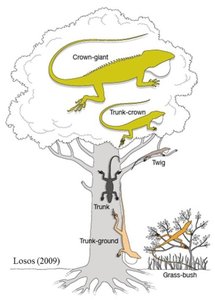
On Caribbean islands, Anolis lizards have diversified into distinct ecomorphs, each adapted to a specific microhabitat (e.g., crown-giant, trunk-crown, trunk, trunk-ground, twig, grass-bush). This is an example of adaptive radiation driven by natural selection, where similar ecological roles are filled by different species on different islands.
Natural Selection: Different habitats select for different morphological and behavioral traits.
Convergent Evolution: Similar ecomorphs evolved independently on multiple islands, reinforcing the role of natural selection.