Indietro
Evolutionary Processes and Patterns: Study Notes for General Biology
Guida di studio - Note intelligenti
 Appunti personalizzati basati sui tuoi materiali, ampliati con definizioni chiave, esempi e contesto.
Evolutionary Patterns and Processes
Introduction to Evolutionary Biology
Evolutionary biology explores how populations change over time through various mechanisms. The study of evolution is foundational to understanding biodiversity and the history of life on Earth.
Evolution is defined as a change in allele frequency in a population over time.
Key chapters: Evolution by Natural Selection, Evolutionary Processes, Speciation, Phylogenies and the History of Life.
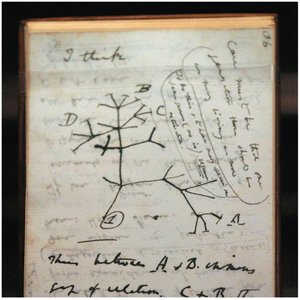
Chapter 23: Evolutionary Processes
Population Genetics and the Modern Synthesis
Population genetics links Mendelian inheritance with Darwinian evolution, forming the basis of the Modern Synthesis. It studies how allele and genotype frequencies change in populations.
Alleles: Different versions of a gene.
Genotypes: Combinations of alleles possessed by individuals.
Phenotypes: Observable traits resulting from genotypes.
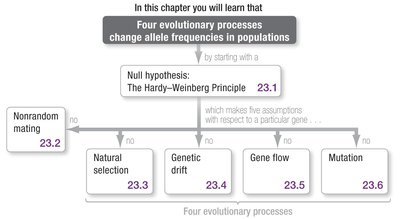
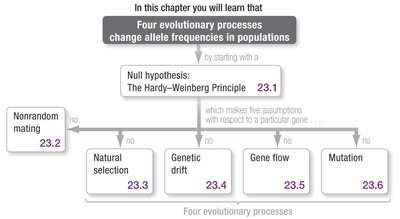
Four Evolutionary Processes
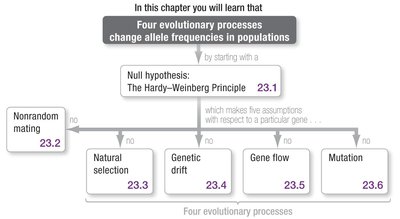
Four main processes drive evolution in populations:
Natural Selection
Genetic Drift
Gene Flow
Mutation
23.1 Null Hypothesis: The Hardy-Weinberg Principle
Hardy-Weinberg Equilibrium
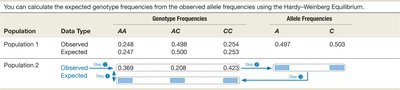
The Hardy-Weinberg Principle provides a mathematical model to test whether evolution is occurring in a population. It predicts genotype frequencies under specific assumptions.
Assumptions: random mating, no natural selection, no gene flow, no genetic drift, no mutation.
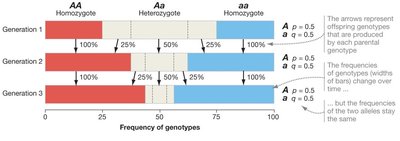
If these assumptions hold, allele and genotype frequencies remain constant (Hardy-Weinberg equilibrium).
Allele frequencies:
Genotype frequencies:
23.2 Nonrandom Mating
Inbreeding and Its Effects
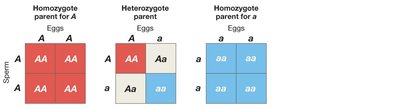
Inbreeding is mating between relatives, leading to increased homozygosity but not changing allele frequencies. It is not a mechanism of evolution but can influence evolutionary outcomes.
Most extreme form: self-fertilization (common in plants).
Increases homozygosity, decreases heterozygosity.
Can lead to inbreeding depression: reduced fitness due to increased homozygosity.
Inbreeding Depression Example
Inbreeding depression is more likely in small populations, such as the Florida panther, where reduced genetic diversity leads to lower survivorship. 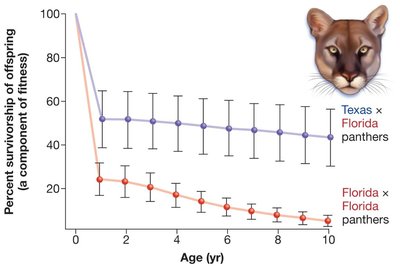
Sexual Selection
Sexual selection is a form of nonrandom mating that changes allele frequencies and is a mechanism of evolution. It favors traits that increase mating success.
23.3 Natural Selection
Types of Natural Selection
Natural selection acts on heritable variation, leading to differential reproductive success. It can affect genetic variation in several ways:
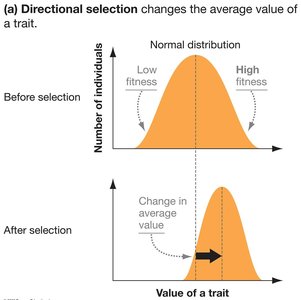
Directional Selection: Favors one extreme phenotype, shifting the average trait value and reducing variation.
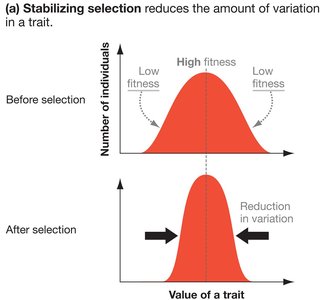
Stabilizing Selection: Favors intermediate phenotypes, reducing variation without changing the average.
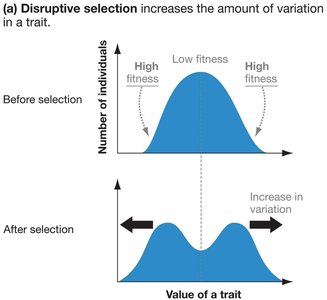
Disruptive Selection: Favors extreme phenotypes, increasing variation and potentially leading to speciation.
Balancing Selection: Maintains multiple phenotypes in a population.
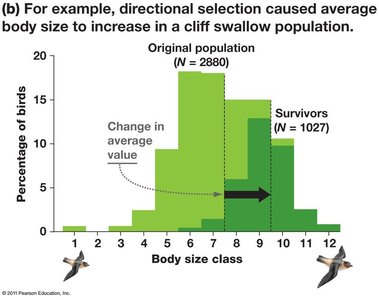
Directional Selection
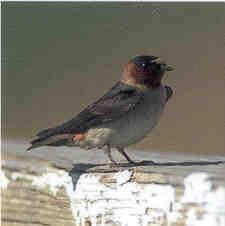
Example: Cliff swallows surviving a cold snap had larger body sizes.
Allele frequency of favored allele may reach fixation (), while deleterious alleles may be lost ().
Stabilizing Selection
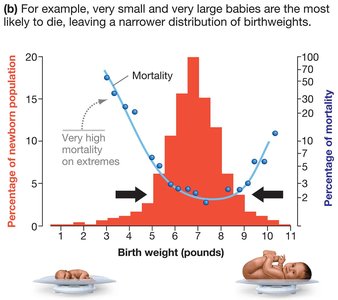
Reduces variation by selecting against extremes.
Example: Human birth weight—very small and very large babies have higher mortality.
Disruptive Selection
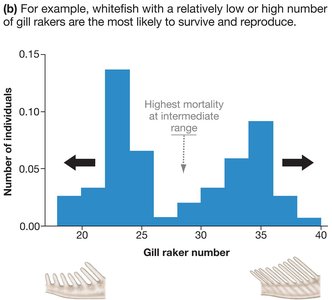
Increases variation by favoring extreme values.
Example: Whitefish with low or high gill raker numbers survive better than those with intermediate numbers.
Can lead to speciation if extremes become reproductively isolated.
Balancing Selection
No single phenotype is favored; diversity is maintained.
Mechanisms include heterozygote advantage and frequency-dependent selection.
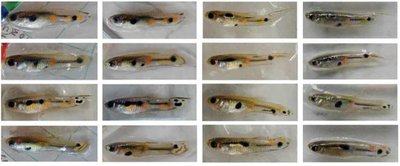
Example: Guppy color patterns—rare colors are favored by predators, maintaining diversity.
23.4 Genetic Drift
Genetic Drift: Random Changes in Allele Frequency
Genetic drift is the change in allele frequency due to random sampling error, especially pronounced in small populations.
Can lead to random loss or fixation of alleles.
Reduces genetic variation.
Does not result in adaptation.
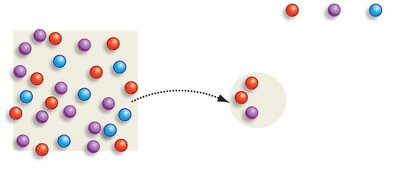
Founder Effect
Occurs when a new population is established by a small number of individuals.
Allele frequencies in the new population may differ from the source population.
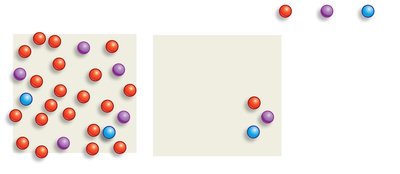
Genetic Bottleneck
Occurs when a population is drastically reduced in size.
Surviving population may have different allele frequencies than the original.
23.5 Gene Flow
Gene Flow: Movement of Alleles Between Populations
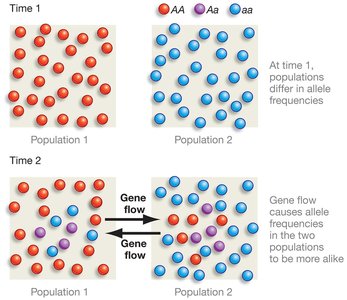
Gene flow occurs when individuals migrate between populations, introducing new alleles and reducing genetic differences.
Can increase genetic diversity and fitness in small populations.
Can decrease fitness in populations adapted to specific environments.
Always reduces genetic differences between populations.
23.6 Mutation
Mutation: Source of New Alleles
Mutation is the ultimate source of genetic variation, introducing new alleles into populations.
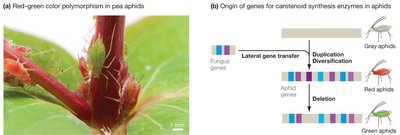
Types: point mutations, chromosome-level mutations, lateral gene transfer.
Most mutations are deleterious, some are neutral, and rarely, some are beneficial.
Mutation alone is usually slow in changing allele frequencies, but combined with other mechanisms, it is essential for evolution.
Summary Table: Mechanisms of Evolution
Mechanism | Effect on Allele Frequency | Effect on Genetic Variation | Adaptation? |
|---|---|---|---|
Natural Selection | Changes | Can increase, decrease, or maintain | Yes |
Genetic Drift | Changes (randomly) | Decreases | No |
Gene Flow | Changes | Can increase or decrease | No |
Mutation | Introduces new alleles | Increases | No |
Key Points for Exam Preparation
Understand the Hardy-Weinberg Principle and its assumptions.
Be able to calculate allele and genotype frequencies.
Recognize the four mechanisms of evolution and their effects.
Know examples of each type of natural selection.
Understand the consequences of inbreeding, genetic drift, gene flow, and mutation.