 Indietro
Evolutionary Processes, Speciation, and Phylogenetic Concepts
Guida di studio - Note intelligenti
 Appunti personalizzati basati sui tuoi materiali, ampliati con definizioni chiave, esempi e contesto.
Evolutionary Processes and Hardy-Weinberg Equilibrium
Gene Pool and Allele Frequencies
The gene pool refers to all the alleles of all the genes present in a population. The frequency of drawing a particular gamete from the gene pool equals its frequency in the population.
Allele frequency: The proportion of a specific allele among all alleles for a gene in a population.
Genotype frequency: The proportion of a specific genotype among all genotypes for a gene in a population.
Hardy-Weinberg Equilibrium
The Hardy-Weinberg Equilibrium describes a state where allele and genotype frequencies remain constant from generation to generation in the absence of evolutionary forces. It serves as a mathematical null hypothesis for studying evolution.
Genotype frequencies: If allele frequencies are p (A) and q (a), then genotype frequencies are given by (AA), (Aa), and (aa).
Allele frequencies: Remain unchanged over time if the population is in equilibrium.
The model is based on five assumptions:
Random mating: Individuals mStudy Guidesate by chance.
No natural selection: All genotypes have equal survival and reproductive success.
No genetic drift: No random changes in allele frequencies.
No gene flow: No migration of alleles into or out of the population.
No mutation: No new alleles are introduced.
Inbreeding and Inbreeding Depression
Inbreeding is mating between closely related individuals, increasing homozygosity and often leading to inbreeding depression, a decline in average fitness due to increased expression of deleterious alleles.
Inbreeding increases homozygosity but does not change allele frequencies.
Can accelerate evolutionary change by exposing deleterious alleles to selection.
Genetic Variation
Genetic variation is the number and relative frequency of alleles in a population, and the proportion of phenotypic variation due to genetic factors.
Maintained or reduced by evolutionary processes such as selection, drift, and gene flow.
Patterns of Natural Selection
Natural selection can act in four main modes:
Directional selection: Changes the average value of a trait.
Stabilizing selection: Reduces variation in a trait.
Disruptive selection: Increases variation in a trait.
Balancing selection: Maintains variation in a trait.
Other important concepts:
Purifying selection: Eliminates deleterious alleles.
Heterozygote advantage: Heterozygotes have higher fitness than homozygotes.
Frequency-dependent selection: Fitness depends on genotype or phenotype frequency.
Genetic Drift, Gene Flow, and Mutation
Genetic drift: Random loss or fixation of alleles, decreasing diversity.
Gene flow: Movement of alleles between populations, increasing diversity in recipient populations.
Mutation: Source of new alleles; can be beneficial, neutral, or deleterious.
Types of mutations:
Silent mutations: Neutral with respect to fitness.
Beneficial mutations: Increase fitness.
Deleterious mutations: Decrease fitness.
Speciation and Species Concepts
Speciation
Speciation is the evolution of two or more distinct species from a single ancestral species, involving genetic isolation and divergence.
Genetic isolation: Barriers to gene flow separate populations.
Genetic divergence: Mutation, selection, and drift cause populations to evolve independently.
Reproductive Isolation
Prezygotic isolation: Prevents mating between species.
Postzygotic isolation: Occurs after mating, often resulting in infertile or inviable offspring.
Species Concepts
Morphospecies concept: Species are defined by distinct anatomical features.
Polymorphic species: Have multiple phenotypes within a population.
Cryptic species: Cannot be distinguished by morphology alone.
Phylogenetic species concept: Defines species as the smallest monophyletic group in a phylogenetic tree.
Phylogenetic Concepts and Systematics
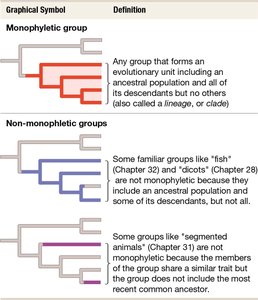
Monophyletic and Non-monophyletic Groups
A monophyletic group (lineage or clade) includes an ancestral population and all its descendants. Non-monophyletic groups include some, but not all, descendants or do not include the most recent common ancestor.
Synapomorphy: Shared, derived trait present in the most recent common ancestor.
Systematics: Characterizes and classifies relationships among organisms.
Taxonomy: Describes, names, and classifies species.
Allopatric and Sympatric Speciation
Allopatry: Populations live in different geographic areas.
Allopatric speciation: Occurs via dispersal or vicariance.
Sympatry: Populations live in the same area.
Sympatric isolation: Divergence within the same area due to extrinsic or intrinsic factors.
Niche: The range of ecological resources a species can use and conditions it can tolerate.
Polyploidy and Hybridization
Polyploidy: Possessing more than two sets of chromosomes.
Autopolyploid: Chromosome doubling within a species.
Allopolyploid: Chromosome doubling via hybridization between species.
Reinforcement and Hybrid Zones
Reinforcement: Selection for traits preventing interbreeding between recently diverged species.
Hybrid zone: Geographic area where interbreeding occurs between species, sometimes producing fertile hybrids.
Phylogeny and Phylogenetic Trees
Phylogeny is the evolutionary history of a group. Phylogenetic trees depict relationships among taxa.
Branches: Represent populations through time.
Nodes: Points where branches diverge, representing speciation events.
Sister groups: Closest relatives in a phylogenetic tree.
Polytomy: Node dividing into three or more branches.
Traits and Homology
Character: Any heritable feature.
Trait: Observable characteristic; in phylogenetics, a state of a character.
Ancestral trait: Found in ancestors.
Derived trait: Modified form found in descendants.
Homology: Similarity due to shared ancestry.
Homoplasy: Similarity not due to shared ancestry.
Parsimony: The simplest explanation is preferred; in phylogenetics, the tree with the fewest changes is most likely.
Convergent evolution: Independent evolution of similar traits in different species.
Fossil Record and Evolutionary History
Limitations of the Fossil Record
The fossil record is biased due to several factors:
Habitat bias: Some environments are more likely to produce fossils.
Taxonomic bias: Certain organisms are more likely to be preserved.
Temporal bias: Recent fossils are more common than ancient ones.
Tissue bias: Some tissues are more likely to fossilize.
Abundance bias: Common and widespread species are overrepresented.
Geologic Time and Major Events
Precambrian: Interval from Earth's formation to the appearance of most animal groups (~4.6 billion to 541 million years ago).
Anthropocene: Proposed current epoch reflecting human-driven changes.
Adaptive Radiation and Extinction
Adaptive radiation: Rapid diversification within a lineage, producing many species adapted to different habitats.
Mass extinction: Rapid loss of at least 60% of species within 1 million years.
Background extinction: Continuous, low-level extinction throughout evolutionary history.
