 Indietro
Exam 1 Review: Evolution, Genetic Variation, Phylogenetics, and the Origin of Eukaryotes
Guida di studio - Note intelligenti
 Appunti personalizzati basati sui tuoi materiali, ampliati con definizioni chiave, esempi e contesto.
Hardy-Weinberg Equilibrium
Principles and Assumptions
The Hardy-Weinberg Equilibrium (HWE) is a fundamental concept in population genetics, serving as a null model to test whether evolution is occurring in a population. It describes the relationship between allele frequencies and genotype frequencies in a gene pool under specific conditions.
Assumptions: No mutations, random mating, no selective advantage, infinite population size, and no gene flow.
Equilibrium State: Allele frequencies remain constant over time if all assumptions are met.
Detecting Evolution: Deviations from equilibrium indicate that evolution is occurring, and the violated assumption can help identify the evolutionary mechanism.
Hardy-Weinberg Equations
Allele and genotype frequencies in a population can be calculated using the following equations:
Allele Frequency Equation: Where p is the frequency of allele 1 and q is the frequency of allele 2.
Genotype Frequency Equation: Where p^2 is the frequency of homozygous genotype for allele 1, 2pq is the frequency of heterozygotes, and q^2 is the frequency of homozygous genotype for allele 2.
Application Example
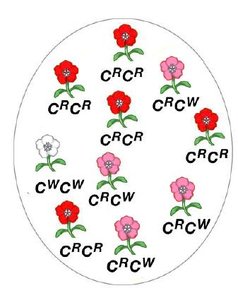
Consider a population of flowers with genotypes CRCR (red), CWCW (white), and CRCW (pink). The Hardy-Weinberg equations can be used to calculate allele and genotype frequencies, and to determine if the population is evolving.
Genetic Variation and Mechanisms of Evolution
Sources and Effects of Genetic Variation
Genetic variation is essential for evolution, providing the raw material for natural selection and other evolutionary mechanisms.
Mutation: Random changes in DNA that introduce new alleles; increases genetic variation.
Natural Selection: Differential survival and reproduction of individuals; can increase or decrease variation depending on selective pressures.
Genetic Drift: Random changes in allele frequencies, especially in small populations; usually decreases variation.
Gene Flow: Movement of alleles between populations; increases variation in recipient population.
Phylogenetics
Character Matrix and Evolutionary Trees
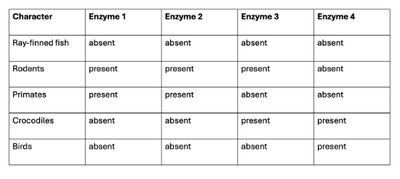
Phylogenetics is the study of evolutionary relationships among organisms. Character matrices are used to compare traits (such as enzyme presence) across species and construct evolutionary trees (phylogenies).
Character Matrix: Used to determine shared and unique traits among species.
Phylogenetic Tree: Visual representation of evolutionary relationships based on character data.
Character | Enzyme 1 | Enzyme 2 | Enzyme 3 | Enzyme 4 |
|---|---|---|---|---|
Ray-finned fish | absent | absent | absent | absent |
Rodents | present | present | present | absent |
Primates | present | present | absent | absent |
Crocodiles | absent | absent | present | present |
Birds | absent | absent | absent | present |
Monophyletic, Paraphyletic, and Polyphyletic Groups
Classification of groups in phylogenetic trees:
Monophyletic Group: Includes a common ancestor and all its descendants.
Paraphyletic Group: Includes a common ancestor and some, but not all, descendants.
Polyphyletic Group: Includes organisms from different ancestors.
The Origin and Diversification of Eukaryotes
Endosymbiotic Theory
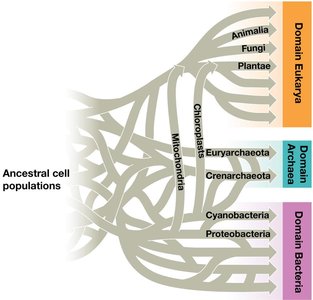
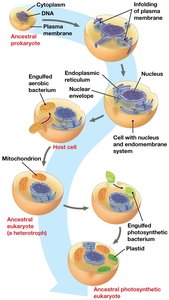
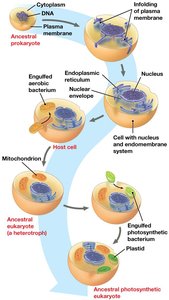
The endosymbiotic theory explains the origin of eukaryotic cells as a result of symbiosis between ancestral prokaryotes. Mitochondria and plastids (chloroplasts) are believed to have originated from engulfed bacteria.
Evidence: Mitochondria and plastids replicate by splitting, have circular DNA, similar ribosomes to bacteria, and can transcribe/translate their own DNA.
Endosymbiosis: One organism lives inside another, forming a symbiotic relationship.
Multicellularity in Eukaryotes
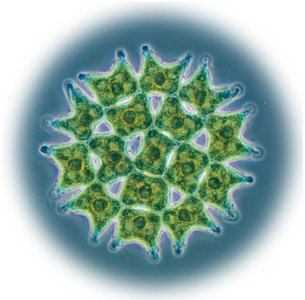
Multicellularity originated independently in several eukaryotic lineages, allowing for increased complexity and diversification.
Colonial Origins: Early multicellular forms were colonies of connected cells with little differentiation.
Extracellular Matrix: Facilitated inter-cell connectivity and interaction.
Independent Origins: Multicellularity arose separately in algae, plants, fungi, and animals.
The Origin of Life
Stages of Cell Formation
Chemical and physical processes on early Earth could have produced simple cells in four stages:
Abiotic synthesis of small organic molecules
Joining of small molecules into macromolecules
Packaging of molecules into protocells
Origin of self-replicating molecules
Speciation and Reproductive Isolation
Reproductive Barriers
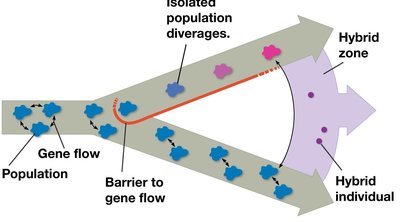
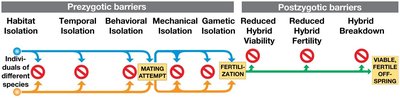
Reproductive isolation is essential for the formation of new species. Barriers prevent interbreeding and the production of viable, fertile offspring.
Prezygotic Barriers: Prevent fertilization (habitat, temporal, behavioral, mechanical, gametic isolation).
Postzygotic Barriers: Affect hybrid viability, fertility, or cause hybrid breakdown.
Modes of Speciation
Speciation can occur via geographic or non-geographic mechanisms:
Allopatric Speciation: Occurs when populations are geographically isolated.
Sympatric Speciation: Occurs within the same geographic area, often via polyploidy, habitat differentiation, or sexual selection.
Hybrid Zones and Speciation Outcomes
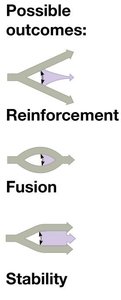
Hybrid zones are regions where different species meet and interbreed. Possible outcomes include reinforcement (strengthening barriers), fusion (weakening barriers), and stability (continued hybrid production).
Broad Patterns of Evolution
Gradualism vs. Punctuated Equilibrium
Evolutionary change can occur gradually or in rapid bursts:
Gradualism: Slow, continuous change over time.
Punctuated Equilibrium: Rapid changes followed by periods of stasis.
Large-Scale Evolutionary Patterns
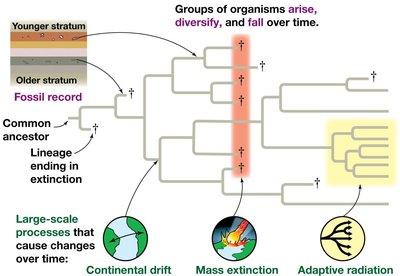
Life on Earth has changed over time due to processes such as continental drift, mass extinction, and adaptive radiation. These events are recorded in the fossil record and phylogenetic trees.

Additional info:
These notes cover chapters 19-25, including population genetics, mechanisms of evolution, phylogenetics, the origin of eukaryotes, multicellularity, speciation, and broad evolutionary patterns.
Key equations and diagrams are provided to reinforce understanding of concepts.
