 Indietro
Exam 2 Review: Nucleic Acids, Carbohydrates, Lipids, and Membranes
Guida di studio - Note intelligenti
 Appunti personalizzati basati sui tuoi materiali, ampliati con definizioni chiave, esempi e contesto.
Chapter 4: Nucleic Acids and the RNA World
Structure and Function of RNA
Nucleic acids are polymers made up of nucleotide monomers. RNA (ribonucleic acid) is a crucial molecule in the flow of genetic information and can also have catalytic functions. The structure of RNA allows it to form complex three-dimensional shapes, enabling it to act as both an information carrier and a catalyst (ribozyme).
Primary Structure: The sequence of nucleotides (A, U, G, C) joined by phosphodiester bonds.
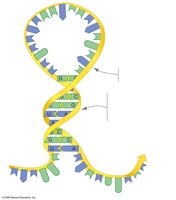
Secondary Structure: RNA can fold into hairpins and loops due to complementary base pairing (A-U, G-C), forming double-stranded regions.
Tertiary Structure: Further folding leads to complex three-dimensional shapes, essential for catalytic activity.
Function: RNA plays roles in protein synthesis (mRNA, tRNA, rRNA) and can catalyze reactions (e.g., self-splicing introns).
Example: tRNA molecules fold into a cloverleaf structure, allowing them to bring amino acids to the ribosome during translation.
Chapter 5: An Introduction to Carbohydrates
Monosaccharide Structure and Isomerism
Carbohydrates are organic molecules composed of carbon, hydrogen, and oxygen, typically with the formula (CH2O)n. Monosaccharides are the simplest carbohydrates and can exist as structural isomers, differing in the arrangement of atoms.
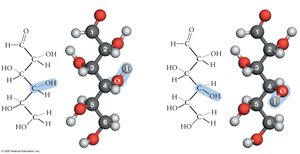
Monosaccharide Structure: Each monosaccharide contains a carbonyl group (C=O), multiple hydroxyl groups (–OH), and a carbon backbone.
Isomerism: Monosaccharides can be classified as either aldoses (aldehyde group) or ketoses (ketone group). They also exhibit stereoisomerism due to the presence of asymmetric carbons.
Example: Glucose and galactose are both hexoses (six-carbon sugars) but differ in the orientation of the hydroxyl group on carbon 4.
Chapter 6: Lipids, Membranes, and the First Cells
Phospholipids and Membrane Structure
Lipids are hydrophobic molecules that play key roles in energy storage, signaling, and membrane structure. Phospholipids are a major component of cell membranes, forming bilayers that separate the cell from its environment.
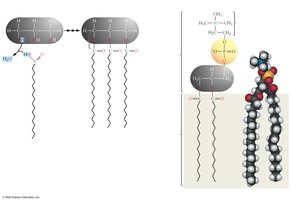
Phospholipid Structure: Composed of a glycerol backbone, two fatty acid tails (hydrophobic), and a phosphate group (hydrophilic head).
Amphipathic Nature: The dual hydrophobic/hydrophilic character drives the spontaneous formation of bilayers in aqueous environments.
Example: The cell membrane is a phospholipid bilayer with embedded proteins and cholesterol, providing fluidity and selective permeability.
Membrane Proteins and Transport
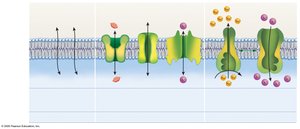
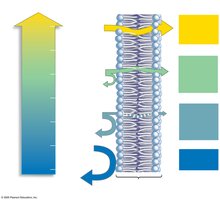
Cell membranes are selectively permeable due to the presence of proteins that facilitate the movement of substances across the bilayer. Transport can be passive or active, depending on the energy requirements and direction of movement.
Passive Transport: Includes simple diffusion and facilitated diffusion through channel or carrier proteins; does not require energy.
Active Transport: Requires energy (usually ATP) to move substances against their concentration gradient via pumps.
Example: The sodium-potassium pump actively transports Na+ and K+ ions across the membrane, maintaining cellular electrochemical gradients.
Membrane Fluidity and Permeability
The fluidity and permeability of membranes are influenced by the composition of fatty acids in phospholipids and the presence of cholesterol. Unsaturated fatty acids increase fluidity, while saturated fatty acids and cholesterol decrease it.
Factors Affecting Fluidity: Temperature, fatty acid saturation, and cholesterol content.
Permeability: Small, nonpolar molecules cross membranes easily; large or charged molecules require transport proteins.
Example: Bacterial membranes adjust fatty acid composition in response to temperature changes to maintain optimal fluidity.
Chapter 7: Inside the Cell
Introduction to Cellular Structure
Cells are the basic units of life, containing specialized structures (organelles) that perform distinct functions. Eukaryotic cells have membrane-bound organelles, while prokaryotic cells do not.
Key Organelles: Nucleus (genetic material), mitochondria (energy production), endoplasmic reticulum (protein/lipid synthesis), Golgi apparatus (modification and sorting), lysosomes (digestion).
Cytoskeleton: Provides structural support and facilitates movement within the cell.
Example: The rough endoplasmic reticulum is studded with ribosomes and is involved in protein synthesis for secretion or membrane insertion.
Additional info: This section is expanded with general academic context, as the original material only listed the chapter heading.
